August 25, 2025
By Laurie Thomas Vass
Sea Trail Fishing Club Member Helps New River Wildlife & Conservation Club, of Fries, Virginia, with Hurricane Helene River Cleanup
The New River Wildlife & Conservation Club, of Fries, Virginia, dedicated the month of August 2025 as Hurricane Helene River Cleanup month.
Forty citizen volunteers showed up on August 23, 2025, and worked in 6 teams to scour the river for debris.
Each team pulled a flat bottom boat upstream, with the workers wading in the knee deep waters.
They pulled out over 100 tires and several tons of debris.

Laurie Thomas Vass, a member of the Sea Trail Fishing Club went to Fries to volunteer to help clean the river.
“I fish in the New River and love that mountain community,” said Vass. “Their little towns, like Fries and Mouth of Wilson were devastated by the storm and I wanted to do something to help them.”
I won the prize for finding the proverbial kitchen sink,” she said.
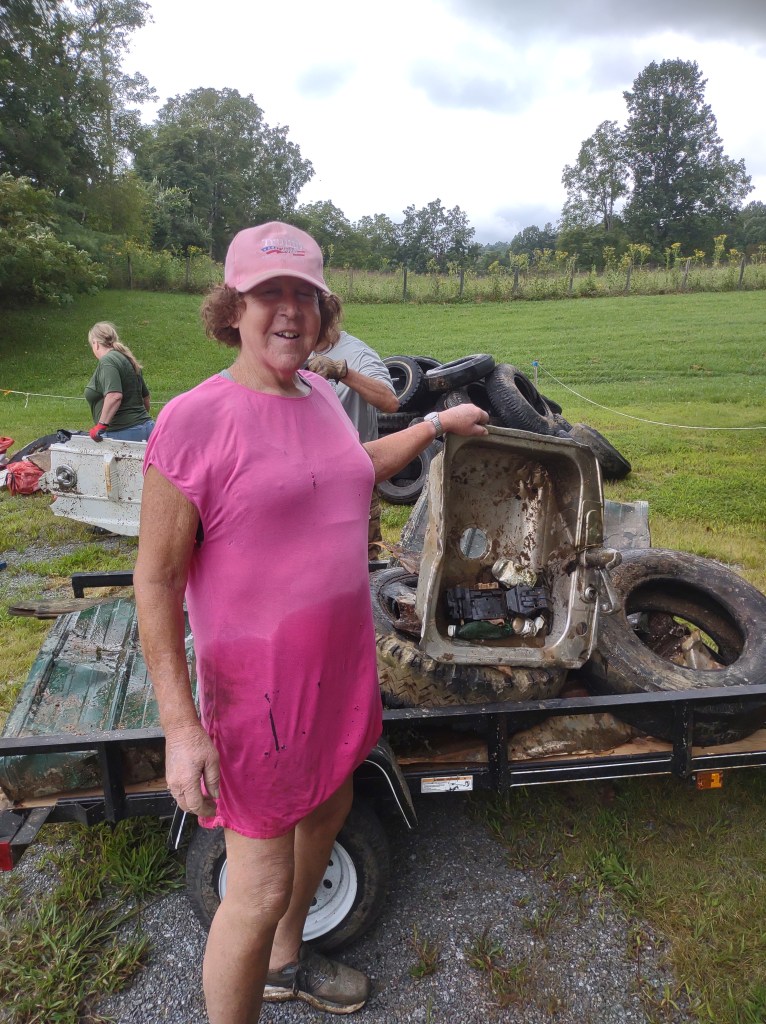
“We found tires, appliances and roof tops, said Vass, “including a fully functional porcelain toilet.”
“The force of the water flushed a lot of things down the river,” she noted dryly.
Keith Andrews, the President of the New River Wildlife & Conservation Club, expressed his appreciation to all the volunteers and noted that the club hopes to conduct a river cleanup, every August.
“I invite all the members of the Sea Trail Fishing Club to come up here next year, and camp in our 32 acre club park, next to the river, and help us recover from the hurricane,” he said.
About New River Wildlife & Conservation Club, Inc. The club is a 501c 3 that offers education programs including fly-fishing clinics, hunter education courses, field-to-table workshops, mountain crafts workshops, nature walks, kayaking lessons, river water chemical testing, and floats throughout the year. The club has been holding annual river cleanups since 2021. Located in Grayson County at 7107 Riverside Dr. Fries, Va. 24330.

 Litopenaeus setiferus, commonly called white shrimp or green tails, are primarily harvested in the estuarine and nearshore ocean waters. They are light gray with green-tinted tails, and their antennae are 2.5 to 3 times their body length. Evidence suggests that warming water temperatures are contributing to an increased abundance of white shrimp in North Carolina and states to the north. North Carolina has historically had the northernmost commercially viable population of white shrimp. However, in 2022, Virginia began permitting a limited offshore shrimp trawl fishery due to the consistent presence of white shrimp in its nearshore ocean waters. Similarly, North Carolina’s harvest of white shrimp has increased over time, with the species surpassing brown shrimp as the majority species of harvest for the first time in 2005 and regularly doing so ever since. In 2023, 3.8 million pounds of white shrimp were harvested from North Carolina waters, with annual landings surpassing 9 million pounds as recently as 2017. Brown Shrimp Fa
 rfantepenaeus aztecus, commonly called brown shrimp or summer shrimp, are primarily harvested in the estuarine waters of North Carolina. They typically remain low in the water column and depend on certain water temperatures to trigger biological changes. Specifically, decreasing water temperatures prompt overwintering behavior, during which they bury themselves in sediment for protection from the cold. Evidence suggests that warming water temperatures may disrupt this behavior, leading to higher natural mortality and greater variability in landings. Reported brown shrimp landings in North Carolina exceeded 2.7 million pounds in 2023, and were as high as 6.3 million pounds as recently as 2015. Pink Shrimp
  Farfantepenaeus duorarum, commonly called pink shrimp or spotted shrimp, are often found in sand or sand-shell bottom habitats. They are easily identified by their pink color and a dark-colored spot between their third and fourth abdominal segments. Similar to brown shrimp, smaller pink shrimp remain in estuarine waters during the winter and bury themselves in the sediment to protect against cold temperatures. In the past, pink shrimp made up a sizable percentage of the total shrimp harvest in North Carolina. However, landings have been low in recent years, with just over 29,000 pounds landed in 2023. Pink shrimp have accounted for less than 20% of the North Carolina harvest since 1993, and less than 10% in most years.
 There is another species of shrimp that is occasionally captured in North Carolina, the invasive tiger shrimp (Penaeus Monodon). Native to Southeast Asia, tiger shrimp were first caught off the Carolinas in 1988, following an accidental release from an aquaculture facility. They can grow up to 13 inches and have a rusty brown to black coloration with distinct banding along their backs. North Carolina’s first documented inshore capture of tiger shrimp occurred in 2006 when five specimens were collected from Pamlico Sound. Tiger shrimp are now considered an established species along the southeast and Gulf coasts.

 Sea Trail Fishing Club
You must be logged in to post a comment.