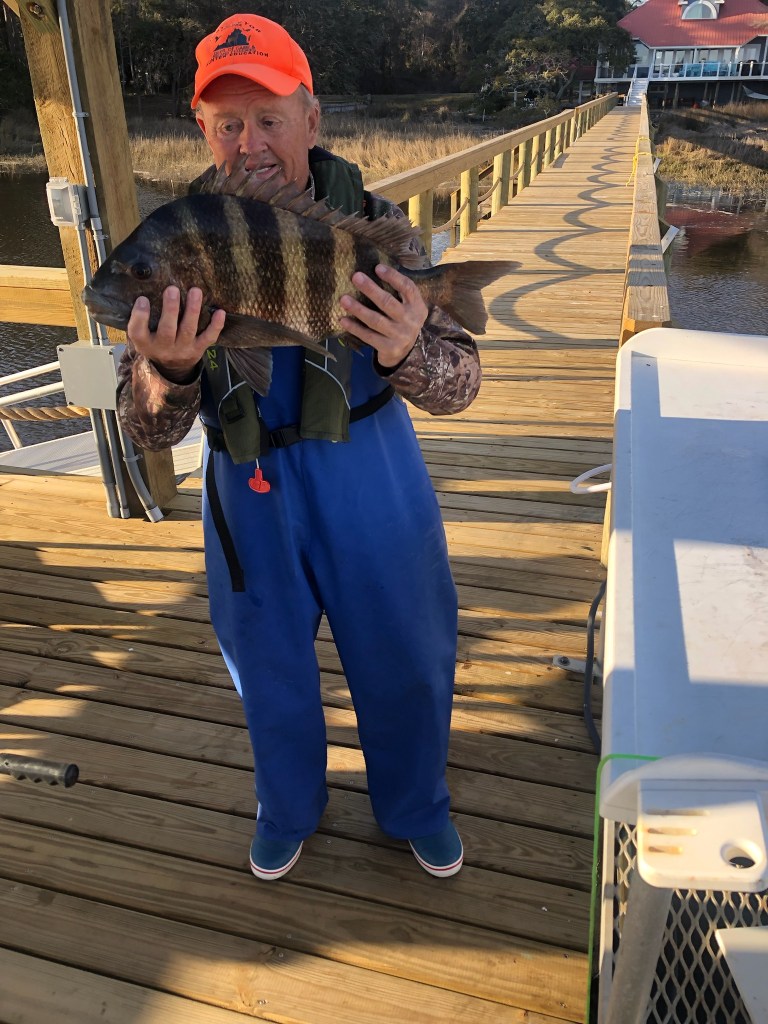
6.5-pound sheepshead. 22.25″
6.5-pound sheepshead. 22.25″
Sailing out of Sunset Beach chasing Black Drum on January 29th
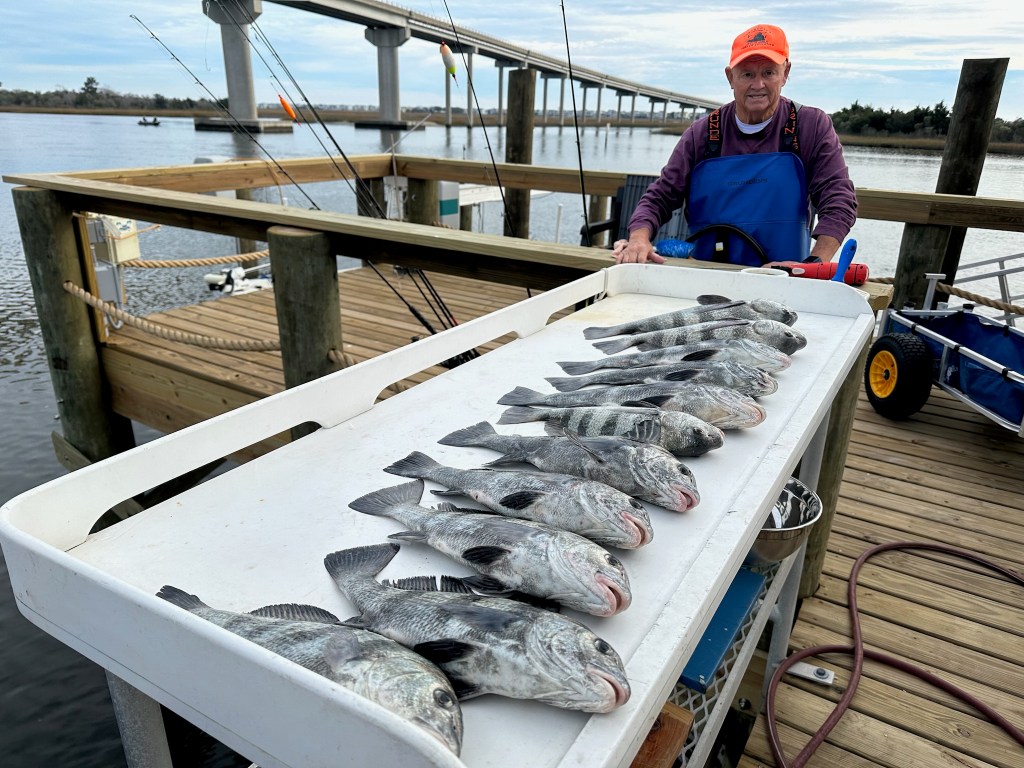
A little further north at Cape Lookout, courtesy of The Carolina Sportsman.
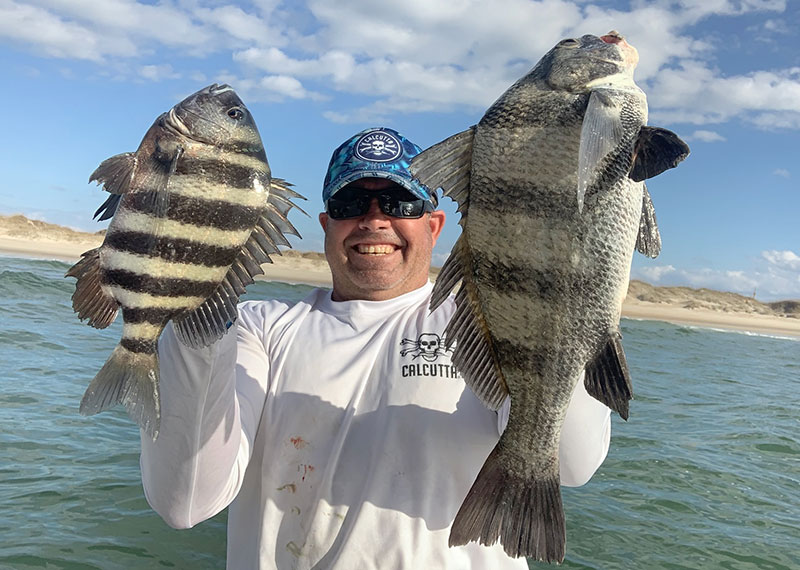
February’s hot fishing in the Cape Lookout area is made up in large part by black drum and sheepshead, and anglers can expect to catch both species in similar areas.
For Capt. Noah Lynk of Noah’s Ark Charters (252-342-6911), this month brings big changes.
“We have a big changeup in February. The gray trout will move out in big numbers, and lots of black drum and sheepshead will be available and biting,” said Lynk.
Both species are structure-oriented fish. Copy & Paste the URL below in your browser for more details.
Note from Mike: Alan was one of the “Founding Fathers” originally recruited by Steve Heins when Steve first envisioned a Sea Trail Fishing Club. Since then he has been notably the most active and diligent member of the club, serving as both Treasurer and Secretary. Here is Alan’s story……..
I was born in Burlington, NC and raised in Graham, NC. Both are small towns east of Greensboro. My earliest memories are fishing in a farm pond that one of my cousin’s grandparents owned in Burlington. I caught my first fish there (a bluegill) when I was very young. Beyond that, for many summers when I was young, I would go to Rock Hill, SC and spend several weeks with my grandmother’s sister (Aunt Sissy) and her husband (Uncle Johnny). Uncle Johnny would take me fishing for bream at farm ponds in the area. We would get up early, pile into his 50’s-something black coupe, go to the bait store and get crickets, and go fishing. I still have memories of him cleaning fish at the kitchen sink. Aunt Sissy would cook them and they were delicious. Uncle Johnny passed on his love of fishing to me. It so impacted me that when I went to college at NC State, I started out in the Fisheries Science Program. Life intervened after three years there and took me in a different direction, but I did graduate from Jacksonville University with a degree in Marine Science, and later served in the Navy. So, I guess it’s all somewhat related . . .
I grew up with limited opportunities to fish. When I did get to fish, it was mostly for panfish and largemouth bass. My grandmother’s second husband’s family owned a rental cottage on the beach at Ocean Isle. During occasional summer vacations, I would fish off the Ocean Isle Pier with cousins.

Since retiring to Sunset Beach, my fishing has all been either off the Sunset Beach Pier or in the Intracoastal. But to this day, I think it’s hard to beat the experience of a lunker largemouth on the line. On the other hand, float fishing with live shrimp ain’t half bad, either. My biggest fish was a 44″ red drum caught at the North outside jetty two years ago on a charter with Captain Tripp.
I fish as often as I can but since I work part-time at the Sunset Beach Pier during the season, my opportunities are restricted. Most often, I fish on the Pier on my days off and try to go out on a charter at least once a month. I would love to go out with Club members if they have room. By far the most productive fishing I have experienced here is drifting a live shrimp on a float rig in the Intracoastal, or on the Pier when the speckled trout show up in June.
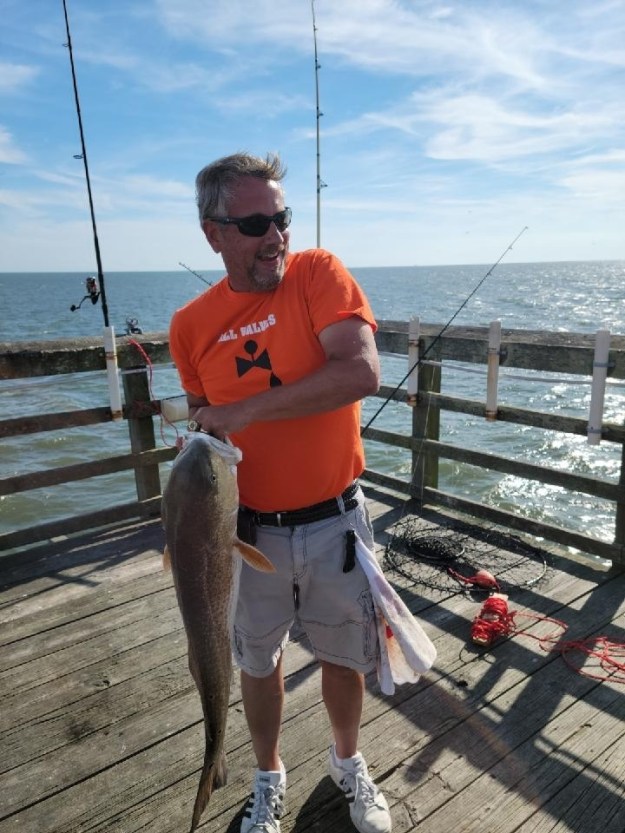
I love to eat the fish I catch. My favorite fish dish is largemouth bass; in my view this fish is the absolute best tasting fish ever. Just a little butter, lemon juice, salt, and pepper on both sides of the fillet. Wrap the fillet in aluminum foil and stick it on a grill. Red drum and black drum are good either blackened or in a stew. My favorite saltwater fish is triggerfish; it’s a close second to largemouth bass when the triggerfish is blackened and grilled.
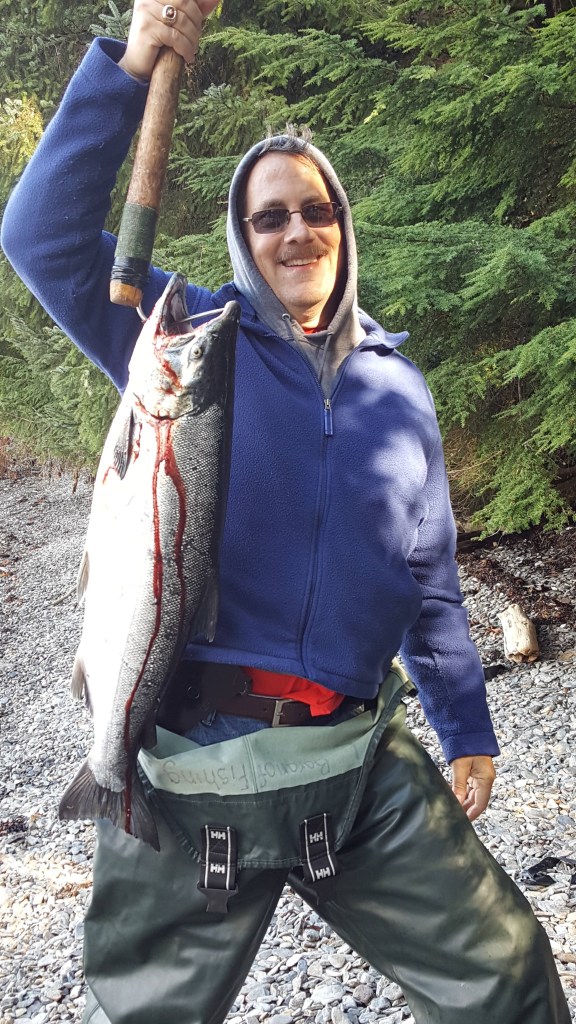
I would love to go to the Keys and catch a big grouper, a sailfish, or a big Mahi. Alternatively, I would go to Louisiana in a heartbeat and try out their redfish opportunities. Then after a good day of fishing, relax and take in the sights and sounds of whatever city I am in, while sampling some of the local seafood and one of my favorite fermented malt beverages. Given the opportunity, I would go back to Ketchikan, Alaska and do some halibut or salmon fishing. I’ve been to Alaska twice. It is breathtakingly beautiful there and the fishing is great!
Because of the Sea Trail Fishing Club, I have met some wonderful, caring folks. It has been my privilege to get to know them and do things with them. The real value of the Club is the bonds you form with other people that you otherwise wouldn’t have had an opportunity to know. I treasure the friendships, and look forward to forming more. If I could, I would like to inspire more members to take an active part in the Club. I believe you get the most out of the Club when you actively participate. If I could that thing would be to inspire more members to take more of an active part in the Club. You learn by doing. You contribute by doing. You form friendships by doing. You get the most out of the Club when you are active and when you actively participate.
Before coming to Sunset Beach, I was fortunate enough to work at Camp Sea Gull for five years. The camp is a large summer camp run by the YMCA out of Raleigh, NC. A full camp is around 1000 boys. The camp is located in Arapahoe, NC on the Pamlico Sound east of New Bern, and features a whole host of activities like motorboating, sailing, and skiing. There is also an 18-hole golf course, basketball courts, a softball diamond, a swimming lake, an archery range, and two large freshwater lakes. Both lakes are stuffed full of largemouth bass. For three years I was the Fishing Chief. My job was to teach boys ranging from ages 6 to 16 how to fish for largemouth bass. There were a few, I think, that really caught the fishing bug. I hope they carried that forward when camp ended. It was a great time that I very fondly remember.
At the Sea Trail Fishing Club Meeting on Thursday, Harold Golding gave a presentation on his methods for catching Flounder, Speckled Trout, Red Drum, Black Drum and Sheepshead. The meeting was attended by almost 50 members and guests. Harold came to the Sunset Beach area 12 years ago. He fishes almost every day and says that he enjoys catching fish and fishing with others in and around Southeastern Brunswick County and the Little River areas of South Carolina.
Harold reminded everyone the importance of having good equipment and the proper rigging for the target fish. This includes rods, reels, terminal tackle and bait. He also confided that it helps to know where to find the good holes.
Although the 2023 flounder season in North Carolina was restricted to only two weeks, Harold was able to catch flounder every single day from his 20-ft Carolina Skiff. Under Harold’s guidance, those fishing with him also landed their one fish per day bag limit while releasing several more. Harold reminded us that flounder like to lurk around oyster beds and structure where they can lie in wait and ambush prey. For flounder, Harold uses a 7-foot medium action rod and a 2500 reel with 20-pound braid.
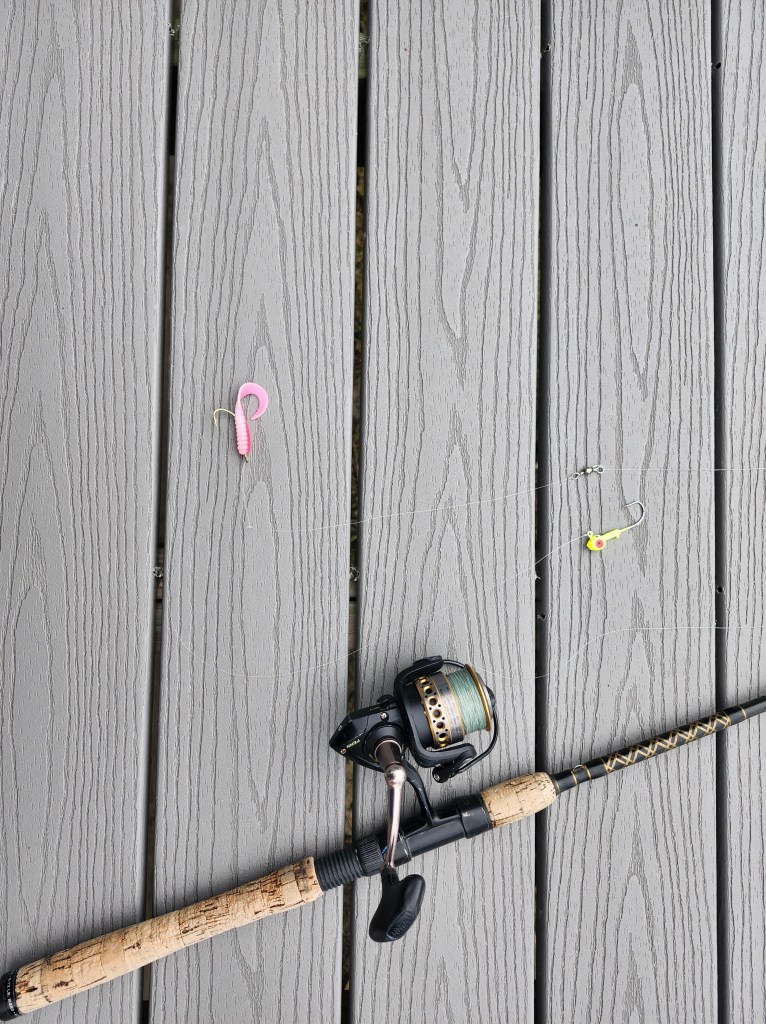
A dropper rig is attached to the braid using a 20-pound monofilament leader. The top hook is baited with a 3-inch pink curly-tail grub and the bottom with a 5-inch white curly-tail grub on a 1/4 to 3/8 ounce jig head. Although many anglers like to use live minnows on a Carolina rig, the scented Gulp grubs work better for him. Harold uses the grub in a jigging fashion close to the boat. When he feels a bite, he generally counts to at least 5 (or more depending on the depth of water) and before setting the hook.
When Harold is targeting Speckled Trout, he uses one or two different methods. In the mornings or evenings, almost any of a variety of top-water plugs can be very successful when fished through of around grass. Good bets for lures include suspending Yo-Zuri or MirrOlip lures that dive on retrieve. But the most productive method that Harold has found for catching speckled trout is to use live shrimp or minnows on a small treble hook under a float rig with a sliding bobber-stop to accommodate depth changes in the rising or falling tide.
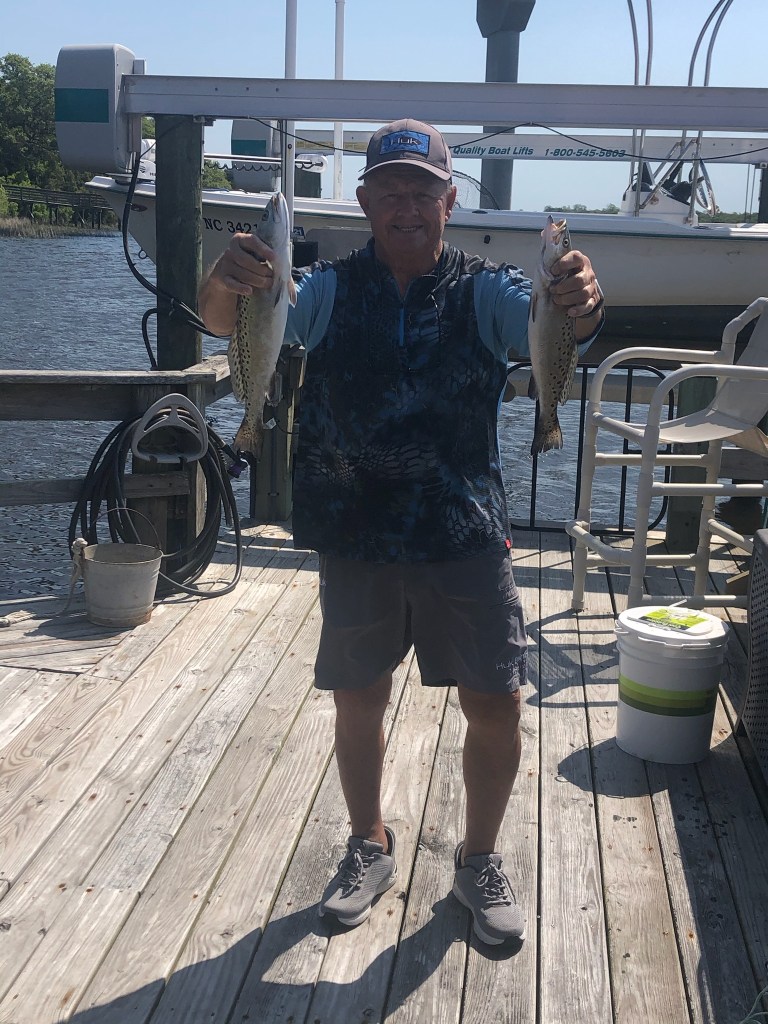
He actually has the most success on the incoming or rising tide. When live bait is not available, he finds that the VuDu shrimp or the various Z-man Trout Tricks work well too.
Black drum and sheepshead will take small fiddler crabs, large black crabs, or dead shrimp. Cut shrimp work well too. Hook the bait on double dropper rig with two small circle hooks and a terminal 2-oz sinker. Black drum and sheepshead like old docks and lots of structure; look for docks with barnacles. The best approach is to drop the bait and wait.

Red drum, also called red fish, spot tail and puppy drum, are found at the jetties or schooling in the shallows within the marshes. At the jetties Harold uses a stiff, heavy action rod with 80 lb. braid tied to a 50 lb. fluorocarbon leader. The go-to setup uses a 4 oz egg sinker on a Carolina rig with a large 3/0 to 4/0 circle hook. Large mullet minnows or live pogies are his favorite baits but if live bait is unavailable, cut mullet will do nicely.
Harold reminds everyone to always use a life vest when fishing from a boat!
A special thank you to Justin Griffith and Alan Trojan for taking excellent notes during the presentation!
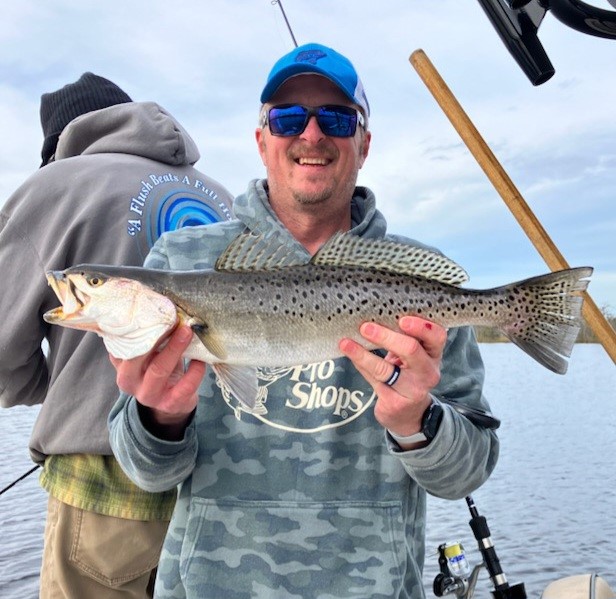
Here is a 4-pounder caught by our member Terry Dremmel’s friend Tom Mears. It last Thursday (January 18, 2024) in the Intracoastal Waterway in South Brunswick County in 4 ft of water using a coffee-colored paddle tail plastic with darker brown spots on it. Tom and friends have been doing very well with that lure that past several weeks.
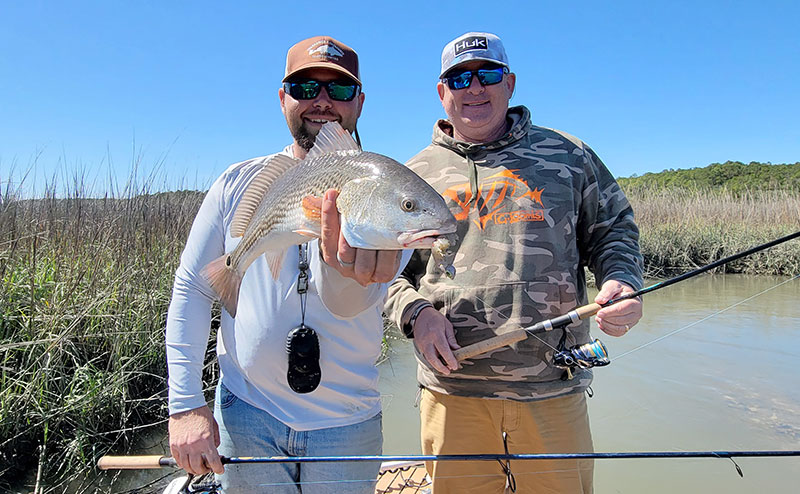
By January, redfish in South Carolina’s lowcountry are gathered up in huge schools, where they patrol the skinniest water they can find. They do this for two reasons: to stay away from flipper as much as possible, and to stay in the sunlight for the warmth it offers.
Many anglers troll up and down main waterways, keeping tabs on these schools and offering them lures as they go. But for Capt. Stephen Flook of Unashamed Adventures, this is the time to get off the main channels. Instead, he parks his boat at the mouth of secondary creeks, many of which are blocked from boats by the presence of oyster mounds.
“I’ll just get into the mouth as far as I can, anchor down, then cast back into those tiny, secondary creeks,” he said.
His favorite spots are the creeks that hold a foot or two of water during dead low tide.
“If it’s deep enough at dead low for redfish to stay, that’s what they’d prefer to do. That keeps them safe from dolphins because it’s not deep enough for the dolphins. Plus, the entrances to these tiny creeks are usually blocked, at least partially, by oyster mounds. So even the smallest of boats are locked out,” he said.
But they don’t stop Flook or his clients from firing a variety of Z-Man soft plastics into those creeks.
“When targeting the big schools on the main waterway, you have to be careful and precise where you cast. That’s not a concern in these tiny creeks because if you spook the fish, they don’t really have anywhere to go. They aren’t going to competely leave the creek because it’s their safest spot at low tide,” he said.
Some of these creeks are so small that you may have room for casts in only one or two tiny areas.
“If you put it in front of a redfish, it’s usually going to pick it up. Maybe not on the very first cast, but they’ll pick it up pretty quickly,” said Flook (864-430-8830) or https://fishingcharterschs.com/
And if they don’t, he’ll pull up anchor, find another tiny creek, and try again.
“Sometimes I’ll even get out and walk into these creeks on foot if it’s possible,” he said.
Flook said anglers should make a cast and work the lure back slowly, but not so slowly that your lure hangs up on the bottom. A twitch here and there is often enough to trigger a strike.
Courtsey of Carolina Sportsman … subscribe to their free newsletter at https://www.carolinasportsman.com/newsletter-2/
BTW … Freedom Boat Club has locations in the Charleston area.


You must be logged in to post a comment.