Author Archives: Mike Shannon

March is Closer than you Think

When Spring arrives in North Carolina the waters around Sunset Beach are the usually the first to warm up. This is the time that a strong bite will pick up for red and black drum as well as some hold-over speckled trout. According to the calendar the first day of Spring is March 20th but with the global climate sceneria – who knows? The winter may come early here. Regardless, we have been blessed with runs of several days of warm climate throughout January and early February. In my kayak, I haven’t seen water temperatures less than 53 degrees yet. We can expect that the water may well begin to warm by early March. That means that red and black drum in particular, and trout to some degree will begin to feed more aggressively.

Austin Kerr of Fellowship Charters in Ocean Isle Beach fishes from the Shallotte River to Little River lnlet. He believes that as the water warms and the fish are not yet “Summer-active” that the best times to fish are a few hours around the change of tide when the current isn’t running strong. Our guess speaker last month, Captain Jacob Frick of J&J Inshore Charters, voiced the same opinion. Kerr believes that water clarity is an advantage and likes to concentrate on oyster beds and docks in the creeks and waterway and sometimes the jetties in the Little River lnlet. Both red and black drum like pieces of shrimp on jigheads. Red drum are more aggressive and will chase down mud minnows, so mud minnows fished on Carolina rigs work well too. Scented artificial baits are often successful but sometimes the fish get very particular about the color. Kerr has everyone on the boat begin with a different color and keeps changing them until they find the right one (the ‘Couleur du Jour‘ if you will). Different days – different colors. Kerr recommends 3 and 4-inch paddletails fished slowly with light jigheads.

If you are interested in charter fishing, feel contact anyone of our contributors:

Captain Austin Kerr, Fellowship Charters, 336-941-7292

Captain Jacob Frick, J&J Inshore Charters, 803-315-3310

Captain Tim DeSano, Tideline Charters, 910-279-2020

Captain Tripp Hook, Capt’n Hook Outdoors, 910-540-7332

Captain Forest David, Follow Me Charters, 910-612-5343
New Logo Information


Several people have asked about getting the new logo. The Club will have hats and a few items available at the meetings but if you want to have shirts or jackets embroidered there are two options. First you may purchase items at the Carolina Shirt Company.

Listed below are the items that you can purchase from the Carolina Shirt Company All below pricing is for standard size (S-XL) after embroidery and this pricing may not be valid after 3/8/23. The items priced below are the items shown in my physical showroom.

Sport Tek Polo, 100% Polyester– $26.73

Port Authority Polo, 65%Poly 35%Cotton– $22.63

Port Authority Button Down– $29.60

Eddie Bauer Jacket– $74.88

Port & Company T-Shirt– $12.82

Gildan T-Shirt– $12

Sport Tek 100% Polyester T-Shirt– $13.98

Port Authority Raincoat– $55.48

Club members are also welcome to bring in their own items, but they will only be accepted if they are NEW WITH TAGS. The cost to embroider something brought in would be $9 per garment. If you have any questions, please contact Kyra Krawiec, Office Manager, Carolina Shirt Company, 910-575-4447

Ten Winter Fishing Tips

The following tips are abridged from an article written by Phillip Gentry in the January 2020 issue of Carolina Sportsman.

Fishing is a year-round sport, but weather, availability of bait, and fish migration and breeding patterns dictate a whole different approach with the changing seasons. Those who think only die-hard anglers fish during the winter are missing out. It’s not even necessary to face Mother Nature head on. With some forethought and planning, fishing can be enjoyable in summer and winter.  Whether you are new or experienced the following tips should be useful.

  1. Dress warmly. You’ve already heard and read of this ad nauseum, but it bears repeating. If you stay warm and dry, you’ll be happier and fish longer and catch more fish. Drysuits, dressing in layers, even full-body wetsuits or neoprene waders — whatever you’re comfortable in — put together the ensemble and wear it. Keep a spare set of clothes handy in case the dry part doesn’t work out by the end of the day.
  2. Scout in advance. Scouting for fishing? The best freshwater fishing is going to be in deep water; the best saltwater fishing is going to be in shallow water. Find these places on topo maps and charts before fishing. Locate suitable areas and check the wind and weather forecast. Choose your fishing spots accordingly. The sun and deep water adjacent to the shore are your friends.
  3. Use braided line. Fish bites in cold water are mushy at best. Using braided line lets you feel them better. If you are concerned about line shyness, use a length of fluorocarbon leader.
  4. Remember topwater baits. Sometimes the area of warmest water is that sunbaked layer on the surface. Even in cold water, baitfish are often pushed to the surface by feeding fish, and topwater baits are the best way to get bit. Rarely is blind-casting topwater baits effective like it is in the summer. If something is going on at the surface, you’ll see it first, then cast to it.
  5. Fifty is nifty. The magic temperature when fishing in the winter is 50 degrees. In mild winters, water temperatures may not get down to 50 or may not stay less than 50 for very long. In hard winters, 50 comes and goes like a crisp fall day, leaving icicles in it’s path. Both freshwater fish and saltwater fish will feed actively in water warmer than 50 degrees, although it may be for shorter periods of time because their metabolism is slower. Less than 50 degrees, and you need to plan on soliciting a reaction bite. That rarely means a fast and furious presentation, but more likely that annoying “in your face”, “easy to get”, “too good to pass up” appeal. That’s where jigging spoons and drop shots and the like shine. Set up over the fish and put that bait on its nose.
  6. Find heated water. As well as live bait works most of the time, both live bait and predator fish become more lethargic at water temperatures less than 50 degrees and probably die at less than 40. While much of this is simply fishing knowledge, the smart angler can take advantage of unique opportunities to find heated water because of access and portability. The extreme upper end of a creek, stream or channel may be much warmer than the impoundment end, and a cut-off slough may warm faster and stay heated longer than a normal tributary arm. The same can be said for shallow saltwater flats that lie upstream behind two or three sand bars that keep the dolphins and power boats at bay.
  7. Fish later in the day. Give your fishing area time to warm up. Some of the best winter fishing is mid-day and afternoon after surface water temperatures have risen a few degrees. Avoid the urge to run-and gun in cold water. Most fish will school or school tighter in the winter. The key to catching fish is first locating them, then taking time to work them slowly to entice strikes.
  8. Use a depth finder. Unless you’re sight-fishing a shallow flat, most winter fishing is going to be vertical, over deeper water. That requires the use of a depth finder, both to identify baitfish, predator fish and yes, even watch your bait as you vertical fish.
  9. Vertical is best. Most of these scenarios work best when vertical fishing for your chosen species. Get on top of the fish. Watch them on your sonar and learn to use a jigging spoon, drop-shot, shaky head, bucktail jig or other heavy, metal bait. These styles of fishing might be slow and boring, but they catch a lot of winter fish.
  10. Use Scent. Finally, don’t forget to use scents like Pro-Cure or Dr. Juice on artificial plastics. The baits don’t have to move much to get a bite as long as they smell like something to eat.

Welcome New Members!

The January Club Meeting was well attended with 28 members present and Captain Jacob Frick gave this perspective on fishing in our area as well as some tips on gear and rigging. The Club welcomed 8 new members: Roman Poremski, Kevin Cassidy, Jeff Titus, David Tucker, Dean Cain, Donald Coldwell, Jimmy Sciascia and Robert Sasso.

Dress Warm

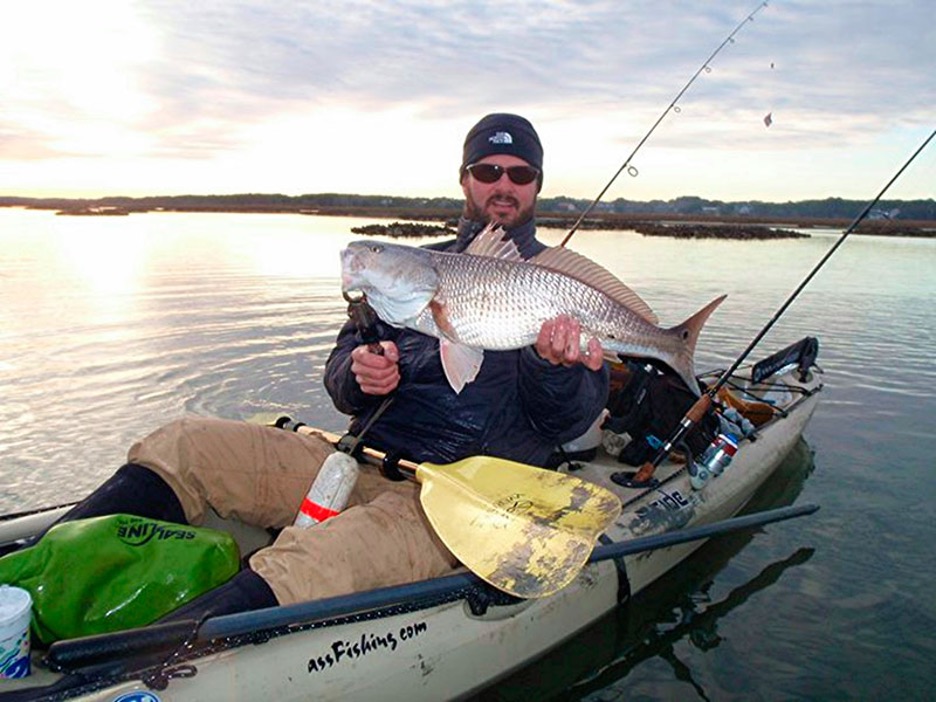
You might have noticed the recent pictures of January catches show that the anglers are bundled up! Temperatures on the water are a lot lower than on shore and the added humidity further lowers the “feels-like” temperature. The following article was slightly modified from an article written by Phillip Gentry for the December 2022 edition of Carolina Sportsman.

Preparation is the Key

Winter weather is a deterrent to many anglers regardless of the craft used simply because of the cold temperatures. That exposure is compounded when fishing from a paddle craft because of the close proximity to the water.

Dressing for a winter fishing event is not unlike any other outdoor sport, combining layers of clothing that can be added or subtracted as the day wears on. It’s always better to use several thinner layers than one or two thicker layers.

Dressing for success means wearing both cold weather and water repellant clothing while avoiding cotton garments. Dressing in layers that allow movement is tantamount. It’s almost impossible not to get wet when fishing from a kayak or small boat, so dress with the understanding that you’re going to get wet to some degree.

Fortunately, mid-winter fishing action doesn’t tend to heat up until the sun is well above the horizon. This allows the angler to get a late start and not miss any of the action. What tends to catch many anglers off guard is the shortness of the day, and the realization that a long trip back to the take-out point may occur at or after sunset if you’re not paying attention to time. Cold, wet, and tired after dark is not the most desirable experience for a winter-time angler.

Finally, plan on packing along emergency gear such as spare clothing, a towel, and emergency heating system in case you find yourself unexpectedly in the water during the trip. If in a kayak or small boat, pack these items in a dry-storage bag so they’ll survive should the the craft turn over.

Redfish are great wintertime targets for kayak anglers.

Redfish Winter

The following article was written by Phillip Gentry for Carolina Sportsman December 31, 2022.

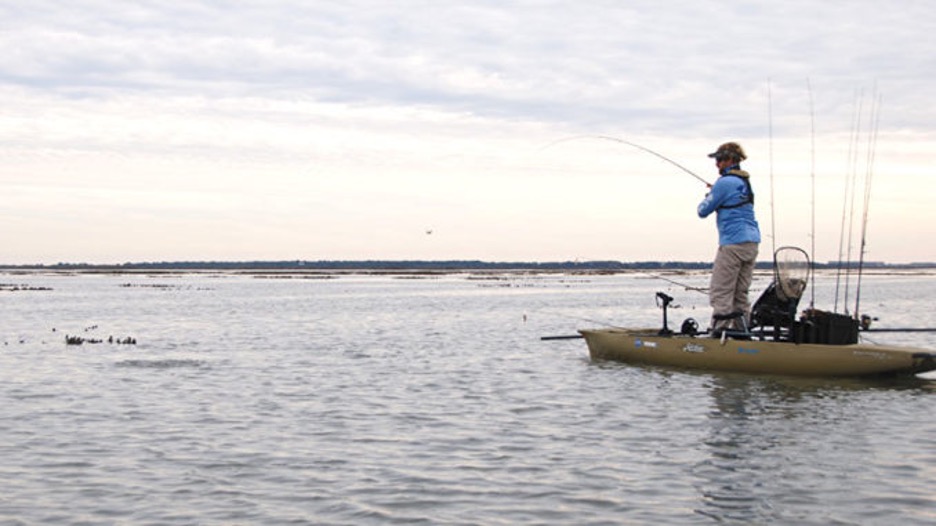
Go shallow for chilly water redfish

Nothing speaks of cold water inshore fishing more profoundly than sneaking up on a tightly packed pod of redfish and attempting to pick them off one by one.

Until they mature and head out into the ocean, most redfish rarely range more than ½ mile throughout their juvenile life. That means those same places where you find redfish in the spring, summer, and fall will be the same places you’ll find them in the winter.

During winter forays, redfish don’t range into deep water holes, but spend more time in shallower water, and for good reason. First, all the bait is gone and dolphins that normally feed on mullet or menhaden are now feeding on redfish. Second, a dark, shallow muddy bottom will be warmer than the surrounding area.

Anglers who can locate and access the most remote reaches of shallow water – too shallow for heavier boats to pass – have a distinct advantage.

Winter tides in the Carolinas tend not to be as wide-ranging as summer tides. So a good bet is to look for mid-tide flats to hold more fish, especially those areas having oyster mounds or sandbars between them and deeper water. With hard ground between you and deeper water, once you’ve located a school of fish, you should have them to yourself.

Fishing shallow water near oyster mounds is a good winter strategy for anglers. (Picture by Phillip Gentry)

Keep it slow

Lures that have a lot of action without having to move it that fast are a good bet. The use of scented baits or at least applying some add-on scent often plays a big part in how redfish find your bait.

Mudflats in the winter are generally devoid of active life. So anything that moves naturally along the bottom tends to get noticed when blind casting for individual redfish. Fast twitching a jerkbait or topwater lure works well in warmer weather but will tend to spook already nervous winter fish.

Unless spooked, redfish schools may not range very far in colder water. But they’ll show a distinctive movement that can be determined by observant anglers who watch and wait for the right time to present a bait. If the movement of the school, which can number from 20, 30 to even 100 fish is too close and moving closer, allow the pod to pass by and then cast ahead of the fish and let them work to it or slowly move it back into the fish, being careful not to let the bait or even your line fall across the fish.

Phillip Gentry of Waterloo, S.C., is an avid outdoorsman and said if it swims, flies, hops or crawls, he’s usually not too far behind.