The two largemouth bass that made the Leaderboard were caught on local golf course ponds. Maybe its time to try your luck?.
The following article is excerpted courtesy of the North Carolina Coastal Federation at CoastalReview.org
Golfing for bass — best use of a course is fishing, of course
05/11/2023 by Capt. Gordon Churchill
As Thoreau would have said, “That golf course is best which is golfed least.”
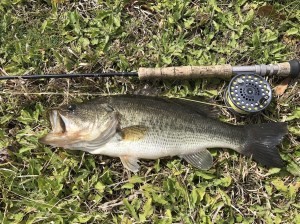
This beautiful largemouth was caught on a fly rod popper. – Photo: Capt. Gordon Churchill
We all like fishing. At least, if you’re reading this, that is my assumption. I’ll fish for anything that swims.
I’ve been happy catching pinfish and croakers and delighted to catch gorgeous, 6-inch-long brook trout. Most of the time these days, you will find me plying the coastal salt waters in pursuit of inshore fish of one kind or another. It takes a bit of planning and often a bit of effort to figure out where we want to go, assess the weather, get boats and gear prepared, and there is no guarantee that fish will actually be in the place we had planned on them being.
Too many variables exist in seasons, wind and waves to make any saltwater fishing excursion a sure thing. However, there is fishing that is available to most people less than 30 minutes away from most anywhere we might be on the coast: golf courses. It is my fervent belief that the best use of a golf course, and the most productive use of the acreage within, is fishing for the bass that live in the so-called “water hazards.” The ponds aren’t hazards, rather they are treasure chests filled with bassy jewels. They’re always there, don’t have anywhere else to be, are usually hungry, and can get really big. Catching them isn’t especially difficult, but there are things to be considered.
The first consideration is access. The best, of course, would be a golf community where you actually live. If you reside in one of these neighborhoods and have never checked the local bass population, you should probably remedy that sooner rather than later. Also, if you have only ever caught a few small panfish or little bass on worms fished under a bobber, you are missing the very best part.
But first, a little science. Due to the acidity of the soil in most of eastern North Carolina, any ponds or lakes we have in “wild” places will be full of mostly small bass that have difficulty spawning due to the unfavorable pH of the soil and, hence, the water. However, golf courses have fairways and greens that are heavily fertilized, which changes the acid/base ratio to something that’s not always best for the environment but is more beneficial to bass. A bit more alkaline than acidic is best. A pH number between 6.5 and 8.5 is optimum. Under that is going to start trending towards too acid.
Now for the access part. Look for a golf course near you. If you don’t already live on one, try to figure out if somebody you know lives on one.
Another good option is farm ponds and for the same reasons. If there is an out-of-business golf course around you, that might be worth checking into as well. Regardless, if you aren’t sure if you are allowed access, assume you don’t and progress from there.
Now, let’s go with the assumption that you have access to one of these fertile bodies of water. You may want to know what I’m talking about when I say there are better ways to do it. There are plenty of options to fish these ponds but I’m going to pinpoint what I consider to be the best.
If you were to ask me what lure I would use if I had one cast to make into a bass pond, I’d tell you it’s a Senko plastic worm. Furthermore, I’d also say that I would rig it “Wacky Style.” You might be nodding your head now, or you might be wondering what the heck I’m talking about. A Senko is a plastic worm made by the Gary Yamamoto Custom Baits Inc. It looks simple enough. Practically plain and without adornment. But it has a certain density that makes it sink at a certain rate — just slow enough that the fish can see it and get to it from a ways away. This is accompanied by a captivating wiggle that it has as it falls with a side-to-side motion that is not easily produced by imitators.
You can hook them with a standard weedless plastic worm hook in the Texas fashion, and that is good for heavy weed cover. But most of the time I use the Wacky Rig. You can use almost any kind of hook, but I prefer the ones made specifically for this kind of fishing and that you can find at any tackle shop that sells to bass fisherman or in online outlets.
Another bass that ate a Senko fished by Rick Harper of Rock Hill, South Carolina, during a visit to the North Carolina coast.
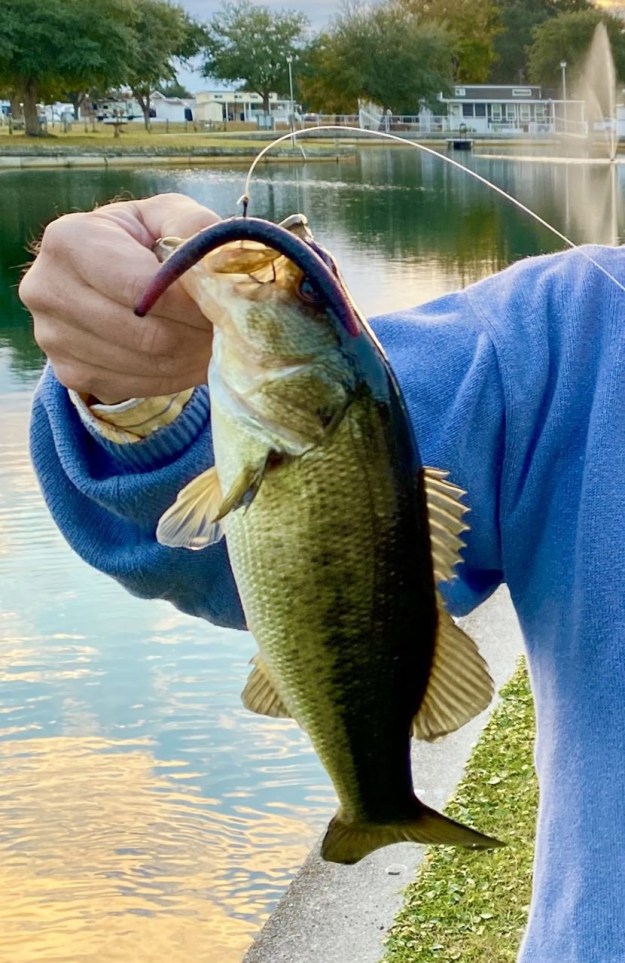
Photo: Gordon Churchill
Simply put the hook in the middle of the worm near the collar. That’s it. It seems too simple, but when you drop it in the water, you’ll see that wiggle. It’s pretty cool. Cast it over toward a log or some floating vegetation. Let it drop. Shake the rod tip a little. Lift and twitch. Let it drop. Lift. Drop. Twitch. Drop. The drop is the key.
You may feel a tick, the line may come tight, it may move to the side, or maybe there will just be a slight weight on the line. Set the hook sharply. You don’t need to haul back freight-train style like the knucklehead TV bass guys. Just snap it back quickly. Be ready for anything. You could be catching a bunch of “nice” fish in the 2- to 3-pound range, and then … a 9-pounder shows up to the party. When she comes clean out of the water and hangs in the air, it’s a vision you won’t soon forget. When she hits the water again, it will sound like a canoe paddle being slapped down.
Plenty of other methods will work. My absolute favorite is a 6-weight fly rod and a small popper that I make out of craft foam. I carve them using scissors until I get the shape. My friends call them “Marshmallow Poppers.” Walk along the shoreline and cast in a 90-degree arc covering the water in front of you and along the shoreline. A simple waltz time makes a good popping time: Pop, 2,3. Pop, 2,3. They’ll hit it usually on 3.
Capt. Gordon catches a nice bass from a small roadside pond.
When I start seeing the first frogs of the season, I like to be on the banks of a pond in the evening.
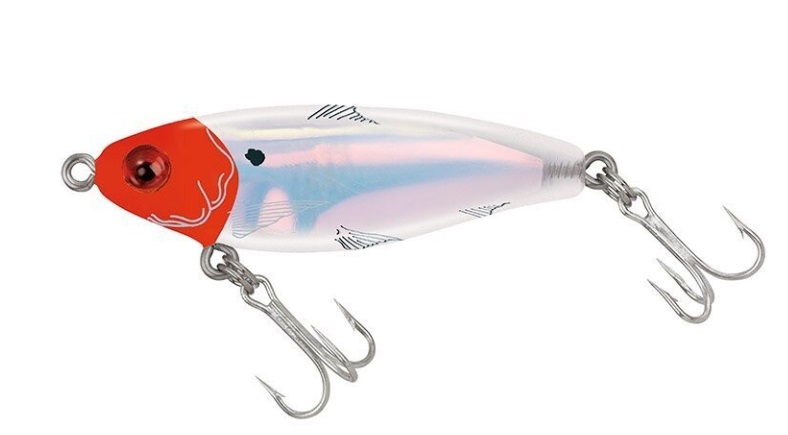
Finally, try to avoid using plugs with treble hooks. Chances are, you’ll see these fish again if you take care of them. Treble hooks take a bit of doing to get out for a quick release. Oh, and yes, this is going to be 100% catch-and-release fishing. Don’t take Big Momma Bass out of that pond. She’s got too much value to add by making more bass for future excursions. Say “hello.” Admire her. Let her go. It’ll be cool to know she’s still in there when you drive past later.




You must be logged in to post a comment.