Southern Flounder Keeper Season for Public AnglersThe N.C. Division of Marine Fisheries announced on Wednesday the recreational flounder keeper season for this year will open at 12:01 a.m. Sept. 15 and close at 11:59 p.m. Sept. 29.
The two-week season will still limit public anglers to a one-fish per person, per day bag limit and a 15-inch minimum size limit for both hook-and-line and gig fisheries.Harvest of flounder with a Recreational Commercial Gear License will be prohibited.
The season and possession limits are set annually to keep the fishery within the recreational quota approved by the Marine Fisheries Commission in the N.C. Southern Flounder Fishery Management Plan Amendment 3. The plan also specifies any overage to the recreational Total Allowable Catch (TAC) requires a pound for pound payback subtracted from the following year’s allowable harvest. In 2022, the recreational TAC of 170,655 pounds was exceeded by 56,340 pounds. For 2023, this means the TAC for the recreational season will be 114,315 pounds. Discard mortality is accounted for in the estimates of TAC. During 2022, dead discards both during and outside of the southern flounder recreational season contributed significantly to the total removals from this fishery and the overage in the TAC. For this reason, the Division discourages anglers from targeting flounder for catch-and-release after they have caught their one-fish limit or when the season is closed. During the open season, the Division also discourages anglers from high-grading (retaining a fish until a larger one is caught) as this increases post-release mortality leading to additional dead discards.The commercial southern flounder seasons will be announced in a separate news release. Will the commercial proclamation also fully address discard mortality in the commercial fishing sector? How many juvenile flounder are killed in shrimp trawl nets each year? Will this be counted against the commercial TAC? Same for flounder discard mortality in crab pots?
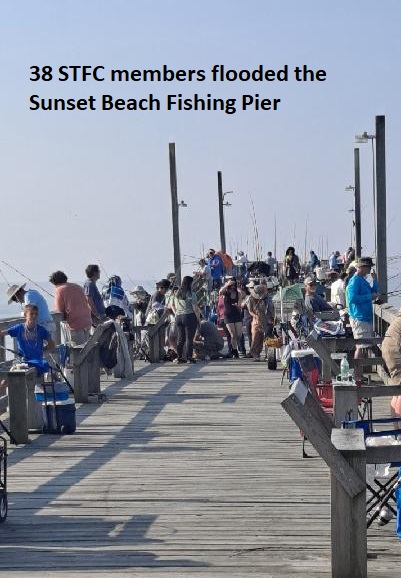
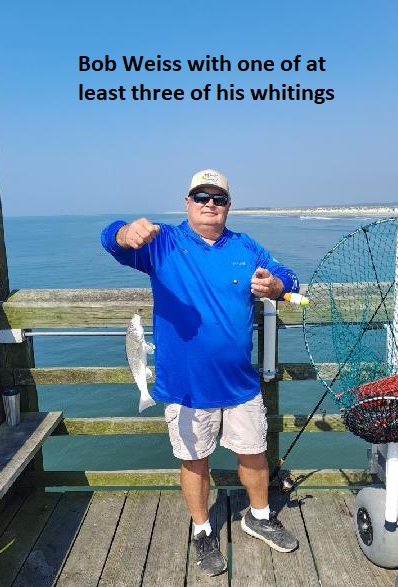
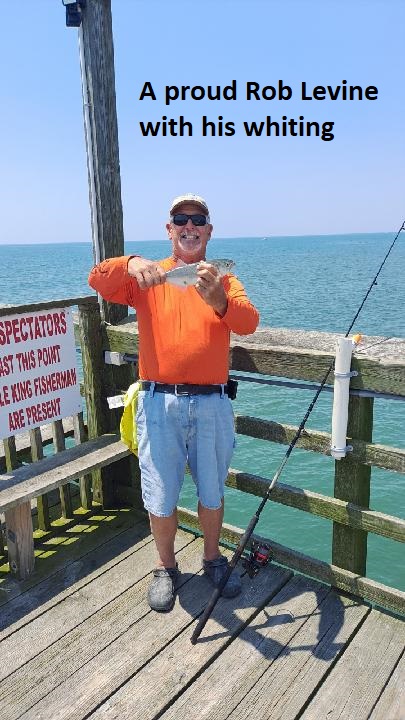
In case you missed it, last Saturday was the Annual Club Pier Fishing Event organized by Alan Trojan and the STFC Board of Directors. I arrived early for my very first try at pier fishing and landed a pompano in about two minutes. Bob Weiss, fishing near me caught a whiting soon after – he landed at least three before 9 AM..
Steve Pendergrass was greeting members at the Club Sign-up table near the dock entrance and Michael Griffin, John Crespin and Brian Brumbaugh handed out live shrimp and/or provided photo ops. President, Steve Heins, Harold Golding and big Bill ‘Buck’ Trull worked the crowd and helped out where-ever needed as 38 of our STFC members took advantage of the great weather.
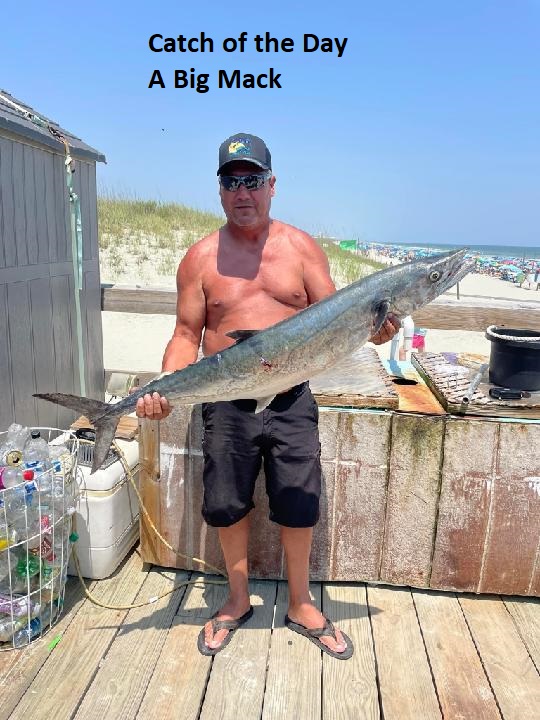
I didn’t realize it but North Carolina’s ocean piers are renowned for their excellent fishing. Key species caught in spring, summer and fall include spot, whiting, croaker, pompano, flounder, bluefish, black and red drum, speckled and grey trout, cobia, tarpon, sheepshead, Spanish and King mackerel and various species of shark. On Thursday, before the pier event, Michael Griffin caught a 19.5 inch king and on Saturday, at about 2:15 PM another angler caught a king that was just shy of 30 lbs.
So if you haven’t tried pier fishing and happened to have missed Saturday’s event, you just might want to consider trying a bit of pier fishing. Piers provide excellent ocean fishing access for anglers that have physical limitations, who don’t own a boat, or who are very young or old. Or even for folks like me who get a tad sea-sick when the waves get rough. Local piers include Holden Beach, Ocean Isle Beach and our own Sunset Beach. A special “Thank You” goes out to the Sunset Beach Pier owners, and STFC members, Gary and Teresa Massey, and to their staff for hosting this event!
The ‘general’ consensus is that live shrimp is the best and most universal inshore bait because shrimp are abundant in the inshore habitat and are universal prey for trout, redfish and flounder. It is also generally agreed that live shrimp are a more effective bait than artificial. Why?
As a kayak angler, my livewell options are limited. So if shrimp are the best bait, which artificial shrimp is best? Recently I have explored this question and herein are my conclusions. I started with the premise that, ‘If it looks like a duck, walks like a duck, and quacks like a duck, then it must be a duck. Or in this case: ‘If it looks like a shrimp, swims like a shrimp, sounds and smells like a shrimp, then most predators will decide that it must be a shrimp’.
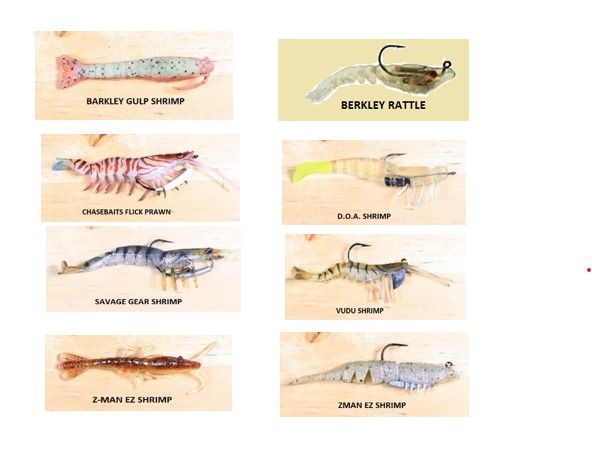
Does it Look like a shrimp? According to Wikipedia, shrimp are widespread and there are thousands of species that vary in size, shape and color. Popular shrimp baits are rather distinctive in shape but several vary in size and some have a wide range of colors. I think that the pre-rigged versions have the most realistic shape – but I am not a fish, so what do I know. The picture below includes a few of the most popular shrimp baits that you will find in local stores, so you can decide which ‘Looks’ the most realistic based on the local shrimp in this area!
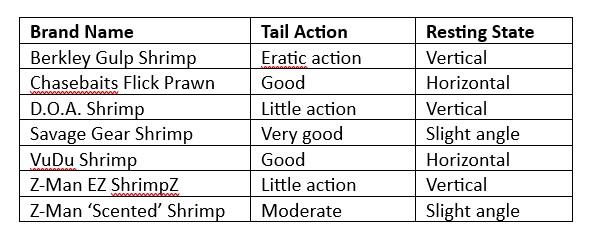
Does it Swim like a shrimp? In a SaltStrong article, (Best Shrimp Lures To Fish Under A Popping Cork [Brand Comparison] (saltstrong.com) ), Tony Acevedo looked at the action of shrimp baits under a popping cork by filming them in a swimming pool. He rated them based on their ‘action’ on the pop and how they settled in the water. A synopsis of his results in the chart below.
Does it Smell and Sound like a shrimp? As for smell, Berkley Gulp Shrimp and Z-Man Scented ShrimpZ are rated as having the best scent but anglers can add scents such as Pro-Cure and Dr. Juice when they think appropriate. I have found that Fishbites E-Z Shrimp strips are very effective with some lures, however, these may interfere with the action of the pre-rigged lures. Berkley and Vu-Du make shrimp baits with built-in rattles that may that attract fish. In addition, D.O.A. sells rattles that can be inserted into shrimp baits but I would suppose at the risk of affecting action. Also. there are rattles that can be attached ‘in-line’ to the leaders.
All -in-all, there are countless variations among the many shrimp lures. I am not endorsing any of these to work in any particular situation. As Abraham Lincoln once said, “With one lure, you cannot please all of the fish, all of the time”. You be the judge.
First of all, let me thank those that went to the Club meeting last Thursday. It was very well attended. I hope those that went enjoyed the excellent presentation by Captain Tim Disano from Tideline Charters. Those that didn’t go missed something. Missing a meeting is missing an opportunity for learning from those that have knowledge that perhaps you don’t. It is an excellent way to become more skilled and to potentially catch more fish. Please take the time to attend a meeting. I promise you it’s worth it.
Secondly, let me thank those that came early and helped set up, and stayed after the meeting and helped break down. Hopefully we will be back in the Pink Palace next month and all the extra effort won’t be required. But, we’ll keep you informed as we are appraised of the situation.
The Club is now up to 107 members on the roster. Seven new members joined this month. A special welcome to all the new members. Poke around on this website and get familiar with what we offer and get yourself enrolled in the Fishing Tournament. Also consider going on to Facebook and sign up for the Sea Trail Fishing Club group. Just go to Facebook, search for the Sea Trail Fishing group, and follow the prompts. Email and Facebook is a primary means by which the Board of Directors communicates with the Club. Getting signed up means that you may, for example, see posts from time to time of people that are looking to go out on charters and need people to join them.
The guest speaker for next month will be Amber White. She is the owner of the Mad Kingz Tackle Shop. A new location just opened in Ocean Isle Beach.
The guest speaker for July is already locked in. I won’t tell you who it is at this point. But I will tell you that it is something different, and that it will be good. You won’t want to miss it.
As of today, the Island Seafood Company is offering a 5% discount on purchases to members in good standing of the Sea Trail Fishing Club. If you are a member in good standing, you will have a membership card that expires on 12/31/23. If you are not a member in good standing, either see me directly or send me a check to cover your dues. Thank you to the owner, Richard Craft, for his generous support. If you are unfamiliar with the business, make it a point to stop by. The owner works hard to ensure a very good selection of fresh and local fish, plus a good selection of shrimp and a whole lot more.
And finally, Gary Massey, the owner of the Sunset Beach Pier with his wife Teresa (both of whom are Club members, by the way) posted on Facebook today that several people caught their limit of speckled trout on the Pier today. That is really good news for the upcoming Pier event on June 10. Get your float rigs ready! If you are a member in good standing, you could be in for a real treat on that day!
As Thoreau would have said, “That golf course is best which is golfed least.”
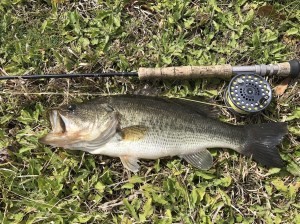
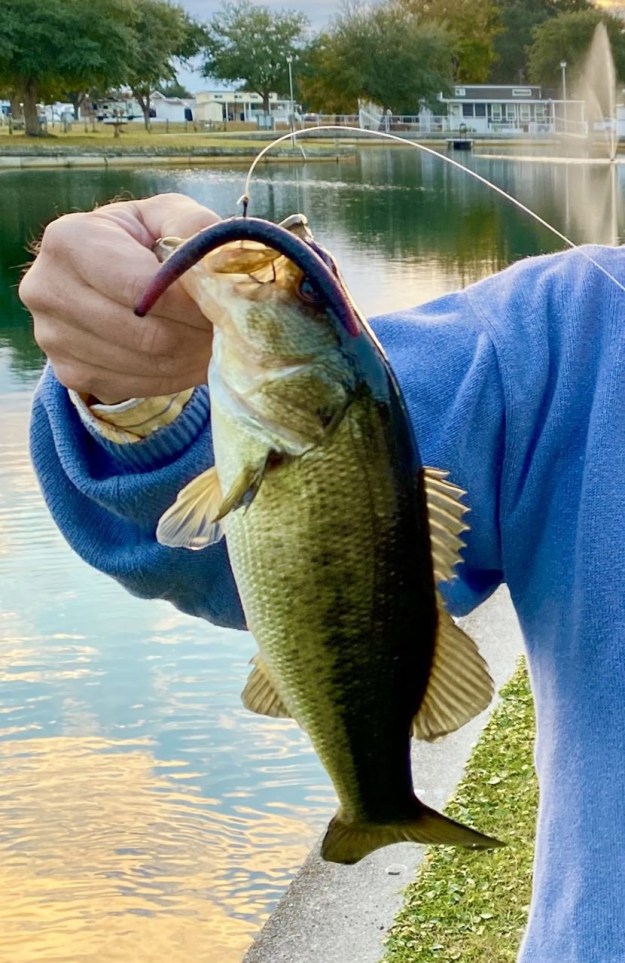
This beautiful largemouth was caught on a fly rod popper. – Photo: Capt. Gordon Churchill
We all like fishing. At least, if you’re reading this, that is my assumption. I’ll fish for anything that swims.
I’ve been happy catching pinfish and croakers and delighted to catch gorgeous, 6-inch-long brook trout. Most of the time these days, you will find me plying the coastal salt waters in pursuit of inshore fish of one kind or another. It takes a bit of planning and often a bit of effort to figure out where we want to go, assess the weather, get boats and gear prepared, and there is no guarantee that fish will actually be in the place we had planned on them being.
Too many variables exist in seasons, wind and waves to make any saltwater fishing excursion a sure thing. However, there is fishing that is available to most people less than 30 minutes away from most anywhere we might be on the coast: golf courses. It is my fervent belief that the best use of a golf course, and the most productive use of the acreage within, is fishing for the bass that live in the so-called “water hazards.” The ponds aren’t hazards, rather they are treasure chests filled with bassy jewels. They’re always there, don’t have anywhere else to be, are usually hungry, and can get really big. Catching them isn’t especially difficult, but there are things to be considered.
The first consideration is access. The best, of course, would be a golf community where you actually live. If you reside in one of these neighborhoods and have never checked the local bass population, you should probably remedy that sooner rather than later. Also, if you have only ever caught a few small panfish or little bass on worms fished under a bobber, you are missing the very best part.
But first, a little science. Due to the acidity of the soil in most of eastern North Carolina, any ponds or lakes we have in “wild” places will be full of mostly small bass that have difficulty spawning due to the unfavorable pH of the soil and, hence, the water. However, golf courses have fairways and greens that are heavily fertilized, which changes the acid/base ratio to something that’s not always best for the environment but is more beneficial to bass. A bit more alkaline than acidic is best. A pH number between 6.5 and 8.5 is optimum. Under that is going to start trending towards too acid.
Now for the access part. Look for a golf course near you. If you don’t already live on one, try to figure out if somebody you know lives on one.
Another good option is farm ponds and for the same reasons. If there is an out-of-business golf course around you, that might be worth checking into as well. Regardless, if you aren’t sure if you are allowed access, assume you don’t and progress from there.
Now, let’s go with the assumption that you have access to one of these fertile bodies of water. You may want to know what I’m talking about when I say there are better ways to do it. There are plenty of options to fish these ponds but I’m going to pinpoint what I consider to be the best.
If you were to ask me what lure I would use if I had one cast to make into a bass pond, I’d tell you it’s a Senko plastic worm. Furthermore, I’d also say that I would rig it “Wacky Style.” You might be nodding your head now, or you might be wondering what the heck I’m talking about. A Senko is a plastic worm made by the Gary Yamamoto Custom Baits Inc. It looks simple enough. Practically plain and without adornment. But it has a certain density that makes it sink at a certain rate — just slow enough that the fish can see it and get to it from a ways away. This is accompanied by a captivating wiggle that it has as it falls with a side-to-side motion that is not easily produced by imitators.
You can hook them with a standard weedless plastic worm hook in the Texas fashion, and that is good for heavy weed cover. But most of the time I use the Wacky Rig. You can use almost any kind of hook, but I prefer the ones made specifically for this kind of fishing and that you can find at any tackle shop that sells to bass fisherman or in online outlets.
Another bass that ate a Senko fished by Rick Harper of Rock Hill, South Carolina, during a visit to the North Carolina coast.
Photo: Gordon Churchill
Simply put the hook in the middle of the worm near the collar. That’s it. It seems too simple, but when you drop it in the water, you’ll see that wiggle. It’s pretty cool. Cast it over toward a log or some floating vegetation. Let it drop. Shake the rod tip a little. Lift and twitch. Let it drop. Lift. Drop. Twitch. Drop. The drop is the key.
You may feel a tick, the line may come tight, it may move to the side, or maybe there will just be a slight weight on the line. Set the hook sharply. You don’t need to haul back freight-train style like the knucklehead TV bass guys. Just snap it back quickly. Be ready for anything. You could be catching a bunch of “nice” fish in the 2- to 3-pound range, and then … a 9-pounder shows up to the party. When she comes clean out of the water and hangs in the air, it’s a vision you won’t soon forget. When she hits the water again, it will sound like a canoe paddle being slapped down.
Plenty of other methods will work. My absolute favorite is a 6-weight fly rod and a small popper that I make out of craft foam. I carve them using scissors until I get the shape. My friends call them “Marshmallow Poppers.” Walk along the shoreline and cast in a 90-degree arc covering the water in front of you and along the shoreline. A simple waltz time makes a good popping time: Pop, 2,3. Pop, 2,3. They’ll hit it usually on 3.
Capt. Gordon catches a nice bass from a small roadside pond.
When I start seeing the first frogs of the season, I like to be on the banks of a pond in the evening.
Finally, try to avoid using plugs with treble hooks. Chances are, you’ll see these fish again if you take care of them. Treble hooks take a bit of doing to get out for a quick release. Oh, and yes, this is going to be 100% catch-and-release fishing. Don’t take Big Momma Bass out of that pond. She’s got too much value to add by making more bass for future excursions. Say “hello.” Admire her. Let her go. It’ll be cool to know she’s still in there when you drive past later.

 Southern Flounder Keeper Season for Public AnglersThe N.C. Division of Marine Fisheries announced on Wednesday the recreational flounder keeper season for this year will open at 12:01 a.m. Sept. 15 and close at 11:59 p.m. Sept. 29.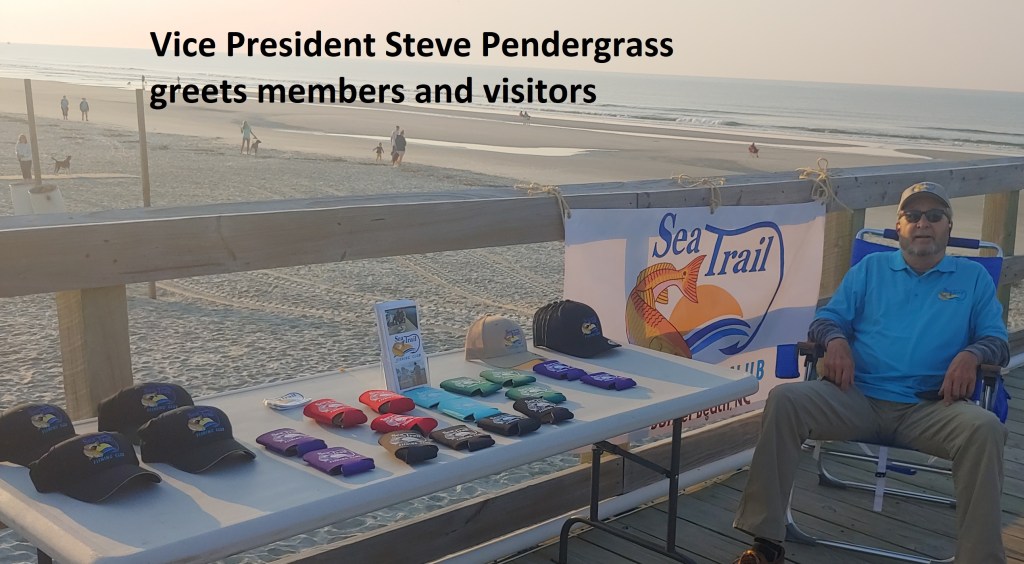






You must be logged in to post a comment.