In this week’s issue of The Brunswick Beacon you can find a feature article of the Club’s Miss Calabash charter.

In this week’s issue of The Brunswick Beacon you can find a feature article of the Club’s Miss Calabash charter.
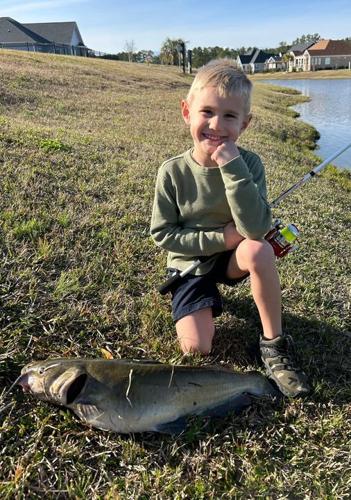
Five-year-old Jameson with his first catfish catch. Photo & Article contributed by Mike Shannon of Sea Trail Fishing Club.
One of the most lasting childhood memories is the experience of the first fish caught. Usually, a father, granddad, uncle or childhood friend is behind that memory. For William’s son, 5-year-old Jameson, the story goes beyond that.
On opening day of this year’s Sunset Beach Pier season, William decided to take his son along to renew his annual pier fishing and parking pass. The pier is managed and operated by Gary and Teresa Massey. Since taking over the pier management, the Masseys have made several improvements, including 24/7 live cameras showing great views of fishing action on the pier, as well as activity and wave conditions on the beach.
The Masseys sponsor live music entertainment between May and September and support the local Sea Trail Fishing Club (STFC) by hosting pier fishing tournaments. As part of that cooperation, the fishing club was given space to set up an information booth on the ramp leading to the pier’s grill and tackle shop.
Jim was just one of the several STFC members that helped to staff the info booth during the two-day opening weekend; but what Jim noticed was that most of the many customers coming to renew fishing permits were, shall we say, “seniors.”
Jim decided that an outreach plan was needed for younger anglers. He purchased a rod and reel combo in the tackle shop and left it at the STFC booth to be presented to the first youngster to show up. Teresa Massey added to the gift by spooling a new line on the reel.
Sometime later, Bill and Jameson arrived on the scene to find out that they were the recipients of the new rod and reel combo.
In the aftermath, a fishing trip was planned, and Bill took Jameson to a big pond in Brunswick Plantation. Bill says the outing provided a lot of excitement for both of them. Jameson hooked a catfish and started to reel it in by himself. but the big cat’ was too strong and started to pull him toward the water. So, his dad held the rod and let Jameson reel it in. No measurements were taken, but by the looks of the picture, it would be hard to guess who weighed the most.
Courtesy of your Brunswick Beacon https://www.newsargus.com/brunswick_beacon/sports/a-first-timer-s-fish-tale/article_1c209dbf-b8c1-51b7-b5dd-5bea7a909d75.html
Hey kayakers and wannabes, here is an opportunity to try out a kayak. Sit inside, sit on top models, fishing yaks and recreational models, as well as paddleboards…over 30 models. Try them for free at this Demo Day event! Representatives from several companies will be there. Organized by Hook, Line and Paddle. Tell Chris I sent you.

Sea Trail Fishing Club
Fish of the Month, March 2024
Spanish Mackerel (Scomberomorus maculatus)
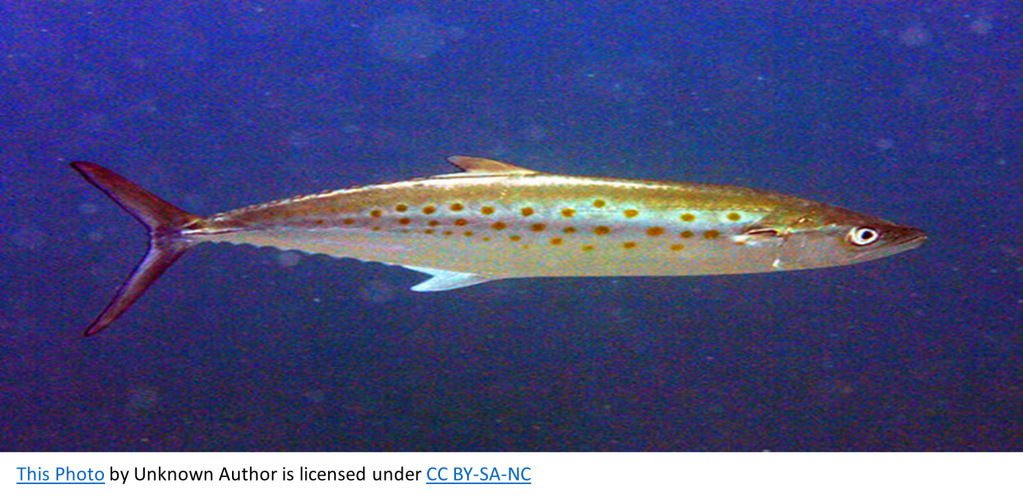
When – Saturday, March 23, 2024.
Morning session begins at 9:00 AM.
Afternoon session begins at 1:00 PM
Where – Sunset Beach Fishing Pier
Spanish Mackerel are usually one of the first game fish to appear in significant numbers around the Sunset Beach Pier. They usually start appearing in April, and usually run in significant numbers for 2-4 weeks. By June their numbers are significantly diminished at the Pier. However, they can still be caught in local offshore waters. They are not normally residents of the Intracoastal.
Spanish tend to forage in schools and to travel in tight formations. They prefer water in the seventy-degree range or warmer. Therefore, they tend to migrate South when the water temperatures cool in the late Fall.
Spanish tend to hit a lure or bait hard. They have excellent vision and are easily spooked. Spanish are extremely fast swimmers. They have sharp teeth in the mouth and can inflict a serious bite. Their teeth also means that lines can often be cut and lures can be frequently lost.
Per FishRules.com, the current bag limit on Spanish in NC inland waters is 15 fish per day, with a minimum size of 12”. Fish are measured from the snout to the fork in the tail.
Per information on the Internet, the North Carolina state record for Spanish Mackerel is 13 lbs, 0 ounces caught in Ocracoke Inlet in 1987. A normal size catch is in the range of 1 to 3 pounds. The minimum weight for a citation Spanish mackerel in North Carolina is 6 pounds.
Spanish will hit a variety of baits. A Sabichi rig is often used on the Sunset Beach Pier to jig for Spanish. Individual Sabichi rigs may be purchased, or you can make your own. Spanish mackerel are attracted to the flash of bare hooks on a Sabichi rig and will readily attack it. A 1-1/2 oz jig is often attached to the end of the Sabichi rig. These jigs are available in a wide variety of colors. Spanish can also be attracted to the flash of bare gold hooks and will readily attack them too. A Gotcha plug will on occasion produce a Spanish bite. Spanish can also be caught on occasion with live finger mullet hooked through the mouth or live shrimp suspended from a float.
Minimize the use of extraneous tackle on a rig, as it provides an additional point of failure and could also provide additional attraction in areas where you don’t want it.
A typical jigging rig includes a light/medium action rod, and a Sabichi rig attached to your main line. If you make your own Sabichi rig, use at least 20 pound test line. The lighter the line weight, the more lures will be lost because of the fish cutting off the line. Wire leaders will likely discourage fish strikes because the fish most likely can see the wire leader due to their excellent vision.
Jigging is usually done fairly close to the Pier. Lures cast far out from the Pier don’t usually produce more strikes than a lure that is jigged in an up-and-down motion near the Pier. Let the jig fall to the bottom, and then jig it upward. Fish will tend to hit on the fall.
The meat on a Spanish mackerel fillet is very fatty and has a strong blood line. Fish, when caught, should be bled to allow as much blood as possible to bleed out. Before cooking, cut out the blood line along with the pin bones that are often found near the blood line. Spanish have tiny scales and thin skin. The skin is not very palatable and should be removed when cleaning the fish. A cold fish can be skinned much more easily than a warm fish; put the fish on ice if possible after bleeding it to make the skin removal process easier.
The high fat content gives the Spanish mackerel flesh a pleasant taste. Fillets can be broiled, baked, or breaded and fried.
Class demonstrations:
Credits:

Born & raised in Denver, Colorado and am 72 yrs old. Have had a condo here at Sea Trails for the past 10 yrs. Don’t play golf and when people often ask “ then why are you here ? “ I answer “ Climate Refugee “ which is the truth. Have a bad back that is sensitive to the cold and slipping and falling on the ice could be the end of me.
My father and my uncle were avid fly fisherman and taught my twin brother & I how to fish at an early age. Not with fly rods at 1st but little Zebco reels with worms worked well. My favorite places to fish were in the small streams and rivers that in those days you had to yourself really. One of my favorite places to fish is Illinois Creek on the north side of Willow Creek Pass which is a huge area of beaver dams, which are hard to navigate through but well worth the effort. There’s big German Browns in there hiding under the undercut banks that will surprise you now & then. My brother & I learned to tie our own flys but at times when they wouldn’t work we used “ Colorado Spinners “ which at times were the ticket for the small Brook Trout that were plentiful. You could use the little spinners with fly rods easily in the running water as well as using salmon eggs or worms if you really were planning on a fish breakfast or dinner. Fly fishing required hip waders to work the holes and pools correctly and slipping and falling or stepping into a deep hole and getting soaked happened. You had to carry all your extra flys and tackle you might need in a fishing vest and you carried a wicker creel for your keepers for the frying pan. I have 7 of my dads & uncles old bamboo fly rods which are so collectable anymore I don’t use them and have one made of graphite that gets used by my son although he mostly uses “ Shakespeare Ugly Stick “ rods & spinning reels with bait & lures. He’s not a fly fisherman.
Early yrs we used to hike into the high country to the lakes at and above timberline. We’d always plan on eating fish and that seemed to work most of the time. Remember well one trip where we were in there in July and it turned real cold & snow flurries for the afternoon, we hadn’t brought enough clothes. You could see huge trout that would follow your lures in but they weren’t having any of it. My brother caught several nice sized trout by trapping them in a pool and rocking up their escape route so we ate some fish. My grandmothers house was on the road to Estes Park at the mouth to the “ Big Thompson River “ canyon and that river was dangerous to fish, no wading around, swift fast moving water. We fished it but you had to be careful. Lots of huge sucker fish that I haven’t even heard mention of in many yrs.
As young adults we’d drive up and fish Wyoming. The “ Miracle Mile “ on the North Platte is famous for fly fishing and we also enjoyed “ Flaming Gorge “ which is a beautiful trip but you have to be careful of getting stuck in that Wyo mud if you get off the pavement. And we’d get off away from everybody as far as we could. My wife has a couple of nightmare stories she likes to recite. Including one at Glendo Resv north of Worland where a tornado gave us a close call and nearly flung my 5 yr old daughter & myself into the lake after we jumped into the tent to keep it from blowing away. Wife & 7 yr old son watched from the vehicle. That lake was one of our cat fishing spots and we’d catch 4 to 6 pd catfish at night using chicken livers. And of course there’s Lake Powell in Utah that we went to ten yrs in a row for channel cats & stripers until they closed off all the 4-wheel drive roads where we’d go off and camp by ourselves far from anybody. Largest fish I ever caught was a 34” stripper at night off an house boat one yr. And have to mention the White River west of Rangely, Colo. A small river known for its White fish and big 2-4 pd catfish again with chicken livers.
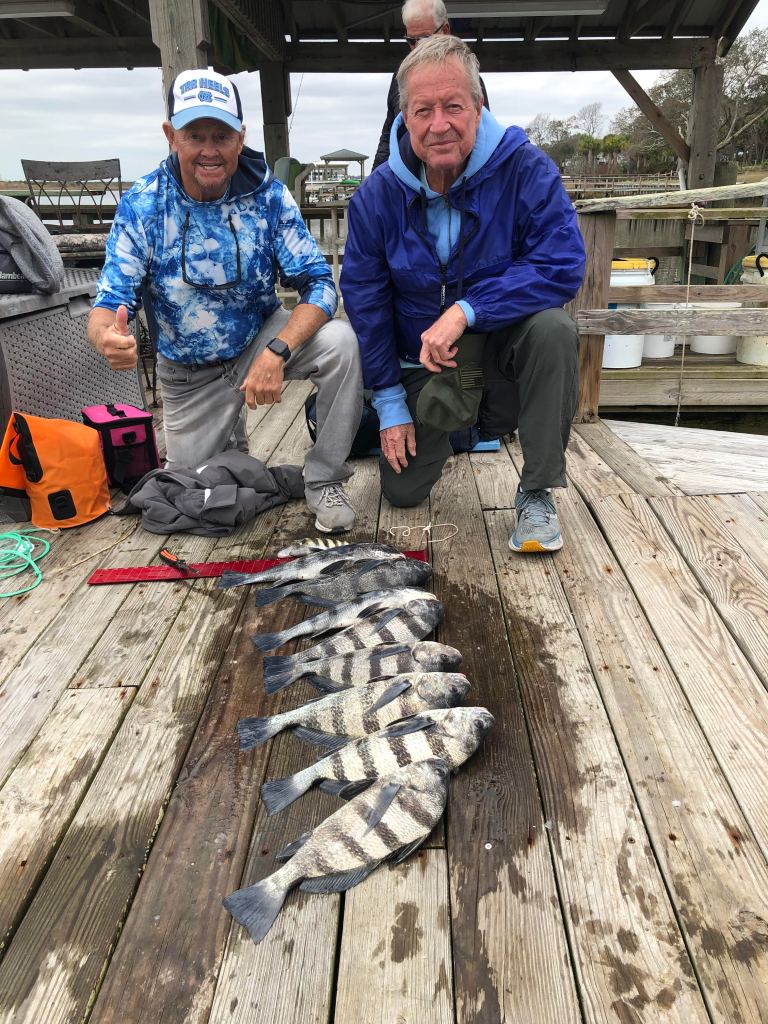
Have been getting fishing lessons from Harold Golding with the Black Drum fillets fried up in a skillet after dunking in an egg wash then rolled in flour and cornmeal being our favorite along with flounder of course. Have surf fished off the beach and done well a couple of times and enjoyed the experience even when they weren’t biting and same with fishing the pier. Being a club member has been a good social thing for me and I look forward to the get together’s.

 Sea Trail Fishing Club
You must be logged in to post a comment.