Category Archives: Education

How to Properly Net a Fish …

Published JULY 18, 2024

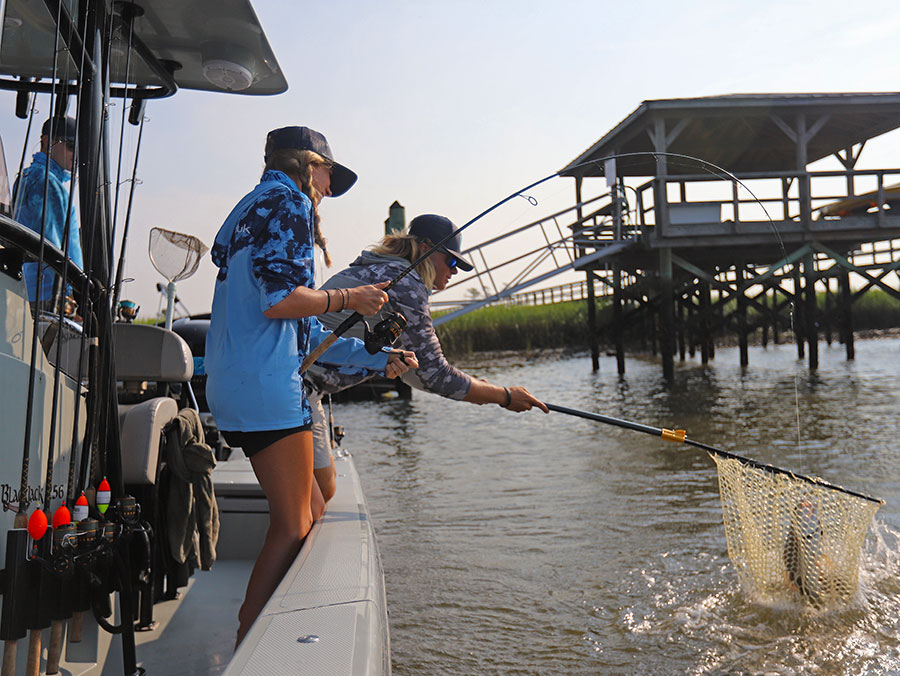
Your fishing partner has hooked into a great fish and yells, “get the net!”

It’s your chance to go from unsung hero to zero. Net the fish successfully, and you’ll likely never get a great deal of credit. Botch the job, and you’ll never live it down.

Don’t worry, it’s not that complicated, as long as you don’t make it complicated. It’s as simple as dipping the net into the water, then waiting on the angler to guide the fish into it.

That’s it. Dip the net in, wait on the angler to guide the fish in, then lift it out of the water.

It’s easy to get it right. And it’s just as easy to get it wrong, if you try to do too much.

What you don’t want to do is follow the fish around with the net, stab at the fish, or lunge the net at it.

When it’s all going well and the angler has the fish right at the net, but then the fish quickly turns or jumps, just wait. It’s tempting here to try and “save the day” by swooping the fish out of the water. But as likely as not, you’ll push the fish in the tail, which may give it just the boost it needs to spring free.

Avoid the temptation, and simply keep the net in the water and wait. It’s up to the angler to guide the fish back to the net, and the last thing the net man needs to do is start sweeping and swooping at the water, just trying to luck into netting the fish.

Exceptions

Like most rules in life, some exceptions are warranted, but they are few and far between.

One exception is when you can see the fish is barely hooked. When a lunker bass is near, and you can tell the hook is holding on to just the slightest piece of skin, it might be worth it to make a move with the net.

And if you’re reeling in a fish that could tangle itself in a drift sock, or around a nearby tree or other brush, you might save yourself some trouble by getting a little aggressive with the net.

In those situations, you just need to accept the fact that you might knock the fish free, or it might simply get free on its own. And you also need to accept that sometimes, the angler just isn’t going to guide the fish into the net properly, the fish will shake free, and you’ll be wondering if you could have done more.

But most of the time, as long as you simply put the net in the water and wait as the angler guides the fish into it, you’ll get the fish in the boat and won’t be the scapegoat that ruined the day.

Tight lines 🎣
New recreational, commercial harvest reporting requirements delayed to Dec. 1, 2025

        July 12, 2024   New recreational, commercial harvest reporting requirements delayed to Dec. 1, 2025   MOREHEAD CITY – New harvest reporting requirements for recreational and commercial fisheries have been delayed by one year and will now become effective on Dec. 1, 2025.   The N.C. General Assembly recently passed Session Law 2024-45, which, in part, amends legislation from last fall that would have implemented the harvest reporting requirements on Dec. 1, 2024.   This extension will allow the N.C. Department of Environmental Quality’s Division of Marine Fisheries (DMF) and the N.C. Wildlife Resources Commission (WRC) to engage with stakeholders, not only to inform them about the requirements, but also to ensure that the reporting process and tool(s) are robust and user-friendly.   The legislation from last fall requires that any person who recreationally harvests Red Drum, flounder, Spotted Seatrout (speckled trout), Striped Bass and Weakfish (gray trout) must report that harvest to the DMF. This requirement applies to fish harvested from coastal fishing waters, joint fishing waters and inland fishing waters adjacent to coastal or joint fishing waters.   Additionally, the law requires anyone holding a commercial fishing license who is engaged in a commercial fishing operation to report all fish harvested to DMF, regardless of sale.   More information, including links to temporary rules to implement the laws, can be found on the Mandatory Harvest Reporting webpage at https://www.deq.nc.gov/mandatory-harvest-reporting. The webpage will continue to be updated as new information becomes available.

For More Information:   DMF Contact: Patricia Smith Phone: 252-515-5500   https://www.deq.nc.gov/dmf   P.O. Box 769, 3441 Arendell St., Morehead City N.C. 28577 WRC Contact: Fairley Mahlum Phone: 919-707-0180   https://www.ncwildlife.org 1701 Mail Service Center Raleigh, NC 27699-1700     NC Division of Marine Fisheries | 3441 Arendell Street | Morehead City, NC 28557 US   Unsubscribe | Update Profile | Constant Contact Data Notice
July 12, 2024 e-mail from NCDMF dmfnews@deq.nc.gov

TAKE NOTE THAT NONE OF THE HYPERLINKS ARE “HOT.” IF YOU WANT TO FOLLOW A HYPERLINK, “COPY & PASTE” INTO YOUR BROWSER SEARCH BAR.

🎣

News from Salt Strong

SALT STRONG INSIDER CLUB PRICE INCREASE (NEW MEMBERS ONLY!) https://www.saltstrong.com/fishing-tip/salt-strong-insider-club-price-increase/?utm_source=Isoft&utm_medium=Email-broadcast&utm_campaign=Insider-tip&utm_content=salt-strong-insider-club-price-increase&utm_term=insiders

Membership is not for everyone, but if it is for you, now is the time to avoid the 50% increase in the price of membership.

Mono vs. Fluoro for your In Shore Leader

I asked MicroSoft Copilot AI “What is the difference between nylon mono and fluorocarbon leader?”

Nylon Monofilament (Mono):

Fluorocarbon:

  • Stiffness: Fluorocarbon is stiffer than mono.
  • Stretch: It has minimal stretch, which is advantageous for deep water jigging and bait fishing.
  • Abrasion Resistance: Fluorocarbon is highly abrasion-resistant.
  • Diameter: Fluorocarbon has a thinner diameter compared to nylon mono of the same breaking strain.
  • Density: It sinks in water.
  • Visibility: Fluorocarbon is less visible to fish.
  • Knot Strength: Fluorocarbon has better knot strength.
  • Use Cases: Use fluorocarbon for deep water jigging, bait fishing, and finesse luring with small soft plastics. It imparts action on jigs and lures, and its minimal stretch helps prevent fish from reaching bottom structures.

Copilot says “In summary, choose mono for shock absorption and ease of knot tying, and fluorocarbon for less visibility, better abrasion resistance, and specific fishing techniques.”

However, independent testing at Salt Strong (https://www.saltstrong.com/fishing-tip/mono-vs-fluoro-insider-only/?&utm_content=weekly-newsletter-4-7-24&utm_term=&utm_medium=Email-broadcast&utm_campaign=Newsletter&utm_source=Isoft) has a different opinion supported with data. (NOTE: only Salt Strong Insiders will be able to view this URL).

Which do you prefer for your leaders, mono or fluoro, and why?

Tight line.