

https://www.carolinasportsman.com/columns/sound-sea/top-out-on-speckled-trout-in-october/

https://www.carolinasportsman.com/columns/cold-doesnt-mean-stop/

October’s Sea Trail Fishing Club’s Guest Speaker will be Jesse Bissette.
Jesse Bissette is the Marine Fisheries Commission liaison for the N.C. Department of Natural Resources Division of Marine Fisheries.
He will address the “Manditory Harvest Reporting Program”
Patricia Smith, Public Information Officer of the N.C. DNR will also be available for questions.
Jesse began his career with DMF in the Marine Recreational Information
Program — in DMF shop talk, that’s MRIP. As an MRIP creel agent, he
spent his time interviewing anglers for recreational fishing surveys up and
down the North Carolina coast. He also worked with the division’s Observer
Program before moving to Public Affairs where he was the division’s multi-
media specialist.
In his current position, Jesse supervises the Marine Fisheries Commission
Office, working closely with the commission chairman, the Division Director,
and Division staff to plan commission and advisory committee meetings.
He is also part of a Mandatory Harvest Reporting Outreach Team at the
Division. He has been visiting fishing clubs across the state to talk about
these upcoming requirements.
In his spare time, Jesse works with team of folks that run the website
NCFishes.com, an independent project dedicated to photographing all of
the various fishes found in North Carolina waters. Many of the beautiful
photographs of fish found on the Division of Marine Fisheries website were
taken by Jesse.
Background Information: North Carolina is implementing mandatory catch reporting for certain species starting December 1, 2025. Both recreational and commercial fishermen must report their harvests. Recreational anglers are required to report specific species: Red Drum, Flounder, Spotted Seatrout, Striped Bass, and Weakfish. Commercial fishermen must report all fish harvested in coastal and joint fishing waters, regardless of whether the fish are sold. The NC Division of Marine Fisheries (DMF) will provide reporting methods, which are expected to include web-based tools and eventually a smartphone app, for the public to comply with this law.
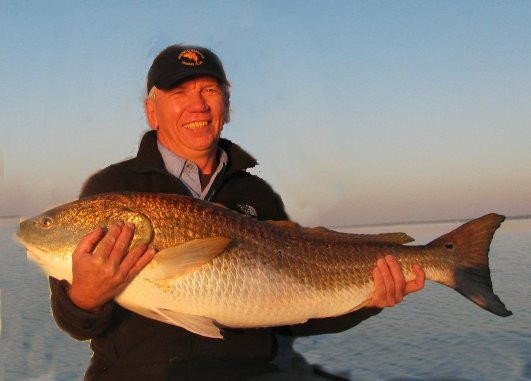
Hey Folks, The Red Drum Tournament has been extended to 4-weeks and now runs through October 19th. The excitment of catching one of these huge fish in our near-shore waters is hard to beat, so get out there and FISH!
This is a member’s-only competition and I know that some of you on this site are not members – so what better time to sign up to be on our club? Annual memberships are only $20. Heck, while you are at it, sign up fpr 2026 as well! There are a lot of exciting opportunities throughout the year. For example, if you missed Captain Tripp Hooks presentation last week, you may be a step back on rigging and tactics for catching these big drum.
If you are thinking about fishing for the ‘Big Reds’, be sure to read the “Important Guidelines” section on the “Tourney Info” page of this website. You need to know how to catch and release these fish without threatening their survival. They are the breeders of the species and their survival is critical to being able to catch keepable slot drum in the future.
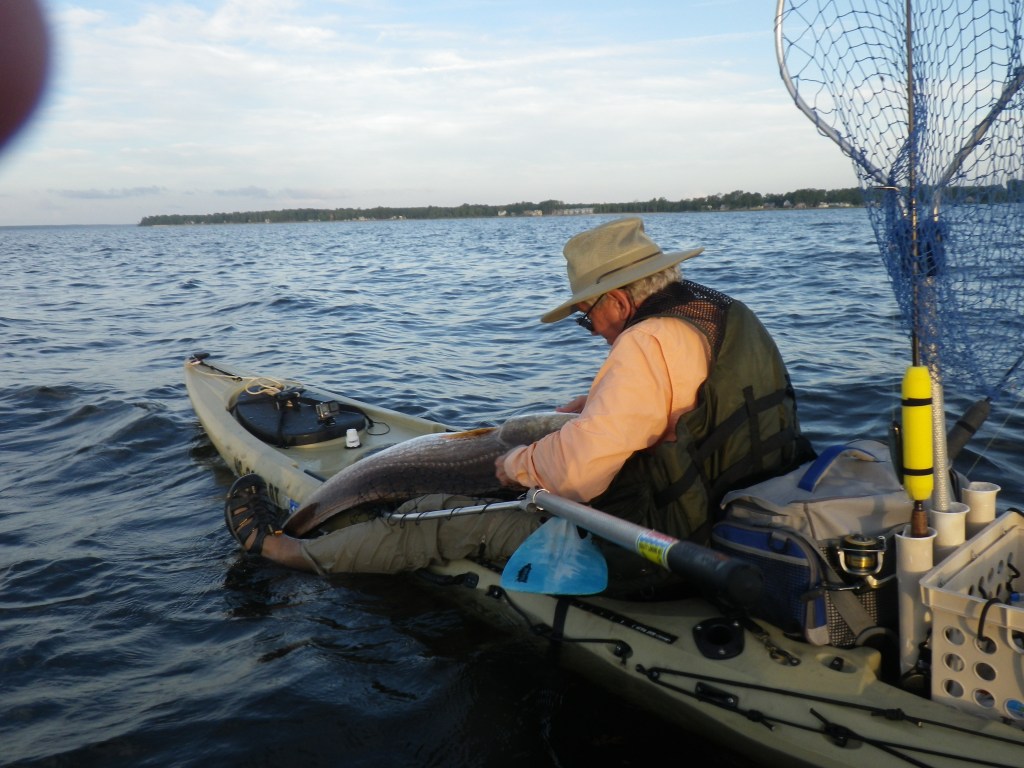
Also, if you are entering the tournament, you need to know how to properly record your catch by making measuements that can be documented!
Take my advice, it is really frustrating to catch one of these nice fish and not have a way to measure it!
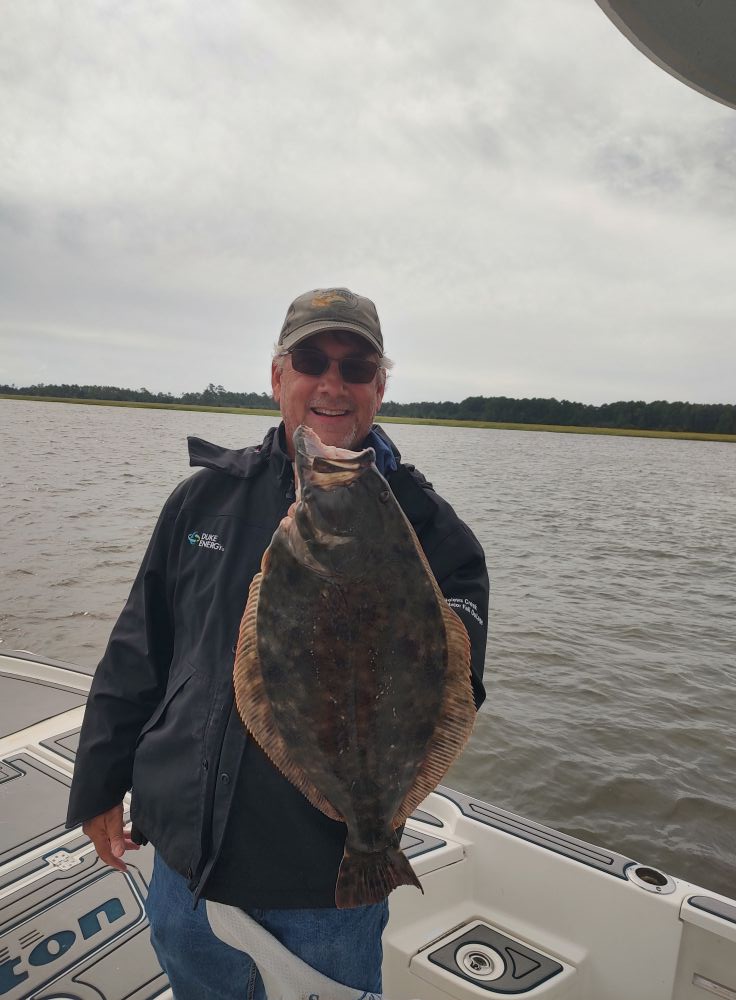
Alan Trojan with 24-3/4″, about 8 lbs, personal best

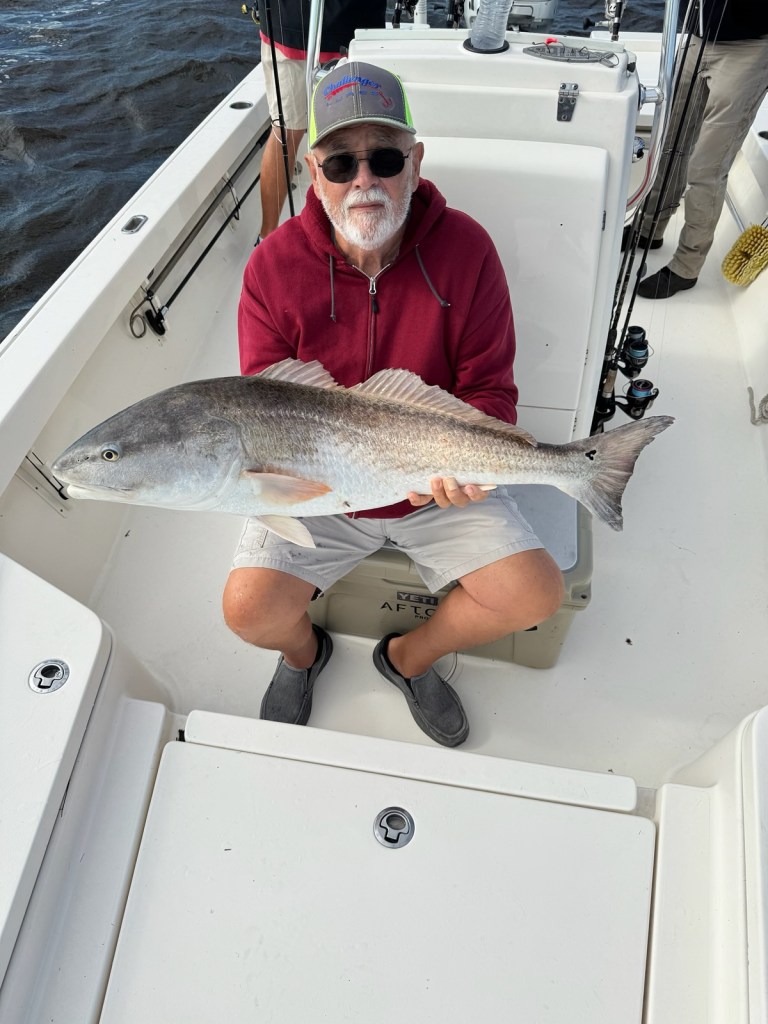
Bob Badzylo’s friends with Bull Reds
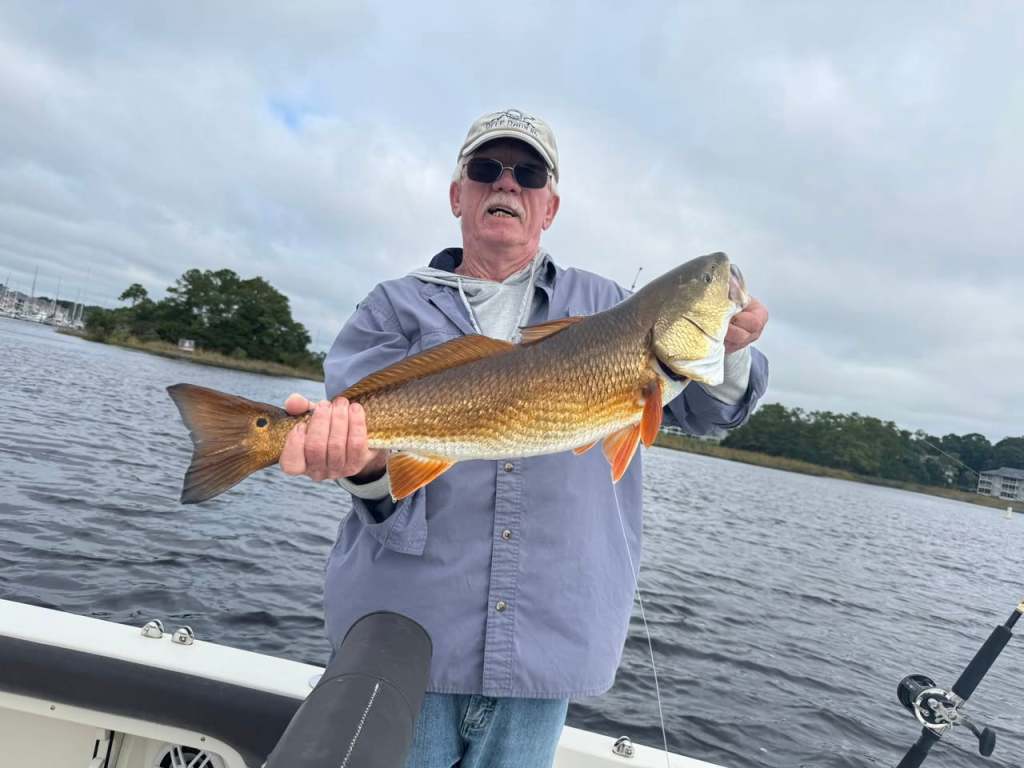
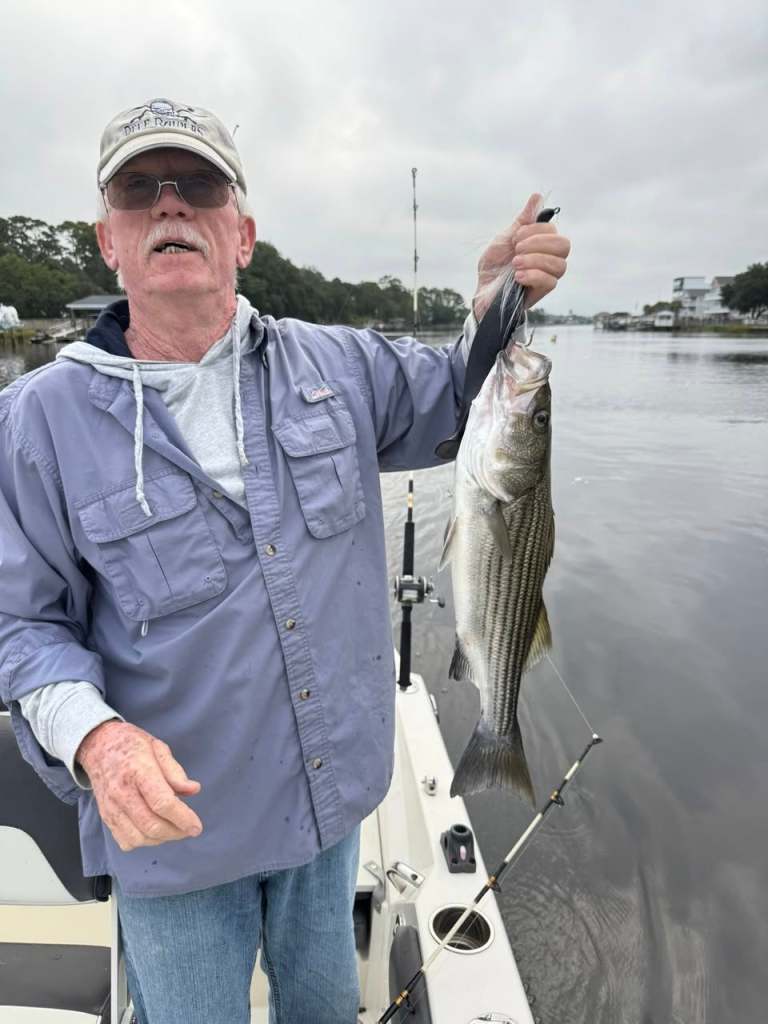
Chuck Fisher with a Bull Red and a Striper

Clint Morschauser with Personal best 26”, 8 lbs.
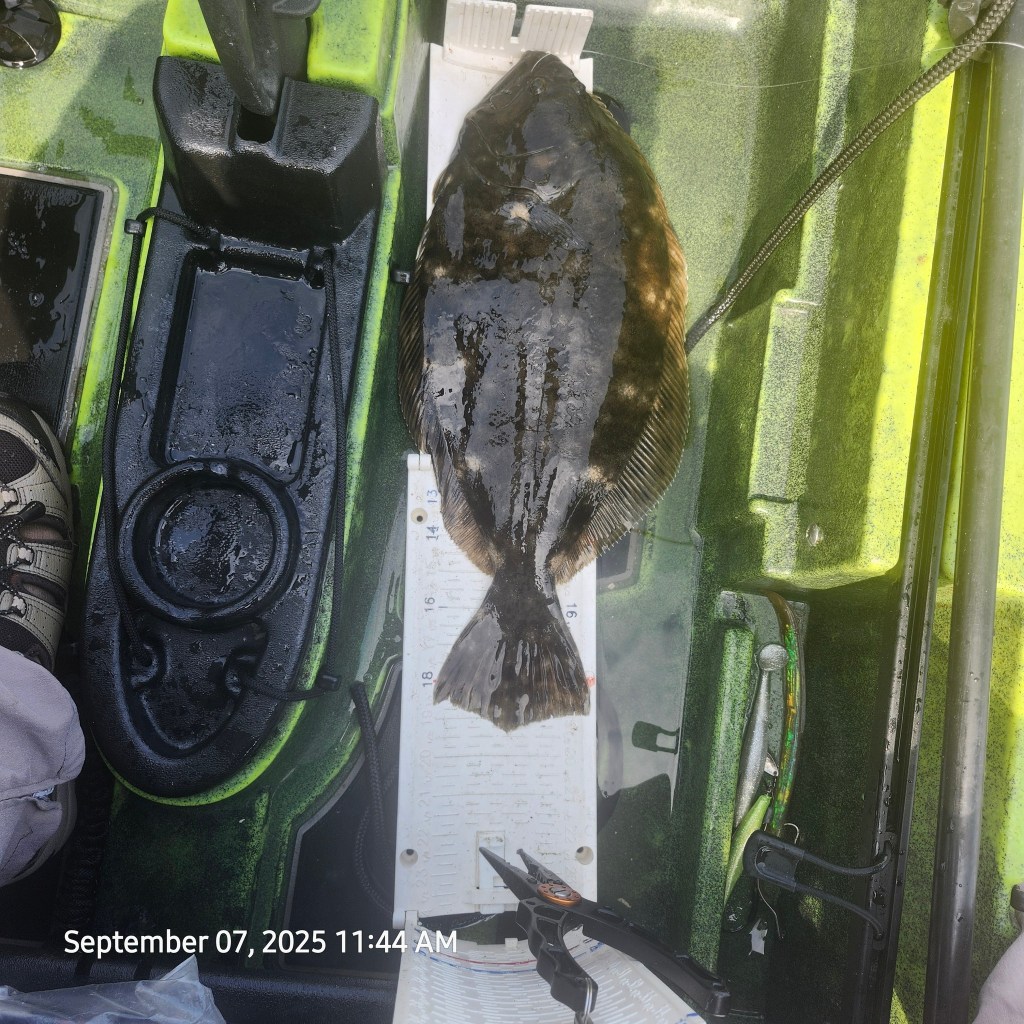
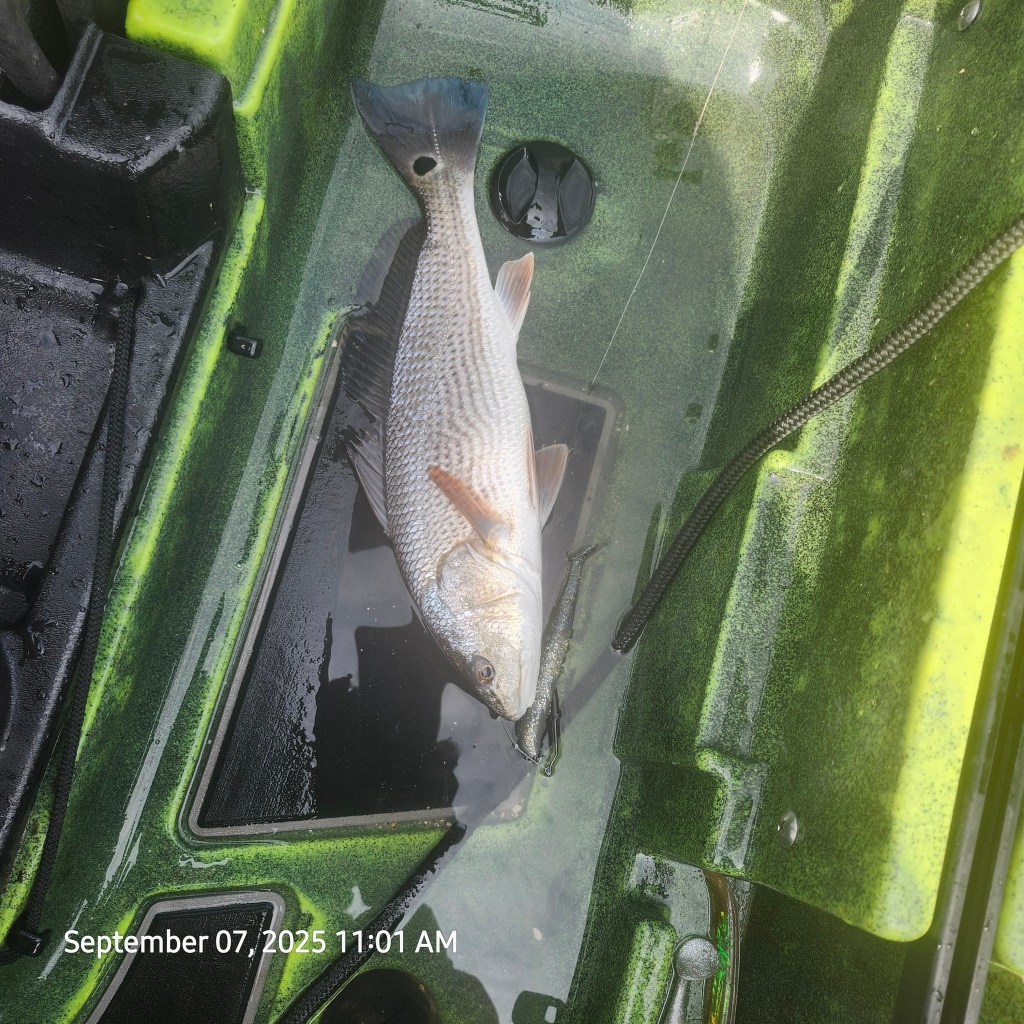
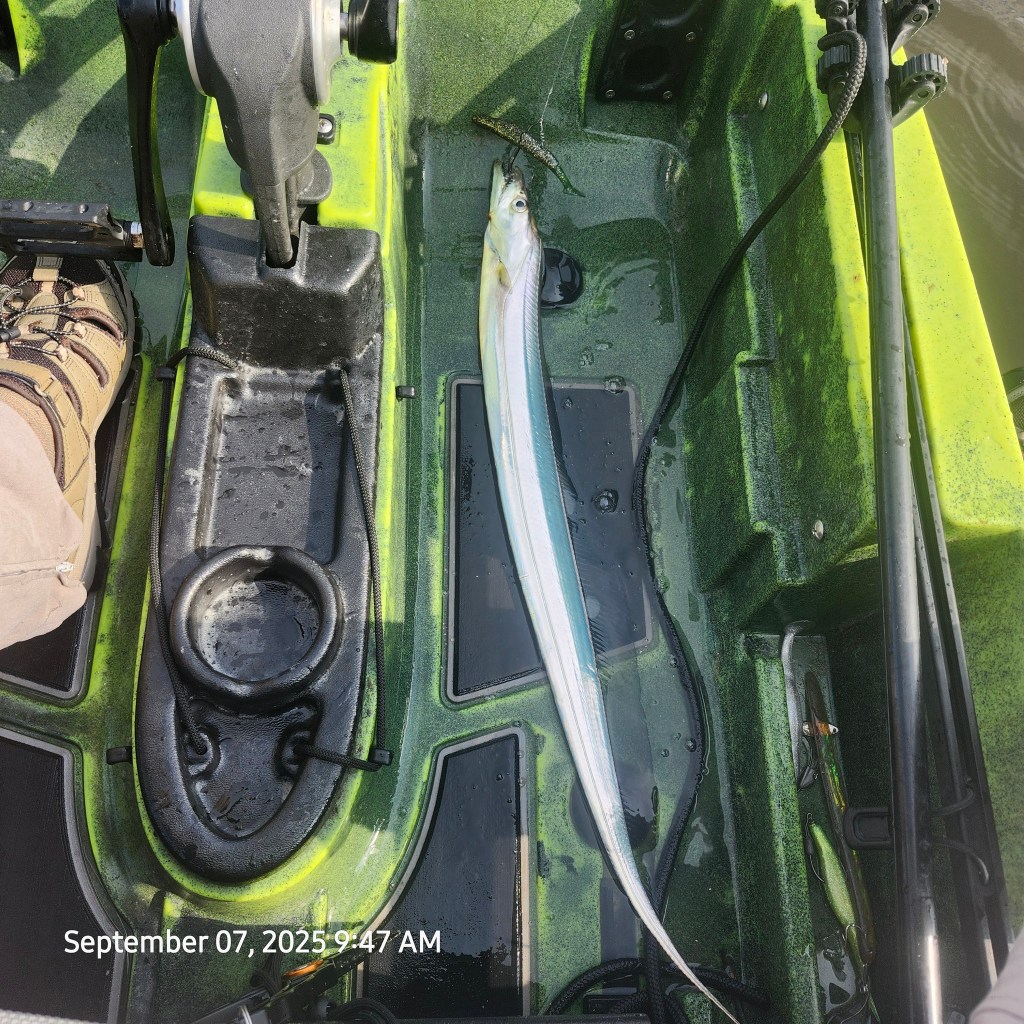
Mike Shannon “yaking” around in the creeks.
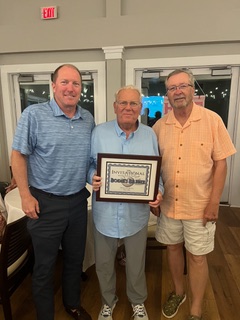
“Bodie’s Breeze,” captained by Steve Bodenheimer, Sgt. at Arms, captures First Place in the Inshore Category and Second Place in the Overall Tournament at the “OIB 59th Invitational” September 12th & 13th. Fish caught in the Categories were flounder and red drum, along with Bonus Fish of silver perch, toad fish, ribbon fish and a large ray.
(Left to right :: Brian Brumbaugh, Steve Bodenheimer & Steve Pendergrass)
August 25, 2025
By Laurie Thomas Vass
Sea Trail Fishing Club Member Helps New River Wildlife & Conservation Club, of Fries, Virginia, with Hurricane Helene River Cleanup
The New River Wildlife & Conservation Club, of Fries, Virginia, dedicated the month of August 2025 as Hurricane Helene River Cleanup month.
Forty citizen volunteers showed up on August 23, 2025, and worked in 6 teams to scour the river for debris.
Each team pulled a flat bottom boat upstream, with the workers wading in the knee deep waters.
They pulled out over 100 tires and several tons of debris.

Laurie Thomas Vass, a member of the Sea Trail Fishing Club went to Fries to volunteer to help clean the river.
“I fish in the New River and love that mountain community,” said Vass. “Their little towns, like Fries and Mouth of Wilson were devastated by the storm and I wanted to do something to help them.”
I won the prize for finding the proverbial kitchen sink,” she said.
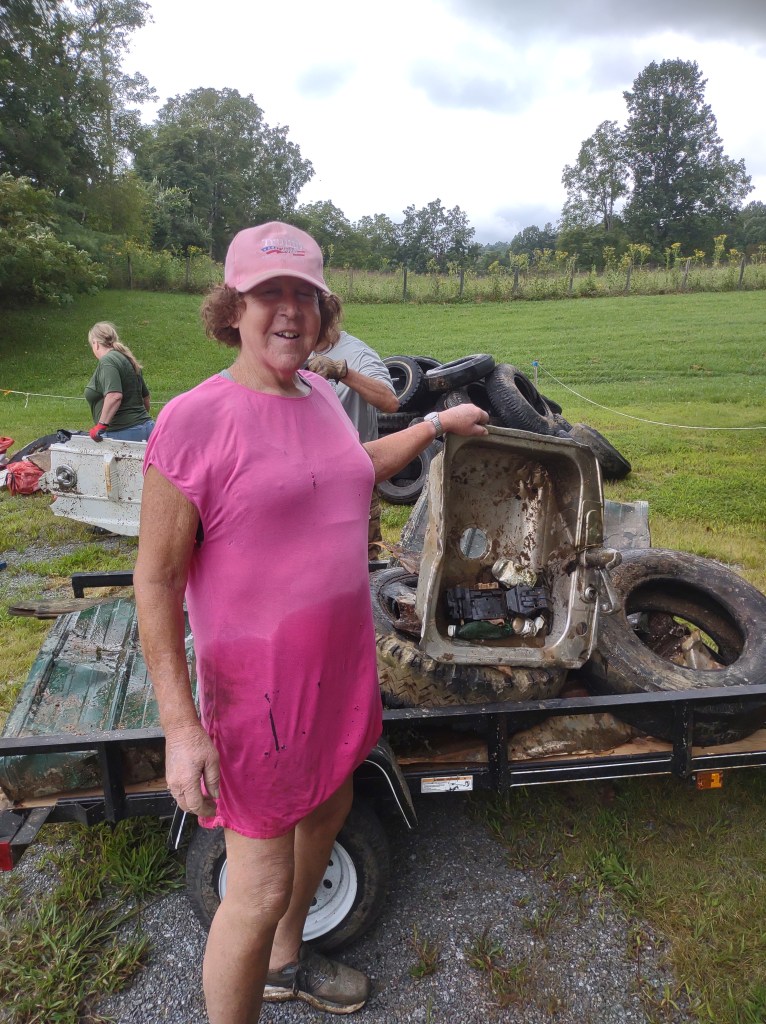
“We found tires, appliances and roof tops, said Vass, “including a fully functional porcelain toilet.”
“The force of the water flushed a lot of things down the river,” she noted dryly.
Keith Andrews, the President of the New River Wildlife & Conservation Club, expressed his appreciation to all the volunteers and noted that the club hopes to conduct a river cleanup, every August.
“I invite all the members of the Sea Trail Fishing Club to come up here next year, and camp in our 32 acre club park, next to the river, and help us recover from the hurricane,” he said.
About New River Wildlife & Conservation Club, Inc. The club is a 501c 3 that offers education programs including fly-fishing clinics, hunter education courses, field-to-table workshops, mountain crafts workshops, nature walks, kayaking lessons, river water chemical testing, and floats throughout the year. The club has been holding annual river cleanups since 2021. Located in Grayson County at 7107 Riverside Dr. Fries, Va. 24330.
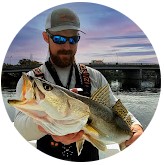
Steve Brewski will be the guest Speaker at the Sea Trail Fishing Club’s August Meeting to be held at the Pink Palace, Sea Trail Plantation on August 21.
Steve is an active advocate for recreational fishing in North Carolina and will present his viewpoints on the state of the sport.
Be sure to join us Thursday evening, 6:30 to 8:30 PM
Steve Brewster Biography:
I was raised in Rome, Georgia, I inherited a passion for fishing—and conservation—from my grandfather. After high school, I joined the Marine Corps and was first stationed in North Carolina in 2005, serving 10 years with deployments to Iraq, Afghanistan, and Japan.
I caught my first New River speckled trout in 2009—a 28.5-inch fish that made me realize this was home.
Today, I run the YouTube channel “Fishing with Brewski“ (https://www.youtube.com/@FishingwithBrewski), which started as a passion project and grew into a platform for change. I began attending NC MFC
(https://www.deq.nc.gov/about/divisions/marine-fisheries/marine-fisheries-commission) meetings in 2015 over the flounder crisis and became committed to reform after witnessing repeated illegal activity go unpunished in our broken system.


You must be logged in to post a comment.