Welcome New Members!

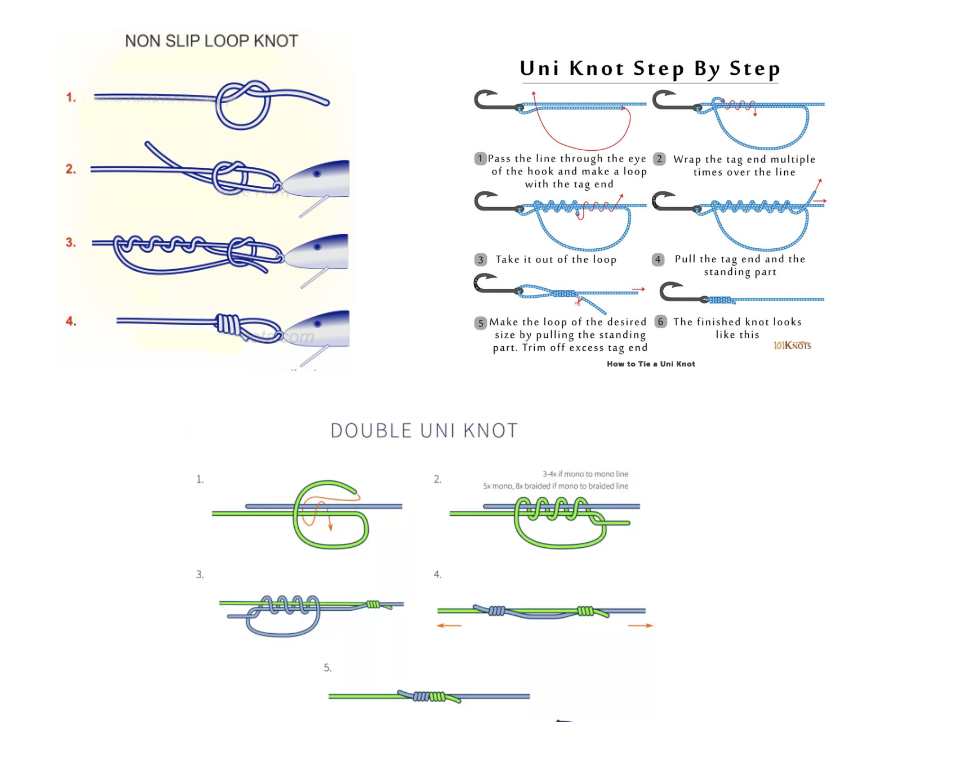
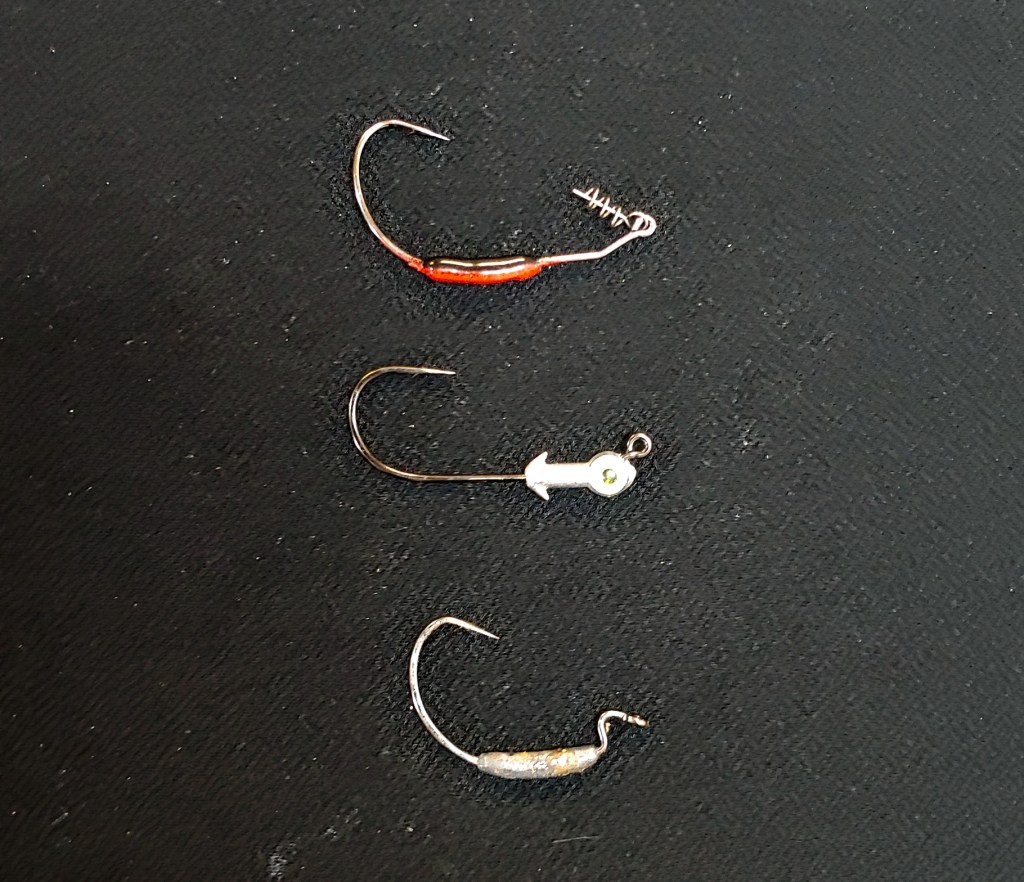
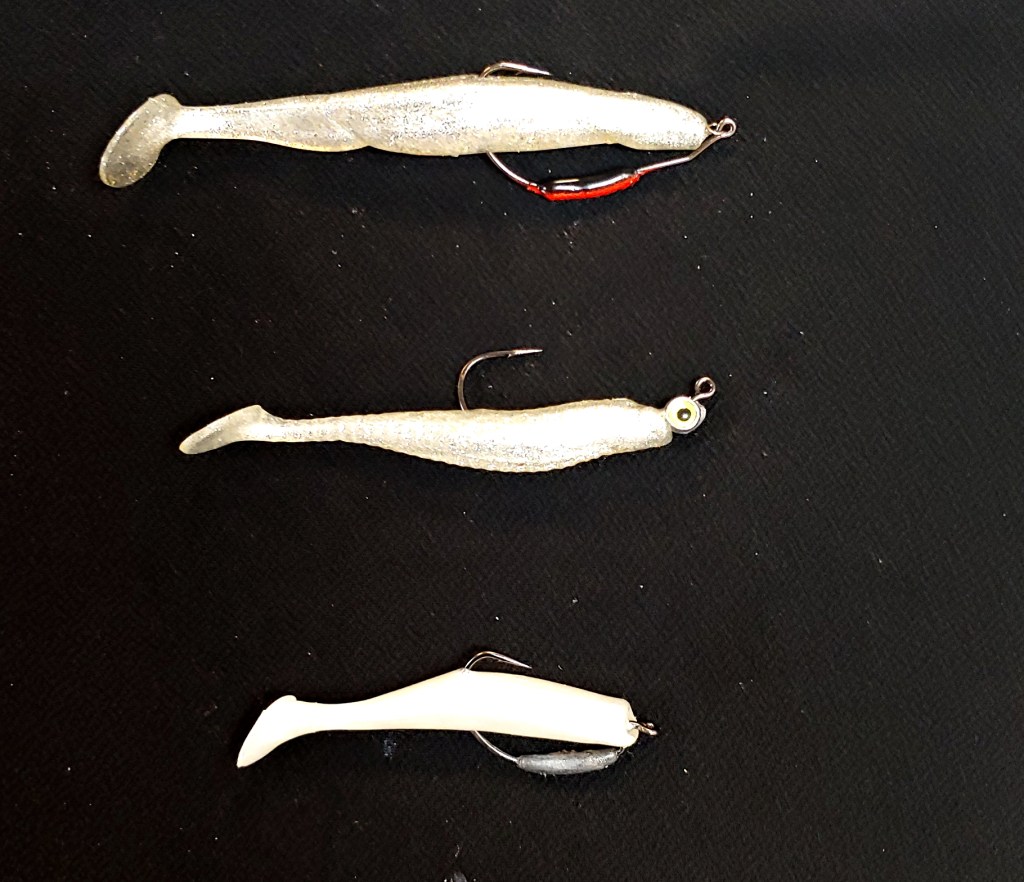
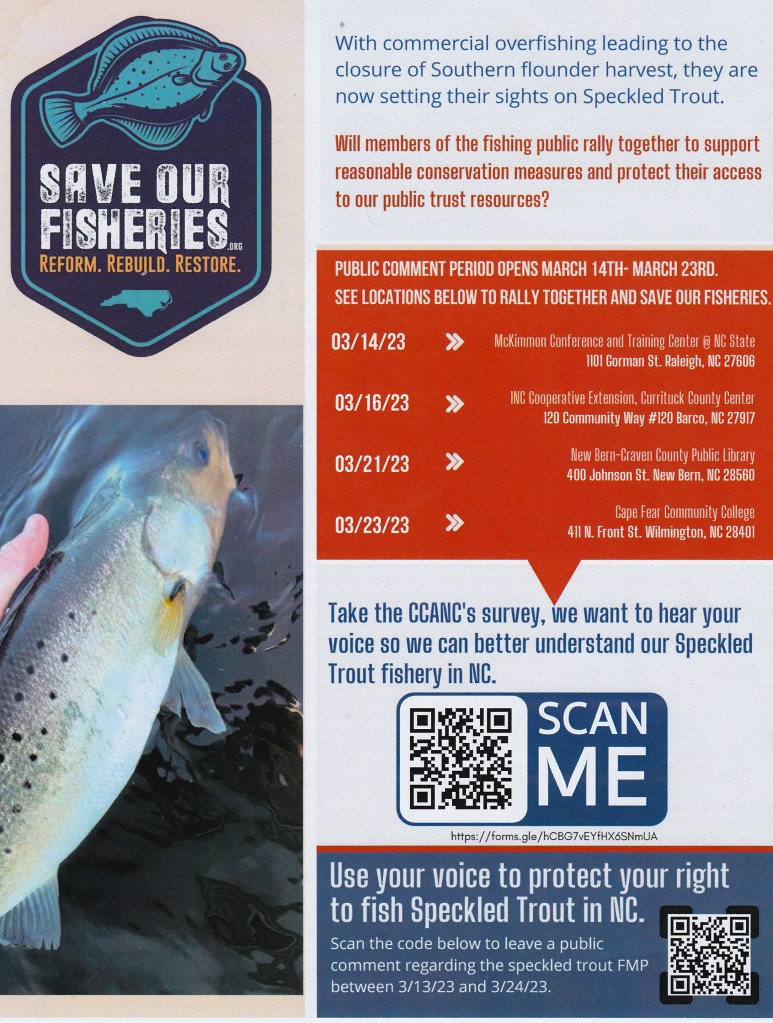
The January Club Meeting was well attended with 28 members present and Captain Jacob Frick gave this perspective on fishing in our area as well as some tips on gear and rigging. The Club welcomed 8 new members: Roman Poremski, Kevin Cassidy, Jeff Titus, David Tucker, Dean Cain, Donald Coldwell, Jimmy Sciascia and Robert Sasso.

Dress Warm

You might have noticed the recent pictures of January catches show that the anglers are bundled up! Temperatures on the water are a lot lower than on shore and the added humidity further lowers the “feels-like” temperature. The following article was slightly modified from an article written by Phillip Gentry for the December 2022 edition of Carolina Sportsman.

Preparation is the Key

Winter weather is a deterrent to many anglers regardless of the craft used simply because of the cold temperatures. That exposure is compounded when fishing from a paddle craft because of the close proximity to the water.

Dressing for a winter fishing event is not unlike any other outdoor sport, combining layers of clothing that can be added or subtracted as the day wears on. It’s always better to use several thinner layers than one or two thicker layers.

Dressing for success means wearing both cold weather and water repellant clothing while avoiding cotton garments. Dressing in layers that allow movement is tantamount. It’s almost impossible not to get wet when fishing from a kayak or small boat, so dress with the understanding that you’re going to get wet to some degree.

Fortunately, mid-winter fishing action doesn’t tend to heat up until the sun is well above the horizon. This allows the angler to get a late start and not miss any of the action. What tends to catch many anglers off guard is the shortness of the day, and the realization that a long trip back to the take-out point may occur at or after sunset if you’re not paying attention to time. Cold, wet, and tired after dark is not the most desirable experience for a winter-time angler.

Finally, plan on packing along emergency gear such as spare clothing, a towel, and emergency heating system in case you find yourself unexpectedly in the water during the trip. If in a kayak or small boat, pack these items in a dry-storage bag so they’ll survive should the the craft turn over.

Redfish are great wintertime targets for kayak anglers.

Redfish Winter

The following article was written by Phillip Gentry for Carolina Sportsman December 31, 2022.

Go shallow for chilly water redfish

Nothing speaks of cold water inshore fishing more profoundly than sneaking up on a tightly packed pod of redfish and attempting to pick them off one by one.

Until they mature and head out into the ocean, most redfish rarely range more than ½ mile throughout their juvenile life. That means those same places where you find redfish in the spring, summer, and fall will be the same places you’ll find them in the winter.

During winter forays, redfish don’t range into deep water holes, but spend more time in shallower water, and for good reason. First, all the bait is gone and dolphins that normally feed on mullet or menhaden are now feeding on redfish. Second, a dark, shallow muddy bottom will be warmer than the surrounding area.

Anglers who can locate and access the most remote reaches of shallow water – too shallow for heavier boats to pass – have a distinct advantage.

Winter tides in the Carolinas tend not to be as wide-ranging as summer tides. So a good bet is to look for mid-tide flats to hold more fish, especially those areas having oyster mounds or sandbars between them and deeper water. With hard ground between you and deeper water, once you’ve located a school of fish, you should have them to yourself.

Fishing shallow water near oyster mounds is a good winter strategy for anglers. (Picture by Phillip Gentry)

Keep it slow

Lures that have a lot of action without having to move it that fast are a good bet. The use of scented baits or at least applying some add-on scent often plays a big part in how redfish find your bait.

Mudflats in the winter are generally devoid of active life. So anything that moves naturally along the bottom tends to get noticed when blind casting for individual redfish. Fast twitching a jerkbait or topwater lure works well in warmer weather but will tend to spook already nervous winter fish.

Unless spooked, redfish schools may not range very far in colder water. But they’ll show a distinctive movement that can be determined by observant anglers who watch and wait for the right time to present a bait. If the movement of the school, which can number from 20, 30 to even 100 fish is too close and moving closer, allow the pod to pass by and then cast ahead of the fish and let them work to it or slowly move it back into the fish, being careful not to let the bait or even your line fall across the fish.

Phillip Gentry of Waterloo, S.C., is an avid outdoorsman and said if it swims, flies, hops or crawls, he’s usually not too far behind.

Post from Steve Heins – Lure Selection

Wise lure selection can mean never being unprepared

A Reprinted article from CoastalReview.org by 01/05/2023 by Capt. Gordon Churchill   


One of the things we get told by old-timers (of which, I must confess, I appear to be now) is, “Find the bait, you’re doin’ great.”

Yes, if you find massive schools of baitfish and there are fish crashing into them in every direction, it’s seems to be a good adage to follow. But what about days when there are signs of feeding fish, but it is not so obvious what they’re feeding on, and then you’re not sure if you have the right lure type to match.

You can meet any inshore fishing situation with a small assortment of lures. I will go out on a limb and say you can catch any fish that swims inshore in any circumstance with three lures — and one extra sub-type that I just really enjoy. If you grab these lures, you will never be caught unprepared.

First, and most obvious I think, is a jig. I’d say that a plain white jighead with white bucktail has probably accounted for more fish caught in the history of angling than anything ever invented or yet to be. I’d go a little further and add a soft plastic wiggle tail instead of the bucktail, just to take advantage of some modern technology. 

Any of the brands you see will work. Let’s stick with white for now but choose any color that will show up in the water you are fishing: Light colors are for clear water, dark colors for stained water, bright colors for muddy.

If you suspect that minnows are being chased and fed upon, retrieve so it stays in the upper part of the water column. Add a little twitch so it appears to be having difficulty swimming. This is the key now. Predators go after prey items that are having a bad day. It might be due to an injury, sickness, or it just might be its time. Whatever. If a minnow is having a tough time, be sure that a predatory fish is going to target it. I’ve always figured that nothing ever dies of old age in the ocean.

A jig can be hopped along the bottom to simulate shrimp or other crustaceans that move sporadically along the bottom. Shrimp also swim pretty quickly, with a couple quick spurts of energy and then a drop. This movement can easily be simulated with a jig. Finally, if crabs are on the menu, a jig can literally be crawled along the bottom. Add a little hop now and then to attract attention. I caught my first bonefish in this manner many years ago.

Hard plastic swimming plugs account for a big percentage of the fish I catch every year.

Q: “There are literally thousands of them on the market, Capt. Gordon. How do you choose which one to use?”

A: That’s an excellent question. If I had to pick just one to fish every day, on the Southeast Atlantic coast, it would be the Mirrolure MR 27 with the pink and chartreuse. It has great action on the twitch, twitch, pause, retrieve. Anything will eat it. I’ve caught striped bass, speckled trout, red drum, croakers, lizardfish, ladyfish, jacks, pinfish, and probably at least one or two others that I can’t think of right now. When a fish sees it doing that weird duck-and-dive motion on the twitch, it is seeing an easy target: a baitfish of some kind, that is having a tough time getting anywhere. It represents calories to gain that will not amount to a large expenditure.

This is what fish do. They can’t actually do algebra or calculus, but they are always figuring how much a certain prey item will add to their caloric total for the day without subtracting too much. Combine this with how exposed they will be to predators. If they can get an easy meal without being too exposed, they will focus on that. The MR 27 presents an easy target and a meaty profile that fulfills all those requirements. 

The bonus option is a topwater plug. I prefer the ‘walk-the-dog” style. My favorite being the Rapala Skitterwalk version. Great for water under 5 feet deep with a grassy bottom or one that has a lot of snags like oyster shells and things. The side-to-side walking motion presents an illusion of an easy target, and the large profile looks like a big meal. Big fish eat these. Sometimes, it’s the only thing that works. It just gets their attention.

If you know for a fact that fish are targeting shrimp, and sometimes even if they are not, you cannot beat a plastic shrimp imitation. The most well-known and the original being the DOA shrimp. There are other brands. They’re all knockoffs of the original. I resisted using these for years. They look like what a kid’s toy shrimp would look like, if there was such a thing. These work. Inshore fish of all species and sizes will gulp them down. I really like the sand-colored ones with the green tails and the all pink. For sight fishing in clear water with a light spinning rod, there is simply nothing that works better. Cast into sloughs and channels and let the current sweep it along.

Most popularly, use under a popping cork in creeks, and on flats. The noise gets their attention, the shrimp get whapped. I’ve even seen guys use them on a Carolina Rig while surf fishing. Trout, redfish, striped bass, bluefish — basically, if there are shrimp in the water and there are gamefish around, the plastic shrimp imitation should be the No. 1 go-to. These things are even my best fish catchers when targeting fish in shallow creeks during cold water periods when a shrimp hasn’t been seen in months. They just like shrimp so much, they can’t resist.

With a selection of these three lure types — plus the bonus — I feel pretty confident in saying there isn’t an angling question that can’t be answered. Yes, there are about a million others. I didn’t mention spoons, spinnerbaits, metal jigs, and a bunch of others. But the ones I mentioned will match any hatch you see to get started. Add to your selection as time — and your wallet — permits.

KEEP IT SLOW AND SMALL

ARTICLE FROM CAROLINA SPORTSMAN:   BY BRIAN COPE

INSHORE FISH ARE GETTING LETHARGIC; MATCH YOUR PRESENTATION

December and January are great months for inshore fishing, but it does require some adjustments from anglers. Redfish and speckled trout both slow down considerably this month, but they’ll still bite properly presented lures. As cold water slows the activity levels of these fish, their appetites become smaller, so it’s a good idea to scale down on lure sizes. Instead of casting 3 and 4-inch long swimbaits, smaller lures like a 3-inch Matrix Shad or the 2 1/2-inch Z-Man Slim SwimZ on jigheads are good choices. These smaller lures can draw strikes when bigger lures presented in the same areas go untouched, This goes against the natural inclination to cast bigger lures that would seemingly fill a fish up with one bite, and also to cast a bigger lure that is more noticeable to lethargic fish.

But the fish don’t need help seeing the bait. They have no choice but to find food to survive, and they are very good at the task. However, they can be extra picky this month. One reason is because of their smaller appetites in cold weather. Another is because the water is generally very clear this time of year, which means the fish can see subtle imperfections in lures that can make them wary. The smaller the lures, the less chance of the fish spotting those unnatural looking details. That, along with their affinity for snack-sized portions during winter will, more often than not, lead to more strikes.

FORGET THE SHADE

Through most of the year, inshore anglers work their lures at a moderate to fast pace. The more water they cover, the more fish they put their lures in front of. But that’s the wrong approach in December. Fish need to reserve their energy as much as possible right now, so they won’t exert too much of it chasing baitfish or artificial lures. Use a slow retrieve this time of year. During spring, summer, and even late into fall, anglers are accustomed to looking in shady spots or deeper holes for inshore fish. That’s especially true in the Carolinas where the temperatures push fish to find the coolest water possible. But it’s the opposite this time of year. Especially early in the morning, inshore fish will seek the warmest areas they can find, and that usually means they’ll be hanging out where the sun is shining brightest. Shallow mud flats warm up quickly in winter when the sun is out. Redfish and specks will flock to those areas to warm up and to find baitfish, which are also seeking the warmth of the sun.

DON’T FORGET BAIT

Natural bait should also be an option for anglers this month. The scent of a tiny piece of shrimp placed on the hook with a swimbait can add just enough scent to entice a wary fish into biting. But it’s also a good time to throw chunks of cut bait on a Carolina rig. These chunks give off strong scent, and anglers can allow them to sit still until a fish picks the bait up.  Many anglers find live bait works better than anything for them during cold weather. Fewer baitfish are inshore right now, but that doesn’t mean redfish and trout won’t eat ones they see. These fish find it hard to pass up a fresh mud minnow or mullet under a cork, especially when the angler casts it near a sunny area, then allows it to move about completely on its own. This isn’t the time to pop and reel like anglers often do from the spring until late fall. An occasional pop might be good to draw attention, but a baitfish moving too much and too quickly is far more likely to be ignored by reds and trout this month.

BREAK THE RULES

These are good guidelines to follow for fishing in cold weather, but it’s always a good idea to spend a little bit of time breaking the rules. A walk-the-dog topwater lure retrieved quickly across the surface may not draw as many bites as during other months, but it can still trigger an explosive strike from an aggressive fish on some days. Expect the bites to be much fewer, but definitely worth taking the chance on. Far fewer anglers are on the water this month, giving diehards some of the most peaceful fishing of the year. The fish may seem less cooperative, but with these tips in mind, anglers can catch more than enough to make the day a success.

Brian Cope of Edisto Island S.C isa retired Air Force combat communications technician. He has a B.A. in English Literature from the University of South Carolina and has been writing about the outdoors since 2006. He has spent half his life hunting and fishing. The rest he said, has been wasted.