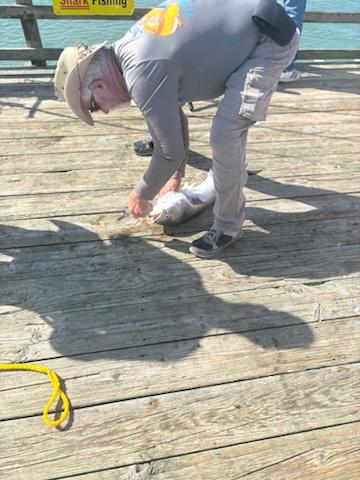
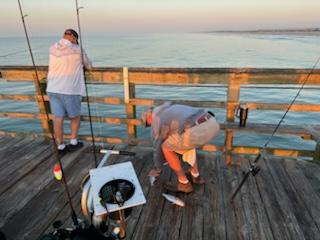
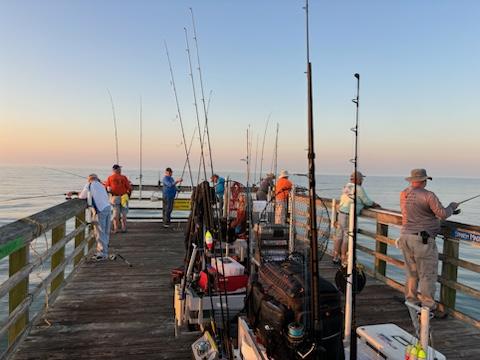
Another STFC tourney is complete! A fun day on the pier, lots of laughs and comraderie shared by 30+ members. A shout out to the Sunset Beach Pier for allowing us to have this tourney!!
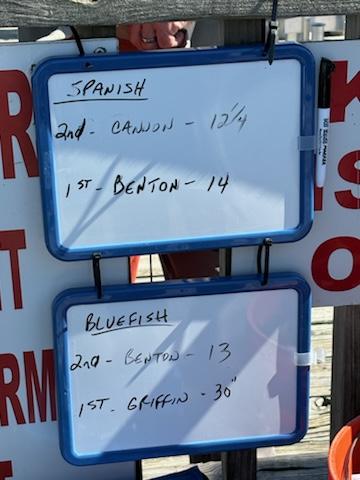
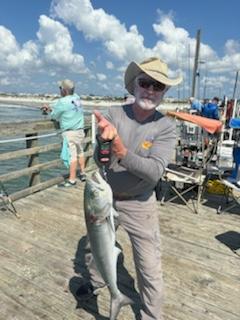
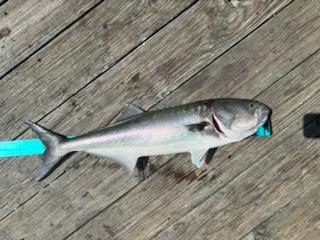
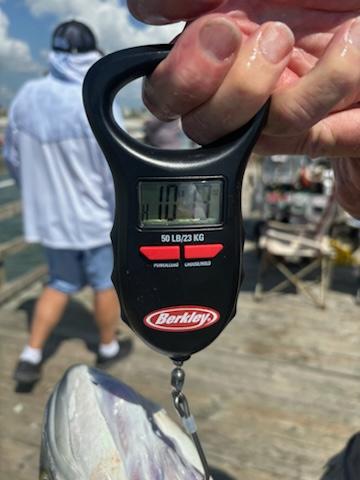
Although the bite was tough, the highlight was two big bluefish (29.75” and 30”) caught by Mike Griffin.
Congrats to the following winners…Spanish Mackerel:
1st place – Dwain Benton $125
2nd place – David Cannon $75
Bluefish:
1st Place – Mike Griffin $125
2nd place – Dwain Benton $75
We’ll be working on the timing of our next tourney – a speckled trout pier tourney in June. Watch your email and this Facebook page for updates!
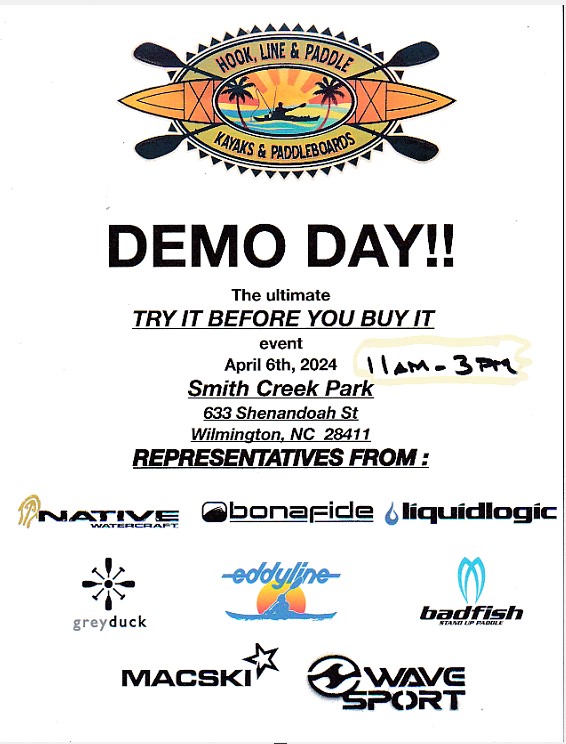
Hey kayakers and wannabes, here is an opportunity to try out a kayak. Sit inside, sit on top models, fishing yaks and recreational models, as well as paddleboards…over 30 models. Try them for free at this Demo Day event! Representatives from several companies will be there. Organized by Hook, Line and Paddle. Tell Chris I sent you.
Born & raised in Denver, Colorado and am 72 yrs old. Have had a condo here at Sea Trails for the past 10 yrs. Don’t play golf and when people often ask “ then why are you here ? “ I answer “ Climate Refugee “ which is the truth. Have a bad back that is sensitive to the cold and slipping and falling on the ice could be the end of me.
My father and my uncle were avid fly fisherman and taught my twin brother & I how to fish at an early age. Not with fly rods at 1st but little Zebco reels with worms worked well. My favorite places to fish were in the small streams and rivers that in those days you had to yourself really. One of my favorite places to fish is Illinois Creek on the north side of Willow Creek Pass which is a huge area of beaver dams, which are hard to navigate through but well worth the effort. There’s big German Browns in there hiding under the undercut banks that will surprise you now & then. My brother & I learned to tie our own flys but at times when they wouldn’t work we used “ Colorado Spinners “ which at times were the ticket for the small Brook Trout that were plentiful. You could use the little spinners with fly rods easily in the running water as well as using salmon eggs or worms if you really were planning on a fish breakfast or dinner. Fly fishing required hip waders to work the holes and pools correctly and slipping and falling or stepping into a deep hole and getting soaked happened. You had to carry all your extra flys and tackle you might need in a fishing vest and you carried a wicker creel for your keepers for the frying pan. I have 7 of my dads & uncles old bamboo fly rods which are so collectable anymore I don’t use them and have one made of graphite that gets used by my son although he mostly uses “ Shakespeare Ugly Stick “ rods & spinning reels with bait & lures. He’s not a fly fisherman.
Early yrs we used to hike into the high country to the lakes at and above timberline. We’d always plan on eating fish and that seemed to work most of the time. Remember well one trip where we were in there in July and it turned real cold & snow flurries for the afternoon, we hadn’t brought enough clothes. You could see huge trout that would follow your lures in but they weren’t having any of it. My brother caught several nice sized trout by trapping them in a pool and rocking up their escape route so we ate some fish. My grandmothers house was on the road to Estes Park at the mouth to the “ Big Thompson River “ canyon and that river was dangerous to fish, no wading around, swift fast moving water. We fished it but you had to be careful. Lots of huge sucker fish that I haven’t even heard mention of in many yrs.
As young adults we’d drive up and fish Wyoming. The “ Miracle Mile “ on the North Platte is famous for fly fishing and we also enjoyed “ Flaming Gorge “ which is a beautiful trip but you have to be careful of getting stuck in that Wyo mud if you get off the pavement. And we’d get off away from everybody as far as we could. My wife has a couple of nightmare stories she likes to recite. Including one at Glendo Resv north of Worland where a tornado gave us a close call and nearly flung my 5 yr old daughter & myself into the lake after we jumped into the tent to keep it from blowing away. Wife & 7 yr old son watched from the vehicle. That lake was one of our cat fishing spots and we’d catch 4 to 6 pd catfish at night using chicken livers. And of course there’s Lake Powell in Utah that we went to ten yrs in a row for channel cats & stripers until they closed off all the 4-wheel drive roads where we’d go off and camp by ourselves far from anybody. Largest fish I ever caught was a 34” stripper at night off an house boat one yr. And have to mention the White River west of Rangely, Colo. A small river known for its White fish and big 2-4 pd catfish again with chicken livers.
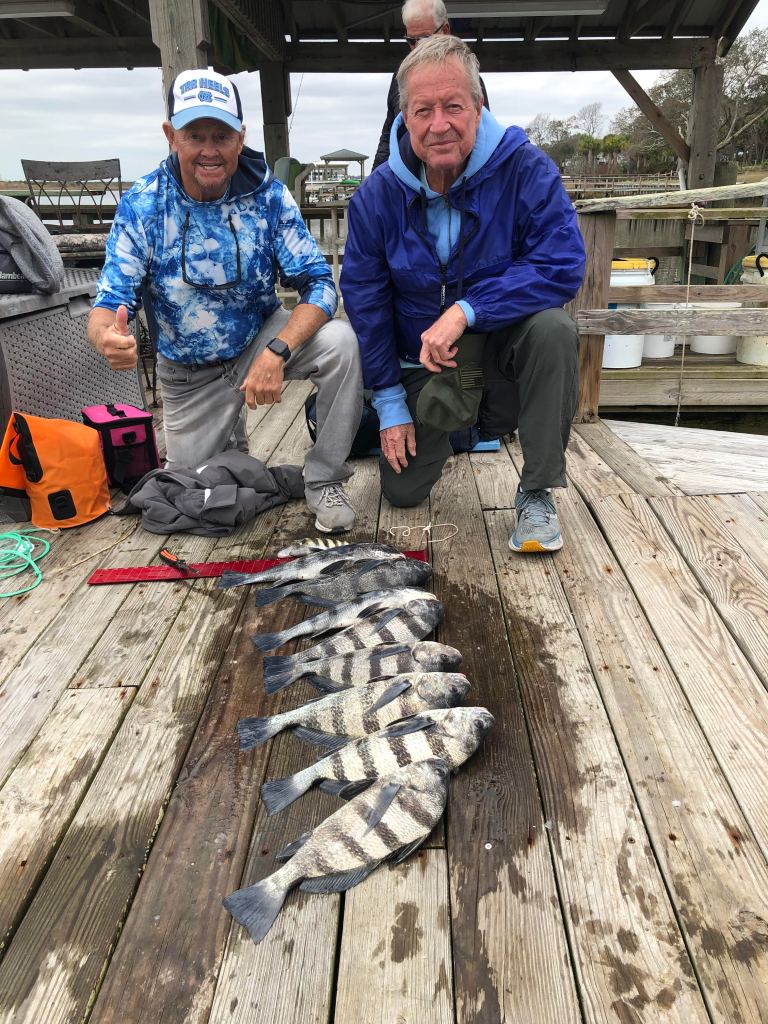
Have been getting fishing lessons from Harold Golding with the Black Drum fillets fried up in a skillet after dunking in an egg wash then rolled in flour and cornmeal being our favorite along with flounder of course. Have surf fished off the beach and done well a couple of times and enjoyed the experience even when they weren’t biting and same with fishing the pier. Being a club member has been a good social thing for me and I look forward to the get together’s.
I know that all of our Sea Trail Fishing Club Members are not on the STFC FaceBook site so I am re-posting these opportunities. I am planning on attending the Wilmington event on March 9th. Feel free to contact me (immikeru@gmail.com) if you want to ride-share to this event.
Fisherman’s Post, the media group that covers most of the saltwater fishing action along the Carolina coast, will be hosting its eighteenth annual Wilmington In-Person Saltwater Fishing School on Saturday, March 9, 2024, at Roland Grise Middle School (4412 Lake Ave, Wilmington, NC 28403) from 8:30 am-4:30 pm.
This year you can also gain access to video recordings of all five main seminars (a mix of inshore, nearshore, and offshore presentations), and the video recordings are available for those who attend in-person or for those that wish to enjoy all the knowledge and insights from the comfort of their home (and have unlimited access for three months after the school date).
For those interested there is also a similar event to be held in Morehead City on Saturday, February 24, 2024, at the Crystal Coast Civic Center on Arendell Street from 7:30 am-5:00 pm.
Note from Mike: Alan was one of the “Founding Fathers” originally recruited by Steve Heins when Steve first envisioned a Sea Trail Fishing Club. Since then he has been notably the most active and diligent member of the club, serving as both Treasurer and Secretary. Here is Alan’s story……..
I was born in Burlington, NC and raised in Graham, NC. Both are small towns east of Greensboro. My earliest memories are fishing in a farm pond that one of my cousin’s grandparents owned in Burlington. I caught my first fish there (a bluegill) when I was very young. Beyond that, for many summers when I was young, I would go to Rock Hill, SC and spend several weeks with my grandmother’s sister (Aunt Sissy) and her husband (Uncle Johnny). Uncle Johnny would take me fishing for bream at farm ponds in the area. We would get up early, pile into his 50’s-something black coupe, go to the bait store and get crickets, and go fishing. I still have memories of him cleaning fish at the kitchen sink. Aunt Sissy would cook them and they were delicious. Uncle Johnny passed on his love of fishing to me. It so impacted me that when I went to college at NC State, I started out in the Fisheries Science Program. Life intervened after three years there and took me in a different direction, but I did graduate from Jacksonville University with a degree in Marine Science, and later served in the Navy. So, I guess it’s all somewhat related . . .
I grew up with limited opportunities to fish. When I did get to fish, it was mostly for panfish and largemouth bass. My grandmother’s second husband’s family owned a rental cottage on the beach at Ocean Isle. During occasional summer vacations, I would fish off the Ocean Isle Pier with cousins.
RT_COLLAGE
Since retiring to Sunset Beach, my fishing has all been either off the Sunset Beach Pier or in the Intracoastal. But to this day, I think it’s hard to beat the experience of a lunker largemouth on the line. On the other hand, float fishing with live shrimp ain’t half bad, either. My biggest fish was a 44″ red drum caught at the North outside jetty two years ago on a charter with Captain Tripp.
I fish as often as I can but since I work part-time at the Sunset Beach Pier during the season, my opportunities are restricted. Most often, I fish on the Pier on my days off and try to go out on a charter at least once a month. I would love to go out with Club members if they have room. By far the most productive fishing I have experienced here is drifting a live shrimp on a float rig in the Intracoastal, or on the Pier when the speckled trout show up in June.
I love to eat the fish I catch. My favorite fish dish is largemouth bass; in my view this fish is the absolute best tasting fish ever. Just a little butter, lemon juice, salt, and pepper on both sides of the fillet. Wrap the fillet in aluminum foil and stick it on a grill. Red drum and black drum are good either blackened or in a stew. My favorite saltwater fish is triggerfish; it’s a close second to largemouth bass when the triggerfish is blackened and grilled.
I would love to go to the Keys and catch a big grouper, a sailfish, or a big Mahi. Alternatively, I would go to Louisiana in a heartbeat and try out their redfish opportunities. Then after a good day of fishing, relax and take in the sights and sounds of whatever city I am in, while sampling some of the local seafood and one of my favorite fermented malt beverages. Given the opportunity, I would go back to Ketchikan, Alaska and do some halibut or salmon fishing. I’ve been to Alaska twice. It is breathtakingly beautiful there and the fishing is great!
Because of the Sea Trail Fishing Club, I have met some wonderful, caring folks. It has been my privilege to get to know them and do things with them. The real value of the Club is the bonds you form with other people that you otherwise wouldn’t have had an opportunity to know. I treasure the friendships, and look forward to forming more. If I could, I would like to inspire more members to take an active part in the Club. I believe you get the most out of the Club when you actively participate. If I could that thing would be to inspire more members to take more of an active part in the Club. You learn by doing. You contribute by doing. You form friendships by doing. You get the most out of the Club when you are active and when you actively participate.
Before coming to Sunset Beach, I was fortunate enough to work at Camp Sea Gull for five years. The camp is a large summer camp run by the YMCA out of Raleigh, NC. A full camp is around 1000 boys. The camp is located in Arapahoe, NC on the Pamlico Sound east of New Bern, and features a whole host of activities like motorboating, sailing, and skiing. There is also an 18-hole golf course, basketball courts, a softball diamond, a swimming lake, an archery range, and two large freshwater lakes. Both lakes are stuffed full of largemouth bass. For three years I was the Fishing Chief. My job was to teach boys ranging from ages 6 to 16 how to fish for largemouth bass. There were a few, I think, that really caught the fishing bug. I hope they carried that forward when camp ended. It was a great time that I very fondly remember.





 Sea Trail Fishing Club
You must be logged in to post a comment.