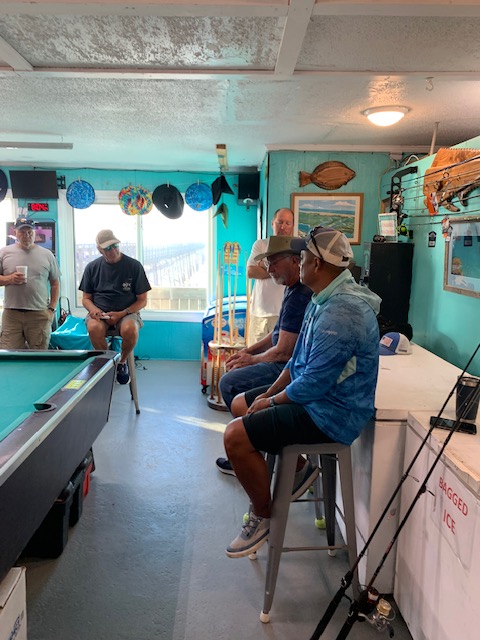
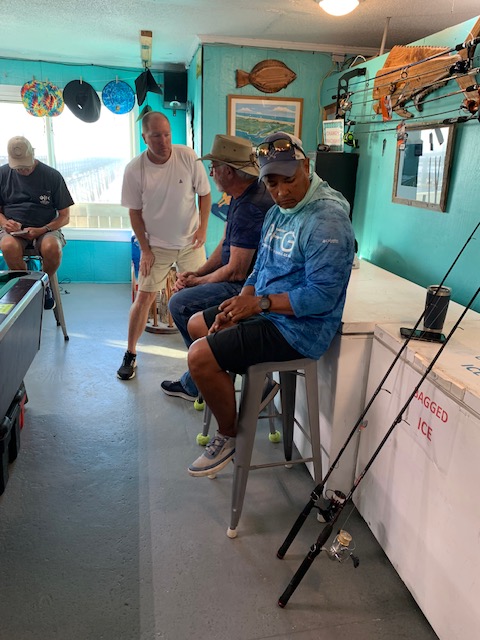
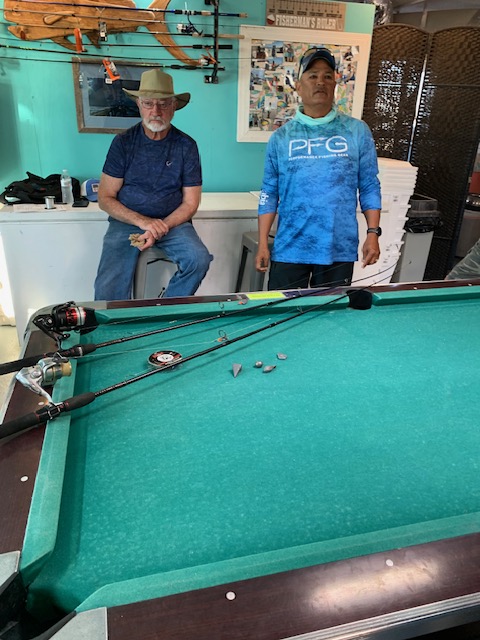
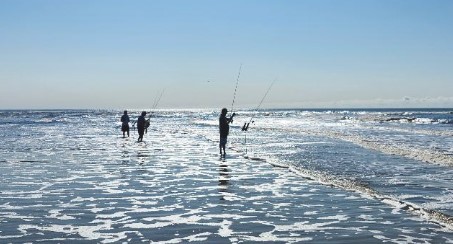
October 6 through the 12th is the Black Drum Fishing Tournament. As an informative warm-up to this event Brian Brumbaugh, Mike Griffin and John Crespin held two sessions at the Sunset Beach Fishing Pier last Saturday.
Each of the hour-long sessions was attended by a dozen Sea Trail Fishing Club members. Topics covered included the terminal tackle that works the best, presentation, preferred baits of black drum, and the best locations to find fish. The pros and cons were discussed by the groups and many questions were addressed by this elite group of Club anglers.
The Sea Trail Fishing Club thanks members Gary and Teresa Massey for hosting this event!
Here’s a great opportunity! Our fishing club is in a unique location: we have greater inner-coastal, in-shore and off-shore fishing opportunities. Add to that the excellent fishing piers and beaches! There is no reason not to take advantage of all these choices.
Recently, Bob White, a member of both Sea Trail Fishing Club and Seacoast Anglers has held clinics on “The Joys of Surf Fishing” [my label!]. He has offered to continue to invite both novices and seasoned anglers to surf fishing events during September. As the waters along the coast cool down, the ‘bite’ will get hotter. So plan to come down to the shore with Bob for a great time of fishing and camaraderie with others!
Bob will lead surf fishing events on September 5 and September 18. Expected start times will be around 8 AM.
To join in on this event email Bob at cuelathe@aol.com and leave your phone number in case of rain dates or changes in times.
If you’re like me, you have a lot of soft plastics. I buy them in plastic packages that do not reseal very well, resulting in a storage problem, plus lures don’t keep well. Over time the bags degrade. Well Salt Strong has a solution, so before you start reaching for those flimsy plastic sandwich bags, check out this soft plastic storage tip from Coach Tony to both protect and organize your lures!
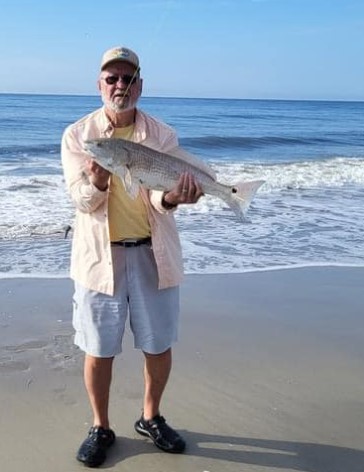
A great turnout for the yesterday’s Surf Fishing foray. Seven members from the Sea Trail Fishing Club joined three members and a guest from Seacoast Anglers for a “How-To” hosted by Bob White (who is actually a member of both clubs). Bob brought live bait and helped us novices with tips for catching our own live bait and showing us how to rig up to catch the big ones out in the surf.
Not so sure that Bob arranged to have the big ones show up for this event. A lot of small fry were caught but a few of the really big one’s got away. I almost had a rod pulled out into the surf. It was saved by a nearby beach jogger! And Brian lost an unidentified lunker that broke off a 40-lb shock leader.
No matter. A good time was had by all and everyone learned a little more about fishing from the beach. (Man! I’ve got to get a better sand spike).
If you missed this one, Bob has promised to hold another clinic in the near future – perhaps on Ocean Isle Beach.
Thanks to our members who showed up for this event – Jim ad Margaret Baumgartner, Ken and Laura Birchett, Dave Cannon the crab catcher, and Brian Brumbaugh. Oh yes, let me not forget, Bob White.
Bob suggests having more than one rod and accompanying sand spikes. For bait: something like a small 5 to 6 ft spinning rod with a 1000 series reel can be rigged with two very small hooks in tandem and used to catch bait fish. Bob suggested live shrimp as the best bait with a 1 -oz sinker, but I am sure that other options would work too. Maybe even a small flashy spoon or spinner bait. Casts are made out 12 to 15-ft into the surf to catch the bait fish. This alone can be fun! An alternative is frozen bait.
Cut bait fish are then used on 9 to 12-ft surf rods with 4000 to 6000 series reels and 4 to 6-oz sinkers. Once the rod is placed into the spike, setting the drag is critical to avoid losing a rod and reel into the surf!
My two-cents worth: I am not a surf fishing expert but I read a lot and after looking at a book or two and, yes, several on-line articles, I noticed that almost all are in disagreement on one point or another. But in a nutshell, here is my own assessment.
Rods and Reels – These need to be a bit more robust than what I typically use for inshore fishing. How much depends on the fish species and size that prowls in the section of the ocean where you are fishing. Rods need to be longer and stronger, 8 to 10-ft seems to be a good average. They should have enough backbone to cast a heavy 3 to 5-lb sinker and a hook loaded with a chunk of bait. Reels need to be in the 4000 to 6000 range with a large line capacity in case you hook that big one – 300 to 500 yards seems to be a sweet spot.
Terminal Tackle – I have heard pros and cons for both braid and monofilament line in the 30 to 50-lb test range. You can get more line on the reel with braid, but it is more prone to wind knots and can result in a nasty cut if you grab the line at the wrong time. It is also more expensive. Fish finder or float rigs work well and although fresh bait is best, frozen shrimp, mullet, and squid will suffice.
Miscellaneous Gear – A sand spike is a necessity unless you want to stand up holding the rod for 3 hours. Add to that, various knives, pliers, and a towel. A bucket to carry everything in is useful and can be used as a convenient seat. Also, don’t forget plastic bags for various things including your cellphone and/or camera. A
Clothing – For this kind of weather, bare feet or sand shoes and shorts will suffice unless you want to wade out into the surf. A hat and sunscreen are also necessities.
For more details on Surf Fishing 101, check out Andrew Courtillet’s article:
You must be logged in to post a comment.