This was previously posted but was mentioned again by President Steve Heins in the April Club meeting)
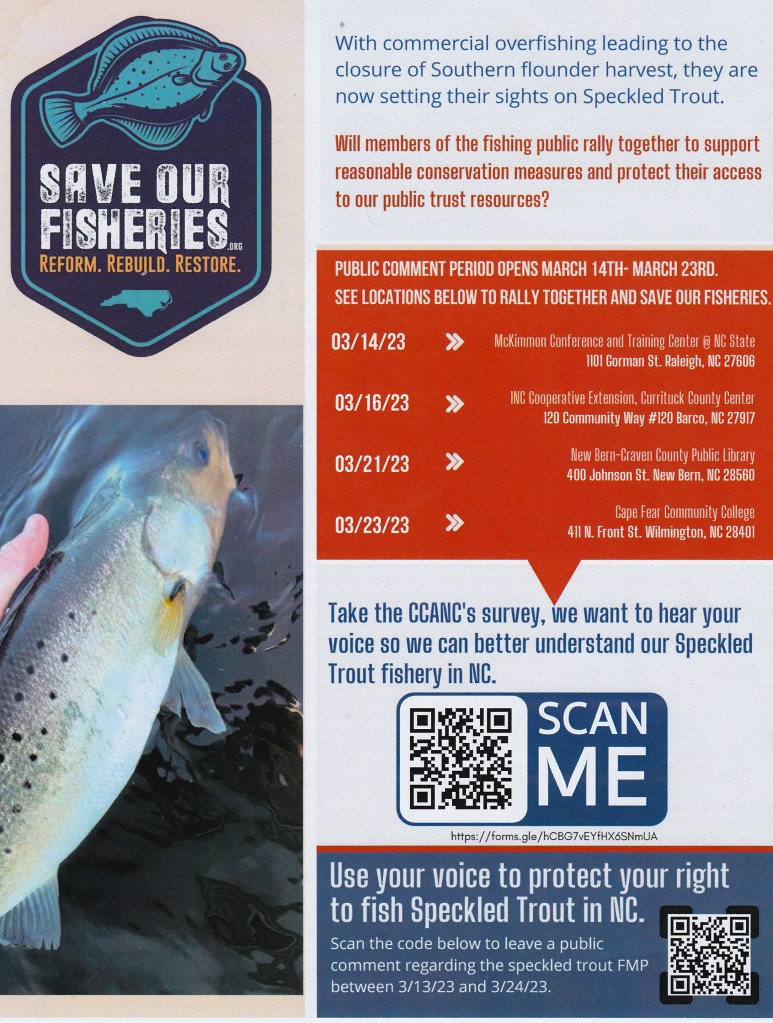
Matthew Wallin, Eastern Regional Director of the Coastal Conservation Association of NC gave an interesting talk about the goals of the CCA and pending NC legislation restricting fishing for Speckled Trout. He encouraged the membership to use their voices to protect their rights to fish for Speckled Trout. If this is a concern to you and you want more infomation please go to: –
Soft plastic lures rigged correctly will move naturally through the water. Whereas baits rigged incorrectly will spin unnaturally and won’t entice fish to bite. When that happens, you won’t catch as many fish as you could. But incorrect rigging isn’t just about how you put soft plastic lures on hooks, but also knots you tie with your lures. Most lures need to erratically dart around for them to be effective, and when you’re using artificial lures, it’s important to work it the correct way to convince a fish to strike. And one of the things you can do to help yourself is to use the right knot with it. There are two types of knots when you’re tying on lures: Snug knots and Loop knots. Snug knots are great for lures that you do a constant retrieve with, while loop knots are great for lures that you need to put action on.
Lures to use a Loop knots with include paddletails, soft plastic jerk shads, spook-style topwaters, and twitchbaits. Snug knots work best on spinnerbaits, chatterbaits, and popper-style topwaters. Although, if a lure has a split ring, then you would tie a snug knot no matter what type of lure it is. For instance, some spook-style topwater lures come with split rings on the end, so you would tie a snug knot to the split ring because the split ring is already acting like a loop by giving the lure room to move. Another thing is that snug knots are stronger than loop knots, so keep that in mind when trying to decide what line size and/or drag setting to use.
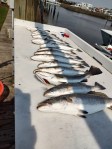
Alan Trojan, Clint Morschauser, and Jeff Titus reported a good day on the water last Friday. They went out on a charter from the docks at Ocean Isle with Captain Tripp Hooks during a falling tide in the morning. The water temperatures were up to 64 degrees. Fishing live shrimp on Carolina rigs resulted in catches in the Intercoastal between Calabash and the Little River. All three limited out on trout, the largest being 22 inches!
In other news, Brian Brambaugh and Mike Shannon reported a few undersize trout, a black drum and a lot of croaker and smaller fish caught mainly on artificial baits along the marshes near the Sunset Beach bridge. Surveys with the locals indicated that the bite was slow but picking up. Alan says its time to get out on the water and to signup for the fishing tournament. You never know when the big one bites!
Last year I became a member of the Salt Strong Insiders Club (www.SaltStrong.com) and continue to find a wealth of information about inshore fishing on their website! Since coming to this area, I’ve found that information on their website has helped to kick-start my understanding of how the local fisheries differ from other places that I’ve been. This week I thought that I would share some tips about developing a ‘game plan’ for Spring fishing.
This time of year you don’t need to worry much about the water temperature because it’s safe to assume that the fish will be comfortable in terms of dissolved oxygen levels and body temperature. So the sole focus of fish will be on finding areas with the most food to eat along with enough protection from predators like dolphin.
Lures: This is the season where smaller baitfish are pouring in, so it’s smart to use smaller baitfish imitation lures like spoons, smaller soft plastics, etc.
Timing: During the spring, the best inshore bite is often in the twilight periods within a couple hours before and after the sun rises and sets. But since the water temperature will stay out of either extreme hot or cold, fish will often feed throughout the day and into the night as well. The best game plan is generally to prioritize the twilight periods overall, and then heavily factor in the tidal movements to determine when the optimal feeding times will be.
– Best Bite: Twilight hours & max current periods
– Best Tide: Incoming or outgoing tides during this time are not as important as good current flow.
Game PIan:
– Morning: Try to get out as eariy as possible and focus on the shallow flats and/or shorelines with lots of life (birds, bait, and any feeding activity)
– Mid-Day: The fish can be both shallow or deep at this time… typically the best bet is to target the zones with the most bait that’snear structure such oyster bars, shoreline points, potholes on grass flats, etc.
– Evening: This is often a great time to target slams up on the flats or along shorelines in the shallows because they’ll often be actively feeding just like they were in the morning.
– Night: The shadow lines of docks and bridges with bright lights can be very effective. You might also target the same zones that were effective during the twilight periods because fish will often hang in those same areas to feed throughout the night.
There is a large winter fishery habitat from Dunn Sound, the upper Calabash River and the large flats behind Bird Island, according to Jeff Burleson (Carolina Sportsman, February 2022).
Guide Brandon Huskins of Any Tide Charters notes that redfish will congregate in areas where there is a 2-3 degree temperature increase occurring in the middle of the day. If you have a shallow draft boat or a kayak you can get to potholes in the backs of creeks, places where the redfish are schooled up during the winter. When the sun heats up the water over dark mud and the shallows during low tide that makes a big difference to a fish. One strategy is to set up near the pothole an hour or two before low tide and let the fish pour out of the shallow spots. They will either be in the potholes or will be feeding along oyster bars and sand flats that lead up to the potholes.
The creeks do not hold as much shrimp and baitfish as during the warmer months, but some mullet and mud minnows do overwinter there. Since food is scarce the redfish may not be too picky, but a slow bait presentation will still work best. Try mud minnows on a jig head or similar artificial fished correctly will work. As always, shrimp are a go-to!
Huskins likes to use lightly weighted Ned Heads with small Z-Man soft plastics. Cast to the target area and wiggle or bounce the lure a little and if they are going to eat, they will take it. He reports days where he can catch 20-30 fish without moving his boat. An exciting fish story to say the least!
He says that redfish are homebodies, and they will routinely come to the same potholes every day for a week or two as long as they don’t get run out of the house by tides or something else.
Brandon can be reached at Any Tide Charters (843-877-7068)
 Sea Trail Fishing Club
You must be logged in to post a comment.