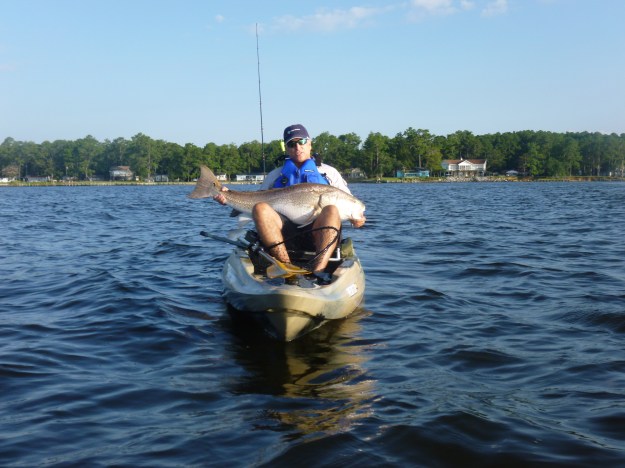
This article comes from Kayak Angler on-line magazine with some modifications.
Background
Trey Carden, Charleston SC, loves fishing for redfish because of their strong fight and willingness to take a variety of artificial lures. Redfish are one of the most iconic inshore fish. The dark copper body punctuated with the famous spotted tail appears on T-shirts, bumper stickers and fishing hats. Their fame derives from the drag-screaming runs that put fishing gear to the test. Trey targets redfish with bait, jigs, swimbaits and topwater, but sight fishing is his favorite tactic. Spotting a school of reds in shallow water, landing a perfect cast and watching the fish attack the lure is one of the most exciting fishing experiences.
Prime time is September through October. In winter, redfish look for clear, cold water. In spring, red drum follow the bait inshore, hunting oyster mounds, mud flats, grass lines and creek mouths. In summer, redfish seek refuge from the heat in deep drop-offs.
Redfish are comfortable in water temperature from 60 to 90 degrees but the fish cooperate best around 70 degrees. Clear water makes it easier for the fish to see the lure and for you to see the redfish. Ideal times are an hour on each side of high and low tide. When the water is at a standstill, expect a lull in the action. For a great topwater bite, fish early in the morning. Overcast skies also call for topwater lures. The bite remains active after sunset; fishing dock lights provides a break from the summer heat. When the air pressure is low or the water is moving too fast, anchor in a creek mouth or find a drop-off and fish a bottom rig with bait.
When the tide is high, sight-fishing on grass flats can be successful from shallow drafting boats and kayaks. If the water is too low to get into the grass, you can target creek bends and submerged structure such as wrecks, rockpiles, oyster bars, sandbars and mud flats. In summer, targeting drop-offs and shady spots under docks is a good option. An oyster bed at a creek mouth on the outgoing tide is a great spot to find reds. When fishing grass lines, try to work parallel to the edge and cast to a hole or indention in the grass. If you don’t find redfish in the grass, you can continue fan-casting and targeting structure and moving water.
Trey’s Redfish Story and Redfish Tactics
I love hitting the water just before sunrise and throwing a walk-the-dog topwater. To give the fish plenty of time to find the lure, I make long casts and slowly walk the dog. For sight fishing, my go-to is a Z-Man DieZel MinnowZ with a 1/8- to 1/4-ounce Eye Strike jighead. To avoid spooking the fish, I use the lightest jig that will reach the bottom. I also like to drift a popping cork down a grass line or over a sandbar. Every 30 seconds I give the cork a few short pops.
The first time I saw redfish belly crawling across a flat, I was shoveling mud with my paddle trying to get into a flat before the tide started to rise. From 50 yards away, I watched bait explode and the back of a large redfish come out of the water. I grabbed my Skitter Walk and made the perfect cast about 10 feet ahead of the fish. When I started the walking action, the redfish took off like a torpedo and completely engulfed the bait. The attack led to a drag-screaming, 15-minute fight and a solid 28-inch redfish. After this trip, I learned that I miss the best fishing when I hit the snooze button on my alarm.
Redfish Tackle Box
- Rod: 7′ Shimano GLF medium light, fast action
- Reel: 2500 PENN Battle
- Line: 10-lb PowerPro Slick braid
- Leader: 24″ 20-lb fluorocarbon leader
- Rigs: Cajun Thunder Popping Cork and DOA Shrimp, Carolina rig with 1/4- to 1/2-oz egg sinker, 2/0 Gamakatsu Octopus Circle Hook. Finger mullet, mud minnows, shrimp, fiddler crabs and quartered blue crab.
- Lures: Z-Man DieZel MinnowZ, Z-Man Jerk ShadZ, Rapala Skitter Walk 8 with 2/0 VMC Inline Hooks
 Sea Trail Fishing Club