| The South Carolina Department of Natural Resources will release hatchery-reared southern flounder into state estuaries for the first time today, March 13, marking a major milestone in the development of a new stock-enhancement program. The initial release will include approximately 10,000 juvenile flounder—about 1 inch long and 45 days old—with additional stockings planned at several size classes throughout 2026. Work on the program began in 2021 and involved collaboration among SCDNR research teams in mariculture, inshore fisheries, and population genetics, along with partners from Texas Parks and Wildlife Department, University of Texas at Austin, North Carolina State University, and the Alabama Department of Conservation and Natural Resources. Scientists evaluated years of fisheries survey data, expanded monitoring in northern estuaries, and developed new hatchery systems tailored to the unique biology of bottom-dwelling flatfish. A central component of the effort is genetics. Researchers have developed DNA microsatellite markers that allow scientists to distinguish hatchery-reared fish from wild fish and track how stocked individuals contribute to different life stages of the natural population. Biologically, southern flounder from North Carolina through Florida are considered a single unit stock. In North Carolina, the species is classified as depleted based on the most recent stock assessment, which uses data through 2017. Because these populations are interconnected, the success or limitations of South Carolina’s stocking efforts could provide valuable insight for fisheries management and potential recovery strategies in North Carolina. |
Category Archives: Regulations
Spring Flounder News from North Carolina Department of Environmental Quality
 Feb. 16, 2026 Spring Gulf Flounder season opens March 9 MOREHEAD CITY Feb. 16, 2026 Spring Gulf Flounder season opens March 9 MOREHEAD CITYThe North Carolina Department of Environmental Quality’s Division of Marine Fisheries will open a two-week, spring recreational Gulf Flounder season in ocean waters off the central and southeastern parts of coastal North Carolina. Season Details: Dates: March 9–22, 2026 Location: Ocean waters only, from north end of Portsmouth Island (south of Ocracoke Inlet) to the South Carolina line. See map. Gear: Recreational hook-and-line only Bag Limit: One fish per person per day Size Limit: Minimum 15-inch total length For more specific information, see Proclamation FF-13-2026. Why these regulations: Anglers primarily catch three flounder species in North Carolina waters: Southern, Summer and Gulf. Historically, North Carolina has managed all three species as one in the recreational flounder fishery. The latest stock assessment indicates that Southern Flounder is overfished and overfishing is occurring. Overfished means the population is too small, and overfishing means the removal rate is too high. For this reason, the state has placed strict regulations on flounder to limit Southern Flounder catch. Amendment 4 to the Southern Flounder Fishery Management Plan does include a provision that allows for a spring recreational Gulf and Summer Flounder season for hook-and-line fishing in the ocean. The spring season was included in the plan to provide recreational fishermen with opportunity to harvest Summer and Gulf Flounder during a time when they are less likely to catch Southern Flounder. North Carolina cannot open a spring season for Summer Flounder, which is jointly managed by the federal Mid-Atlantic Fishery Management Council and the Atlantic States Marine Fisheries Commission. These entities require that recreational Summer Flounder regulations remain at status quo in 2026 and 2027 based on harvest estimates compared to the recreational harvest limit, and the stock’s biomass estimate compared to the biomass target. This means that North Carolina’s recreational Summer Flounder season in 2026 and 2027 must align with the fall flounder season. Summer Flounder range in distribution from Massachusetts to Florida but are most abundant from southern New England to Hatteras Island, N.C. Gulf Flounder range from North Carolina through the Gulf of Mexico. Along the Atlantic Coast, Gulf Flounder become more abundant as you move south. The Division considered these distribution ranges in choosing the area that will open for harvest of Gulf Flounder while limiting the probability of catching Summer Flounder. Flounder identificationThe Gulf Flounder has the same, familiar flat, rounded body and olive-brown color of other flounders that can change shade depending on the color of the bottom. It has three prominent, ocellated dark spots arranged in a triangle on its eyed side. One spot is above and one is below the lateral line while the third is in the middle of the line towards the tail, forming a triangle. The spots may become obscure in larger fish. Information on how to identify a Gulf Flounder from a Summer Flounder and a Southern Flounder can be found on the Division’s Flounder Identification webpage. Other information can be found on the Spring Gulf Flounder Season Frequently Asked Questions page. If there is incidental harvest of Southern Flounder during spring 2026, it will count against the annual quota. Correct identification will be key in minimizing any effects on a future fall flounder season. The Division encourages anglers to release flounder if they are not sure of the species. Reporting requirements A new state law requires anglers to report their harvest of flounder, as well as Striped Bass, Spotted Seatrout, Weakfish (gray trout), and Red Drum to the Division. Learn more about this harvest reporting requirement. This reporting requirement does not replace the Marine Recreational Information Program. The Marine Recreational Information Program is still the best available scientific method of collecting recreational fishing information in a representative manner, and anglers are strongly encouraged to participate in the interviews. For More Information Contact: Patricia Smith Phone: 252-515-5500 Website: https://www.deq.nc.gov/dmf Facebook: https://www.facebook.com/NCMarineFisheries Instagram: https://www.instagram.com/NC_DMF Twitter: https://twitter.com/NC_DMF P.O. Box 769, 3441 Arendell St., Morehead City N.C. 28557 Share / View as a webpage |
Stay Connected with North Carolina Department of Environmental Quality:      SUBSCRIBER SERVICES: SUBSCRIBER SERVICES:Manage Subscriptions | Unsubscribe All | Help |
| This email was sent to slpender2@gmail.com using govDelivery Communications Cloud on behalf of: North Carolina Department of Environmental Quality · 217 West Jones Street · Raleigh, NC · 27603 |

Lines of Communications meetings upcoming in North Carolina
Share / View as a webpage  Jan. 20, 2026 New “Lines of Communication” meetings scheduled for North Carolina MOREHEAD CITY – Itching to share your ideas on federal fisheries management? The North Carolina Department of Environmental Quality’s Division of Marine Fisheries encourages fishermen to attend one of four upcoming South Atlantic Fishery Management Council Lines of Communication meetings scheduled for North Carolina. Lines of Communication is a new council initiative to build relationships with fisheries stakeholders and provide an opportunity for mutual sharing of information. The meetings allow attendees to provide their perspectives with local council members, council staff and other fishery participants. The meetings will be held in-person along the South Atlantic coast. Jan. 20, 2026 New “Lines of Communication” meetings scheduled for North Carolina MOREHEAD CITY – Itching to share your ideas on federal fisheries management? The North Carolina Department of Environmental Quality’s Division of Marine Fisheries encourages fishermen to attend one of four upcoming South Atlantic Fishery Management Council Lines of Communication meetings scheduled for North Carolina. Lines of Communication is a new council initiative to build relationships with fisheries stakeholders and provide an opportunity for mutual sharing of information. The meetings allow attendees to provide their perspectives with local council members, council staff and other fishery participants. The meetings will be held in-person along the South Atlantic coast. North Carolina Lines meetings are scheduled as follows: Feb. 2, 6-8 p.m. Town Creek Community Center 6420 Ocean Highway East Winnabow, NC 28479 Feb. 3, 6-8 p.m. NC Division of Marine Fisheries Central District Office 5285 Highway 70 West Morehead City, NC 28557 Feb. 4, 6-8 p.m. Hatteras Civic Center 57688 NC- Hatteras Highway Hatteras, NC 27943 Feb. 5, 6-8 p.m. Virginia S. Tillett Community Center 950 Marshall C Collins Dr. Manteo, NC 27954 The South Atlantic Fishery Management Council is one of eight regional fishery management councils in the United States that manages fisheries in federal waters. The South Atlantic Council is responsible for the conservation and management of fishery resources in federal waters ranging from 3 to 200 miles off the coasts of North Carolina, South Carolina, Georgia and east Florida. It manages species such as Dolphin, Wahoo, mackerels, snapper and grouper. For More Information Contact: Patricia Smith Phone: 252-515-5500 Website: https://www.deq.nc.gov/dmf Facebook: https://www.facebook.com/NCMarineFisheries Instagram: https://www.instagram.com/NC_DMF Twitter: https://twitter.com/NC_DMF P.O. Box 769, 3441 Arendell St., Morehead City N.C. 28557 |
Taking home these 5 fish triggers new North Carolina rule – the Back Story
Catch reporting for Recreational Anglers begins Monday December 01, 2025.
From the Carolina Sportsman – Published Today as Top Story

Fishing News Around this Old North State
Weekend Updates from CCA NC View in browser  Not a Good Look for NC Not a Good Look for NC 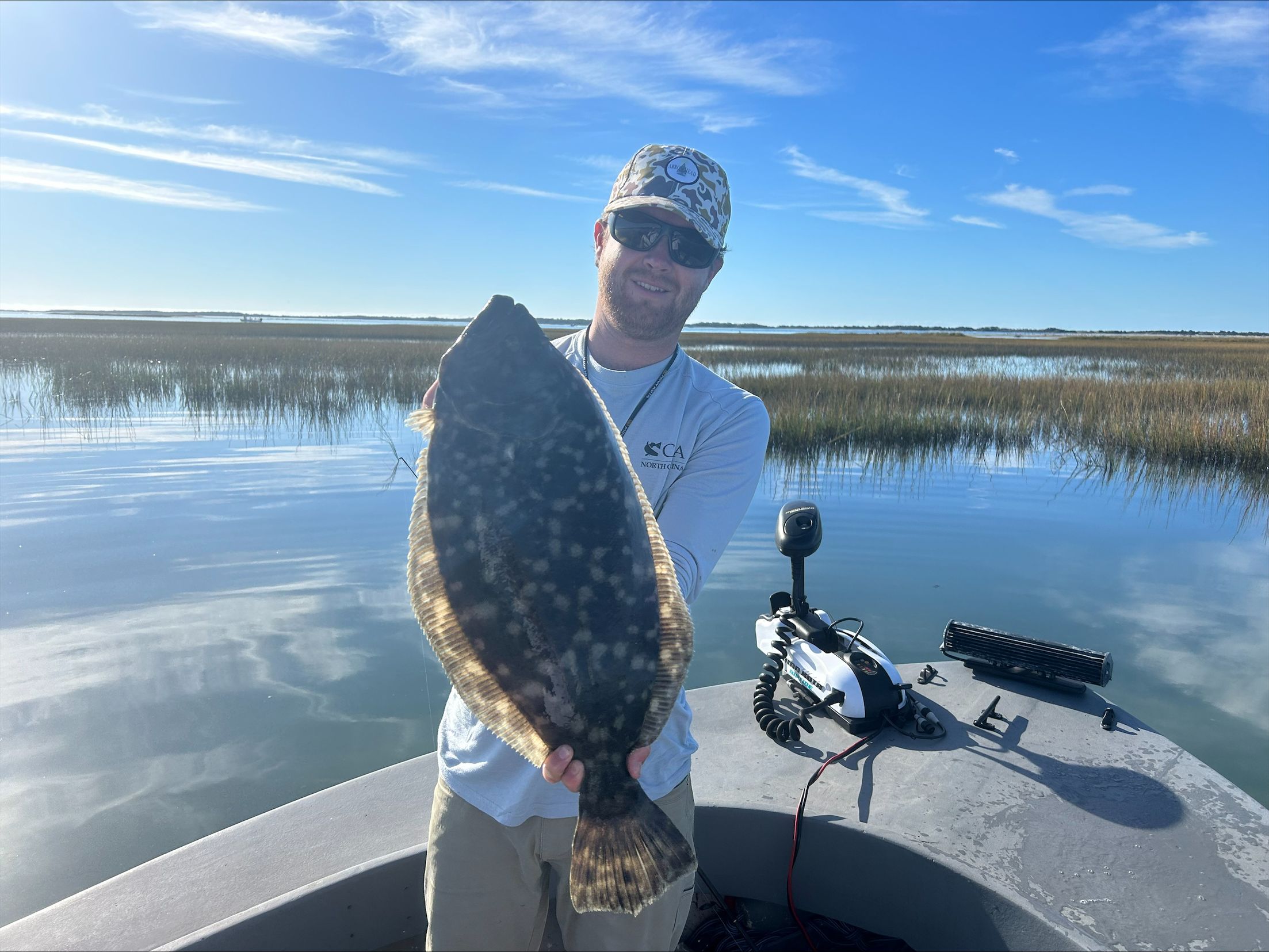 Someone made that statement to me as we were talking about the ongoing dispute between the NC Wildlife Resources Commission and the NC Marine Fisheries Commission over who controls hook and line fishing in NC joint waters, and it has stuck with me. The dispute is supposed to be settled by the governor, yet Governor Cooper has been unwilling to step in. This dispute is fueling calls from many citizens to merge the two agencies into one single fish and wildlife commission as many states have already done. Everyone is aware by now that the Division of Marine Fisheries announced during the May MFC meeting that because public anglers exceeded their quota for Southern flounder in 2023, there would be no recreational harvest season in 2024. The commercial fishermen exceeded their quota by a small margin so there will be a commercial harvest season on Southern flounder this fall. This was a result of the MFC giving 70% of the total allowable catch to the commercial sector under Amendment 3 to the Southern Flounder Fisheries Management Plan. One thing that gets forgotten in this allocation argument is that public anglers are also prohibited from keeping any Gulf or summer flounder caught in North Carolina waters, neither of which is considered overfished. So, by allocating the entire 2022 summer flounder quota of 3,361,569 pounds to the commercial sector, commercial fishermen can harvest 96% of the flounder landed in North Carolina. The public anglers get the remaining 4% when they get anything at all. The WRC chairman Monty Crump wrote a letter to MFC chairman Rob Bizzell in June stating WRC was “extremely disappointed the MFC did not take action to open a recreational flounder season in 2024” and urged the MFC to call a special meeting to move up the timeline for changing the Southern flounder allocation to 50/50. The current Southern Flounder FMP timeline moves the allocation to 60/40 in 2025 and 50/50 in 2026. MFC Chairman Bizzell tried for a special called meeting to consider changing the timeline at their May meeting but did not receive the necessary five votes. At their July meeting, the WRC voted to allow a four-day flounder season in inland and joint fishing waters in defiance of the MFC’s Southern Flounder FMP. MFC Chairman Bizzell replied that they would direct their Marine Patrol Officers to ticket any angler caught in possession of Southern flounder in joint and coastal waters. So, we are back to the dispute over who has authority over hook and line fishing in joint waters and public anglers are caught in the middle. Not a good look for North Carolina. Attorney General and Democratic nominee for Governor Josh Stein even issued his own statement regarding the decision to not open a recreational flounder season in 2024: “North Carolina has a rich history of both recreational and commercial fishing – both help power our state’s economy. The recent decision to close flounder fishing for North Carolina families as they head to the beach for summer vacation, while allowing commercial flounder fishing to continue, isn’t fair. As Governor, I’ll work to achieve a better balance when it comes to our state’s fisheries management, I’ll also continue to focus on protecting our water, including our sounds and shorelines.” It is encouraging that this issue caught the eye of his campaign, however as the Attorney General, in 3-1/2 years of defending the State in our lawsuit, Josh Stein is well aware of state fisheries management problems but has done nothing to resolve them. Governor Cooper and AG Stein are not alone, in that the General Assembly has since 1997 largely ignored the fisheries management crisis as it has worsened, with both Democrats and Republicans balking at admitting or addressing public trust fisheries management problems. Southern flounder has been, historically, one of the most sought-after species, if not the species, by public anglers fishing in coastal waters. Southern flounder has been known to be overfished since at least 1989 and this overfishing has almost exclusively resulted from commercial overharvest, not public angler overharvest. Yet, if the public wants to eat a flounder dinner in North Carolina they are relegated to purchasing it from a seafood market or in a restaurant. It is wrong – really unconscionable – that the State allocates 70% of a coastal fish stock highly sought after by public anglers to a few thousand citizens for profit, while penalizing 11 million North Carolinians by allowing them to have the “crumbs” left over from commercial harvest. That allocation should be reversed. Similarly, it is unconscionable to allow a 2024 commercial harvest season for Southern flounder while banning public anglers from fishing for Southern flounder, particularly when the State has the ability – by allocating harvest – to readjust management to allow a meaningful public angler season. In addition, the State has the authority, but lacks the will, to open harvest of Gulf flounder to public anglers. Anyone in state government at this point who doesn’t know about the serious public resource management issues that have brought a popular public fishing species like flounder to its knees is either not paying attention or just doesn’t care, or both. Public anglers have always been willing to do their part to ensure the long-term viability of our fisheries. What we need now, more than ever, is visionary leadership from our state.  CCA NC Hires New Regional Director In July, we welcomed Mary Ellen Hunter to the CCA NC team as a new Regional Director. Mary Ellen grew up hunting and fishing with her father on and around the Pungo River. She has already demonstrated how her passion and excitement for the outdoors and conservation will help in her responsibilities for membership engagement and development! Look for her at an event near you or feel free to reach out to her with any questions about chapter happenings in your area: maryellen@ccanc.org CCA NC Hires New Regional Director In July, we welcomed Mary Ellen Hunter to the CCA NC team as a new Regional Director. Mary Ellen grew up hunting and fishing with her father on and around the Pungo River. She has already demonstrated how her passion and excitement for the outdoors and conservation will help in her responsibilities for membership engagement and development! Look for her at an event near you or feel free to reach out to her with any questions about chapter happenings in your area: maryellen@ccanc.org  CCA NC Regulator Boat Raffle Regulator Marine has generously partnered with CCA NC by donating the 2024 Yamaha demo boat for this year’s CCA NC boat raffle! The 2024 Regulator 26XO with a 450 XTO Yamaha comes ready with a Garmin 16 XO Fish Package and a Wesco trailer. Tickets are available online through September 16 and the winner will be drawn live at our Crystal Coast Banquet in Morehead City on September 19th. Will you be the one who takes it home? CCA NC Regulator Boat Raffle Regulator Marine has generously partnered with CCA NC by donating the 2024 Yamaha demo boat for this year’s CCA NC boat raffle! The 2024 Regulator 26XO with a 450 XTO Yamaha comes ready with a Garmin 16 XO Fish Package and a Wesco trailer. Tickets are available online through September 16 and the winner will be drawn live at our Crystal Coast Banquet in Morehead City on September 19th. Will you be the one who takes it home?  Last week we had a chance to tour the Regulator Marine factory in Edenton and we sat down with Joan Maxwell to talk boats, conservation, fishing and the special culture at the company. Last week we had a chance to tour the Regulator Marine factory in Edenton and we sat down with Joan Maxwell to talk boats, conservation, fishing and the special culture at the company.  2024 CCA NC Annual Dove Hunt This year’s hunt will be held on Saturday, September 7th in Dunn, NC and hosted once again by Avery Corning and Southeastern Transformer Company. There are a limited number of spots available so be sure to get registered before we sell out. You won’t be able to find a better deal out there for a dove hunt, a meal, and for a good cause so invite your friends and get registered! 2024 CCA NC Annual Dove Hunt This year’s hunt will be held on Saturday, September 7th in Dunn, NC and hosted once again by Avery Corning and Southeastern Transformer Company. There are a limited number of spots available so be sure to get registered before we sell out. You won’t be able to find a better deal out there for a dove hunt, a meal, and for a good cause so invite your friends and get registered! 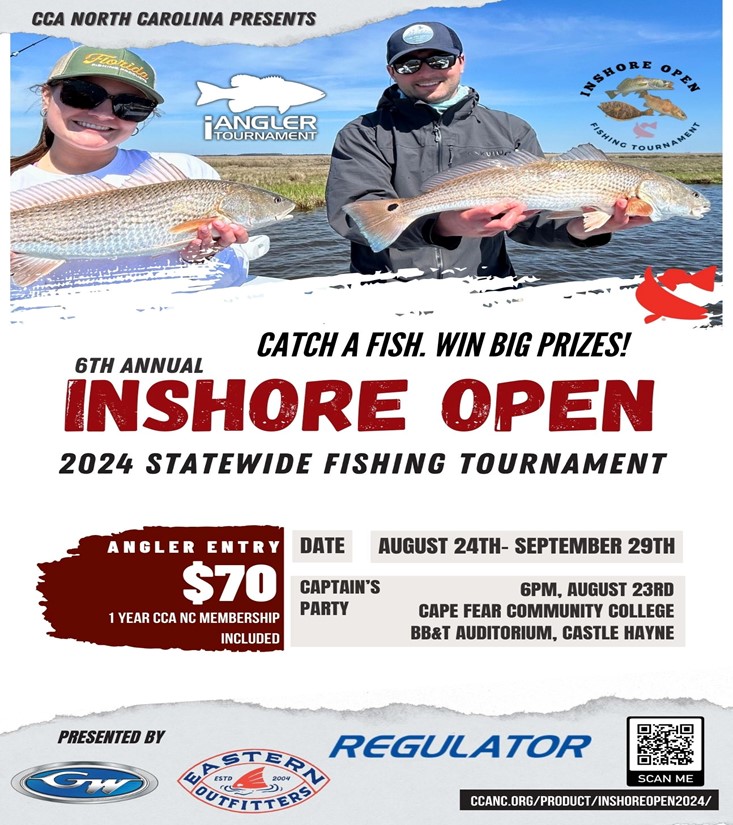 2024 Inshore Open We are excited to bring back the STATEWIDE “Inshore Open” fishing tournament for yet another year. Help us make the 6th annual the best one yet. We have added some new divisions to the tournament this year – for all those Kayak anglers out there, now you can compete on your own completely separate from the boat anglers! You know you are going fishing anyway, so why not register and have a chance at some great prizes and statewide bragging rights? 2024 Inshore Open We are excited to bring back the STATEWIDE “Inshore Open” fishing tournament for yet another year. Help us make the 6th annual the best one yet. We have added some new divisions to the tournament this year – for all those Kayak anglers out there, now you can compete on your own completely separate from the boat anglers! You know you are going fishing anyway, so why not register and have a chance at some great prizes and statewide bragging rights? 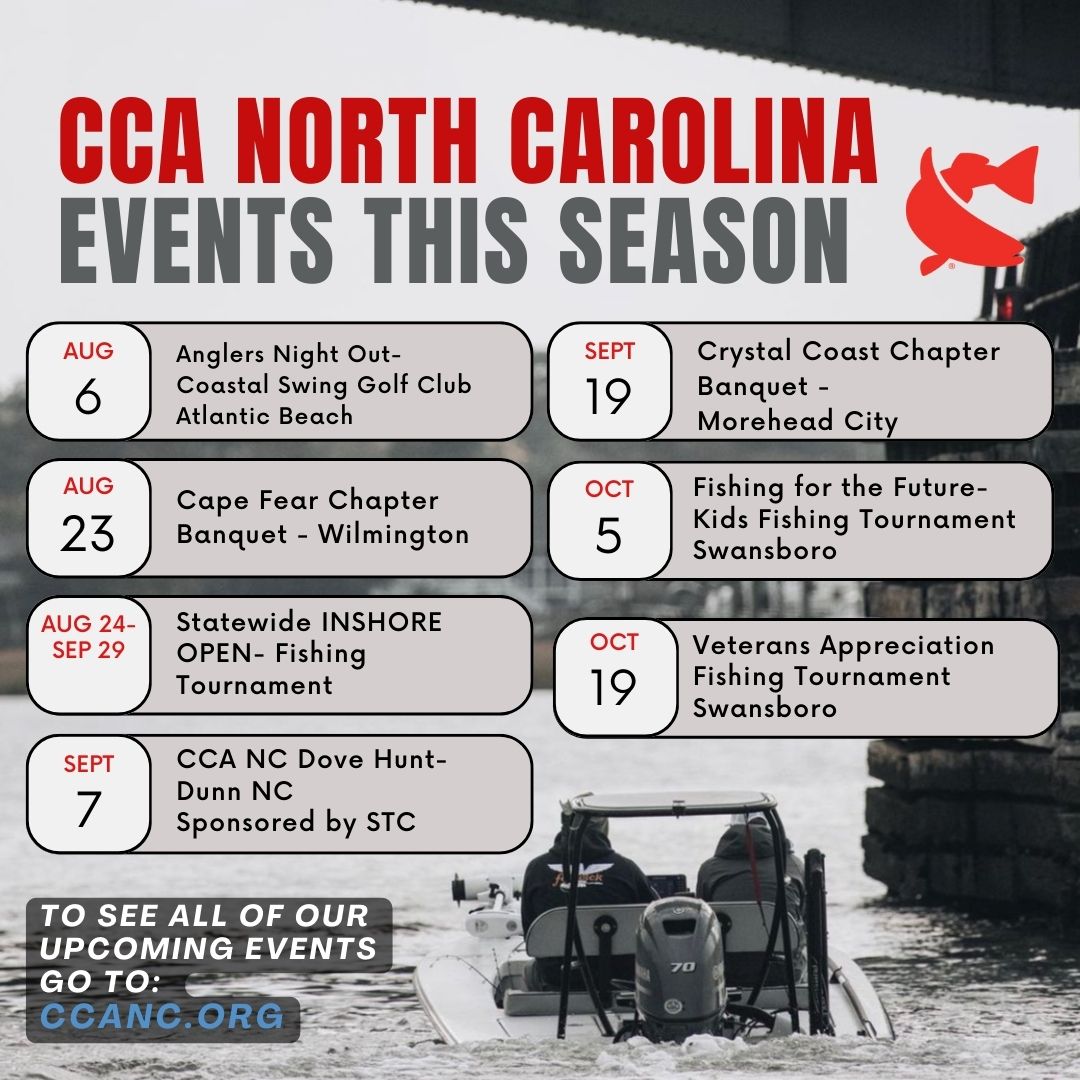 Upcoming Events We have a busy fall schedule of events including the Inshore Open, our annual dove hunt, chapter banquets, kids fishing tournament and a fall military appreciation fishing weekend. For more information on all of our upcoming events, please visit the website. Upcoming Events We have a busy fall schedule of events including the Inshore Open, our annual dove hunt, chapter banquets, kids fishing tournament and a fall military appreciation fishing weekend. For more information on all of our upcoming events, please visit the website. United States of America   You received this email because you signed up on our website or made a purchase from us. Unsubscribe You received this email because you signed up on our website or made a purchase from us. Unsubscribe |
 Sea Trail Fishing Club
You must be logged in to post a comment.