https://podcast.show/ncwrc-better-fishing/episode/152777364/
March is the month that shad start showing up in the coastal rivers of North Carolina, from the Cape Fear to the Roanoke.
https://podcast.show/ncwrc-better-fishing/episode/152777364/
March is the month that shad start showing up in the coastal rivers of North Carolina, from the Cape Fear to the Roanoke.
| MEDIA ADVISORY FOR IMMEDIATE RELEASE: MARCH 6, 2026 MURRELLS INLET, S.C. — The South Carolina Department of Natural Resources (SCDNR) will mark a historic milestone in marine conservation on Friday, March 13, 2026, as the agency releases hatchery-grown Southern flounder into South Carolina estuaries for the first time. The release represents the culmination of four years of pioneering research by SCDNR scientists that established the first southern flounder stock enhancement program along the Atlantic coast. The program reflects a science-driven approach to strengthening coastal fisheries and supporting the long-term sustainability of the species in South Carolina waters. A public flounder release event will be held at the Murrells Inlet Boat Launch to celebrate the milestone and highlight the collaborative effort among researchers, recreational anglers, and state leaders who helped support the initiative. Interview opportunities will be available with: Dr. Tom Mullikin, Director, SCDNR Blaik Keppler, Deputy Director, SCDNR Marine Resources Division Legislative guests and partners supporting the program Media are invited to attend and capture footage of hatchery-grown southern flounder being released into the estuary. WHAT: Public release of hatchery-grown southern flounder WHO: SCDNR leadership, legislative guests, and fisheries scientists WHEN: Friday, March 13, 2026 | 1:00 p.m. WHERE: Murrells Inlet Boat Launch: 4139 US-17 BUS, Murrells Inlet, SC 29576 VISUALS: Live release of hatchery-grown southern flounder; scientists and agency leadership on site; interview opportunities with agency officials and legislative guests Members of the media planning to attend are encouraged to arrive shortly before the event start time. Cheyenne Twilley Chief of Education, Outreach, and Information South Carolina Department of Natural Resources TwilleyC@dnr.sc.gov 260 D. Epting Lane, West Columbia, SC 29172 |
Brian Cope Features, Newsletters, Redfish, Speckled Trout

January in the Carolinas brings a quieter rhythm to the inshore waters, but for anglers who understand seasonal patterns, it can be one of the most rewarding times to target redfish and speckled trout.
Cold fronts sweep through regularly, water temperatures drop, and bait becomes less abundant, forcing fish to adjust their behavior.
These changes concentrate redfish and trout into predictable areas, making patience and strategy more important than covering water quickly.

Speckled trout are particularly sensitive to cold and tend to gather in deeper holes, creek bends, and channels where water temperatures remain more stable.
about:blank
During January, they often stack tightly, sometimes by the dozens, especially following extended cold spells. Anglers who locate these wintering areas can experience steady action, but must also fish carefully to avoid stressing fish in cold water. Slow presentations are key, as trout metabolism decreases and aggressive retrieves are far less effective than subtle, deliberate movements.
Redfish are more tolerant of cold but still seek out similar structures. Schools of slot-sized reds commonly hold along muddy shorelines, oyster edges, docks, and deeper flats adjacent to shallow feeding areas. On sunny winter days, redfish will often slide into skinny water that warms quickly, especially on a rising tide. Dark, muddy bottoms absorb heat and can raise water temperatures just enough to trigger feeding activity, sometimes for only a short window during the afternoon.
Weather plays a major role in January success. A strong cold front can shut down the bite temporarily, pushing fish deeper and making them lethargic. Conversely, a few days of stable conditions often lead to improved fishing, especially when afternoon temperatures climb. Many experienced anglers plan trips around warming trends rather than calendar dates, understanding that winter fishing is as much about timing as location.

Artificial lures dominate January inshore fishing, as live bait becomes scarce and less effective in cold water. Soft plastics rigged on light jigheads are a favorite for both redfish and speckled trout. Natural colors like opening night, new penny, and white tend to perform well in the often-clear winter water. Slow hops along the bottom or gentle drags through deeper holes mimic injured baitfish and appeal to cold-stunned predators.
Suspending twitch baits are another popular option, particularly for speckled trout. These lures excel when worked slowly with long pauses, allowing them to hover in the strike zone. Many winter strikes occur during the pause rather than the retrieve, requiring anglers to remain focused and ready to react. Downsizing lures can also make a difference, as fish are less likely to chase large meals in January.

Tides influence winter fishing more subtly than in warmer months. Extreme low tides often expose mud flats and force fish into deeper water, making them easier to locate but sometimes harder to entice. Moderate moving water is usually ideal, providing enough current to concentrate bait without sweeping lures unnaturally. Slack tides can still produce, but presentations must be even slower to draw attention.
Ethical handling becomes especially important during winter. Cold water reduces fish resilience, and speckled trout are vulnerable to stress and delayed mortality. Limiting air exposure, handling fish gently, and releasing them quickly helps ensure healthy populations for the future. Many anglers voluntarily practice catch and release during January, valuing the experience over harvest.

Throughout January, the bite may be less explosive than in warmer months, but the solitude, clarity of the water, and opportunity to catch quality fish all make January a uniquely satisfying time on the coast.
About Brian Cope
Brian Cope is the editor of Carolina Sportsman. He has won numerous awards for his writing, photography, and videography. He is a retired Air Force combat communications technician, and has a B.A. in English Literature from the University of South Carolina. You can reach him at brianc@carolinasportsman.com.

Winter Teeth – Sheepshead. https://www.carolinasportsman.com/columns/coastal-cast/winter-teeth/
Specks are December Specials. https://www.carolinasportsman.com/fishing/inshore-fishing/speckled-trout/specks-are-december-specials/
A trout fisherman discovers it’s not always conventional medicine that brings respite. Courtesy Garden & Gun, December 2025/January 2026 edition, by Jeff Zillgitt
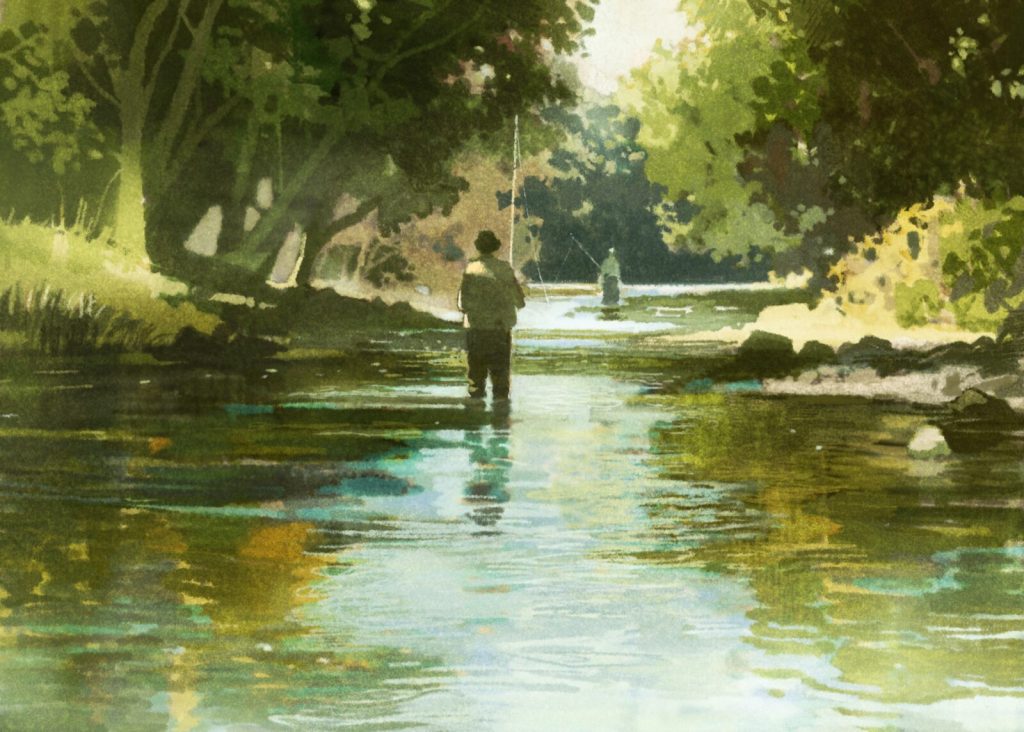
Two fried chicken thighs and two legs. When I shuffled into the Wolftown Mercantile Country Store, on a two-lane road near two of my favorite brook trout streams in Virginia’s Shenandoah National Park, that’s the order I placed as a matter of routine.
But on this day in late March 2023, I had no business going fly fishing, much less eating a meal for two. Three weeks earlier, I’d lost 80 percent of my stomach during surgery for gastric cancer. Alison, my wife, was desperate to get me out of a funk (even a bit of depression) and asked my friend Grover to go fishing with me. “When am I going to get my old Jeff back?” Alison asked. She knew getting me to a mountain stream was a step in that direction.
My new tiny stomach allowed just a few nibbles, but returning to one of my fly-fishing rituals felt gratifying—a dose of normalcy amid uncertainty, not to mention a much-needed break from the bland hospital food and unsatisfying high-calorie shakes that nourished me postsurgery. In a quick photo Grover took of me, I’m holding a nice brook trout, with a hint of a smile coated in a sheen of grease emerging. The stream, the trout, the fried chicken: They all helped me find a day better than the one before.
If you fish, hunt, hike, kayak, or boat, you undoubtedly have rituals—routines that become embedded in your pursuits. Rituals are not always the same as superstitions. Superstitions are attached to luck or fortune, and I don’t ascribe my fishing success or lack thereof to my rituals. I practice them because they bring comfort, appreciation, and balance.
Take the streamside lunch. Or even better, the in-stream lunch, sitting on a boulder with water flowing around me. I need that meal to feel right about a day on the water. Beyond sustenance, I need the joy of sharing that meal with a friend, when discussions drift from fishing to other important matters: family, marriage, living, dying. I have never walked into the woods and waded a stream to escape anything. I go to find and rediscover and leave the mountains a better person than when I entered—or at least with a reset equilibrium and deeper connection to the natural world.
Lunch doesn’t always come from the same place. Depends on where I’m fishing. Sometimes it’s a chicken salad sandwich from Red Truck Bakery in Warrenton, Virginia, on my way to a stream near Sperryville. Sometimes it’s a Capri sub (prosciutto, Genoa salami, provolone, and spiced capicola) from the Italian Store in Arlington, or it might be a pulled pork sandwich from Bean’s Barbecue in Edinburg, while headed to a seldom-fished brook trout stream tucked inside the George Washington and Jefferson National Forests.
As time has passed since that first post-surgery outing, I now eat more than a few bites. The surgeon told me the 20 percent of my stomach that endures would “stretch out,” and I’d be left with a functioning organ the size of a small fist. It’s still a task to eat a large meal, but my enjoyment of the streamside lunch has not waned. And I find that when I’m removed from the stress of daily life and eased by the peace of the stream, sometimes, even if just for a minute, my situation doesn’t feel as daunting.
The barbecue place sits next door to Murray’s Fly Shop, the store Harry Murray founded in 1962. He is the unofficial dean of brook trout fishing in Virginia. His book, Trout Fishing in the Shenandoah National Park, is required reading, and learning from Murray will put you into fish whether on a mountain creek along the spine of the Blue Ridge or big Western rivers. My copy is tattered from years of use, and it’s one of a handful of fishing books I revisit during the winter, when my fishing is reduced to daydreams—another of my rituals. I flip through for tips I had forgotten and for stream information. Should I try Big Run or East Hawksbill Creek in the spring?
As with others enamored with both fly fishing and literature, A River Runs Through It, Norman Maclean’s classic, remains a steadfast friend. No matter how many passages I have marked, I find new ones to highlight each year. Christopher Camuto’s A Fly Fisherman’s Blue Ridge is a naturalist’s solemn rumination on each season. I can open to most any chapter and I know where he is. Harry Middleton’s The Earth Is Enough is another book I return to each winter. An extraordinarily thoughtful author on all things fly fishing in the Southern Appalachians, Middleton, who died in 1993 and spent his last days working on a garbage truck, deserves wider appreciation.
Those books and authors have been with me for decades—companions unaware of their impact. In late 2016 and early 2017, I underwent treatment for metastatic colon cancer, and chemotherapy caused a debilitating and life-threatening heart condition called coronary vasospasms that kept me awake through the night. As I struggled through discomfort in the quiet of 3:00 a.m., books about rivers, trout, and fly fishing provided intermittent respites from the pain, allowing my mind to get lost in the waters of Maclean’s Big Blackfoot River and Middleton’s Starlight Creek. Middleton’s honest, brutal, and poetic prose is a soulful ode to small mountain trout streams and the earned wisdom that spills from the hills. It’s a salve for the mind, spirit, and heart.
“The angler hopes for nothing and prays for everything,” Middleton wrote. “He expects nothing and accepts all that comes his way. And although he knows all along that he will never sink his hook into a trout stream’s true mystery, the desire to try, to cast once more and once more again, is never quenched, for there is always that chance that one more cast will carry him beyond skill and luck and bring him untarnished magic.”
See, it is not always conventional medicine that provides healing. Another spring arrived and another one after that, and then a few more, and I am grateful. I read those books before cancer and will continue rereading them, waiting for another spring.
Even the drive to the stream is an important ritual—a snippet of time reserved for undisturbed thought. With each mile, stress diminishes and excitement mounts. I cue up a playlist of familiar tunes—the SteelDrivers’ “Sticks That Made Thunder,” Tim O’Brien’s “Restless Spirit Wandering,” Steep Canyon Rangers’ “The Mountain’s Gonna Sing,” and lately, Billy Strings’s “I’m One of Those,” among them—and it’s as if I can hear the fiddle coming down the mountain. When I get closer to the water, I turn down the volume, roll down the windows, and listen for the stream. The river’s song is vital too. Too loud, and the water might be too high to fish. Too quiet, and it might be too low. But there is a volume that indicates the perfect flow. Listen to what the river says.
While I’ve long appreciated time on the water, I’d be naive to minimize the impact of two gastrointestinal cancers on my gratitude. Time is limited, and for me, that calculus is more acute. The days turn from endless to numbered, with the idea that another winter and another rereading of a classic will lead to one more streamside lunch. That hope has helped sustain me this far.
At the end of my final day of the season last year, in mid-November, I hiked back to my car and snipped off the fly, an orange Stimulator pattern, a go-to for brook trout in these waters. As I tossed it into the center console, I recalled that I’ve kept a fly, not the same one, in that spot for about the past decade. A leader and a spool of tippet sit alongside. They stay there through the winter—not as talismans but as reminders, of days spent on the river, and of days still ahead.
An audio version is here https://gardenandgun.com/articles/healing-on-the-fly-how-i-found-myself-again-in-the-rituals-of-the-stream/?utm_source=emma&utm_medium=newsletter&utm_campaign=december2025_tots_2&utm_content=troutfisherman
 Sea Trail Fishing Club
You must be logged in to post a comment.