I asked MicroSoft Copilot AI “What is the difference between nylon mono and fluorocarbon leader?”
Nylon Monofilament (Mono):
Elasticity: Mono is more elastic than fluorocarbon, making it a good shock absorber. When a fish strikes aggressively, the stretch in mono helps prevent tackle failure.
Knots: It’s easy to tie knots with mono.
Buoyancy: Mono floats on the water’s surface.
Visibility: Mono is more visible to fish due to its buoyancy and transparency.
Strength: For a given diameter, mono is weaker compared to fluorocarbon.
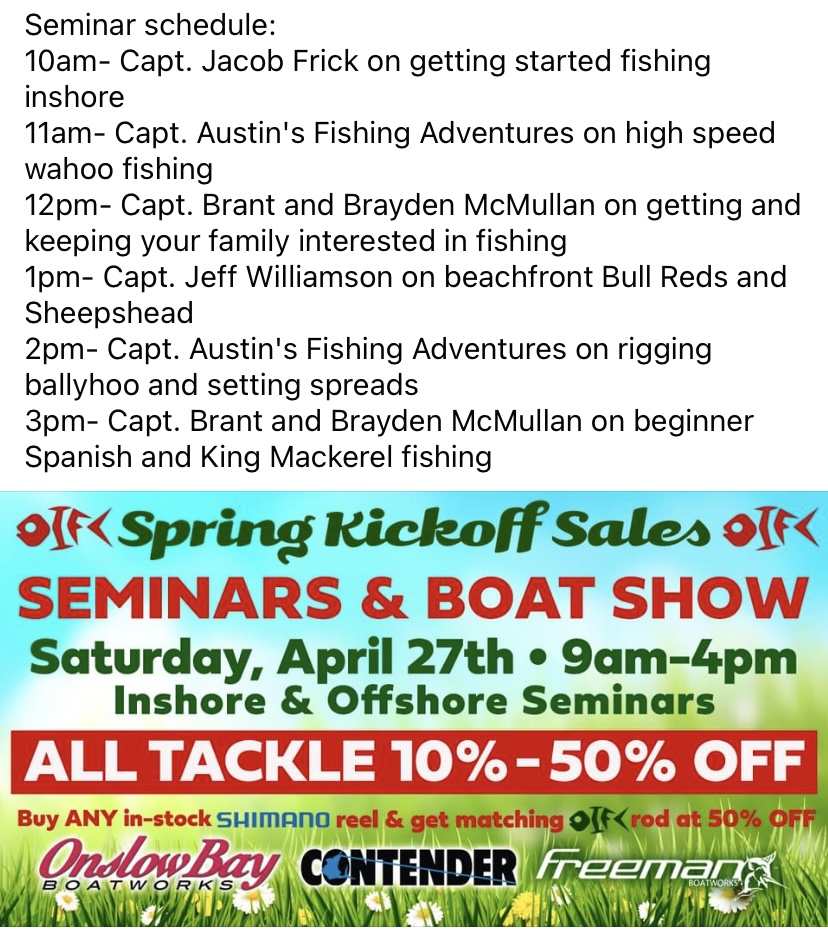
Join us this Sunday (9:00 AM – 1:00 PM) for our annual Captains’ Meet & Greet! We’ll be raffling off lots of great prizes every hour, on the hour and handing out kids’ fishing gear.
The Two Bald Biologists are back for April 2024 … Better Fishing with 2 Bald Biologists
Our two bald biologists, Ben and Corey, talk about spring shad fishing with NC Wildlife biologist David Belkoski. No shad topic is safe. We cover the biology of shad and fishing for them throughout the coast. Listen in to glean tips that will help you become a better shad angler and understand why shad migrate from the Bay of Fundy to our back yards.
REMINDER: Registration open for North Carolina Southern Flounder SymposiumMOREHEAD CITY – Are you interested in learning more about southern flounder (Paralichthys lethostigma) in North Carolina? Sign up to attend the North Carolina Southern Flounder Symposium.
The day-long conference, hosted by the Division of Marine Fisheries, will begin at 9 a.m. on March 20 at the Riverfront Convention Center of Craven County, 203 S. Front St., in New Bern.
The symposium is free, but registration is required.
Speakers will discuss the life history, movement and migration, habitat of Southern Flounder, its management in North Carolina and some of the ongoing research. Stakeholders will have the opportunity to engage with each other, as well as the researchers and Division of Marine Fisheries staff, and to learn how they can contribute to the research.
P.O. Box 769, 3441 Arendell St., Morehead City N.C. 28577
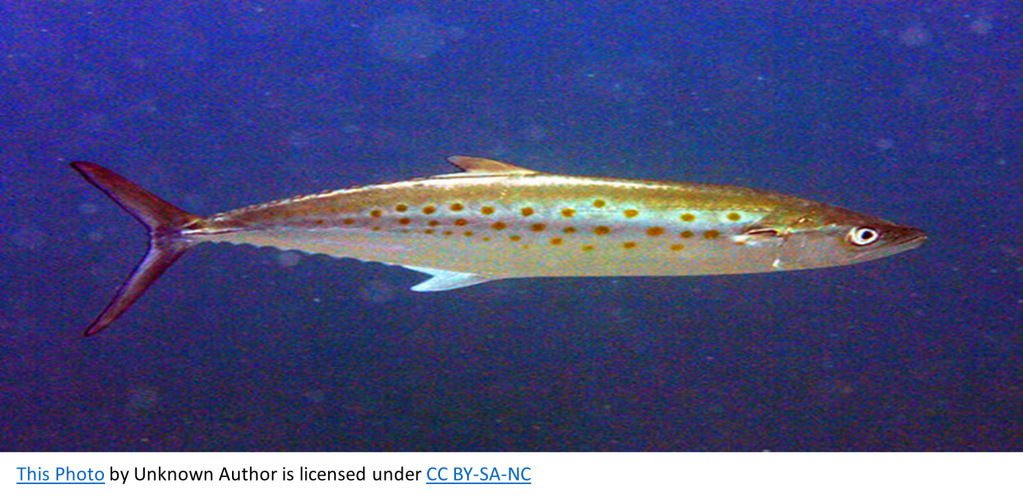
Spanish Mackerel are usually one of the first game fish to appear in significant numbers around the Sunset Beach Pier. They usually start appearing in April, and usually run in significant numbers for 2-4 weeks. By June their numbers are significantly diminished at the Pier. However, they can still be caught in local offshore waters. They are not normally residents of the Intracoastal.
Spanish tend to forage in schools and to travel in tight formations. They prefer water in the seventy-degree range or warmer. Therefore, they tend to migrate South when the water temperatures cool in the late Fall.
Spanish tend to hit a lure or bait hard. They have excellent vision and are easily spooked. Spanish are extremely fast swimmers. They have sharp teeth in the mouth and can inflict a serious bite. Their teeth also means that lines can often be cut and lures can be frequently lost.
Per FishRules.com, the current bag limit on Spanish in NC inland waters is 15 fish per day, with a minimum size of 12”. Fish are measured from the snout to the fork in the tail.
Per information on the Internet, the North Carolina state record for Spanish Mackerel is 13 lbs, 0 ounces caught in Ocracoke Inlet in 1987. A normal size catch is in the range of 1 to 3 pounds. The minimum weight for a citation Spanish mackerel in North Carolina is 6 pounds.
Spanish will hit a variety of baits. A Sabichi rig is often used on the Sunset Beach Pier to jig for Spanish. Individual Sabichi rigs may be purchased, or you can make your own. Spanish mackerel are attracted to the flash of bare hooks on a Sabichi rig and will readily attack it. A 1-1/2 oz jig is often attached to the end of the Sabichi rig. These jigs are available in a wide variety of colors. Spanish can also be attracted to the flash of bare gold hooks and will readily attack them too. A Gotcha plug will on occasion produce a Spanish bite. Spanish can also be caught on occasion with live finger mullet hooked through the mouth or live shrimp suspended from a float.
Minimize the use of extraneous tackle on a rig, as it provides an additional point of failure and could also provide additional attraction in areas where you don’t want it.
A typical jigging rig includes a light/medium action rod, and a Sabichi rig attached to your main line. If you make your own Sabichi rig, use at least 20 pound test line. The lighter the line weight, the more lures will be lost because of the fish cutting off the line. Wire leaders will likely discourage fish strikes because the fish most likely can see the wire leader due to their excellent vision.
Jigging is usually done fairly close to the Pier. Lures cast far out from the Pier don’t usually produce more strikes than a lure that is jigged in an up-and-down motion near the Pier. Let the jig fall to the bottom, and then jig it upward. Fish will tend to hit on the fall.
The meat on a Spanish mackerel fillet is very fatty and has a strong blood line. Fish, when caught, should be bled to allow as much blood as possible to bleed out. Before cooking, cut out the blood line along with the pin bones that are often found near the blood line. Spanish have tiny scales and thin skin. The skin is not very palatable and should be removed when cleaning the fish. A cold fish can be skinned much more easily than a warm fish; put the fish on ice if possible after bleeding it to make the skin removal process easier.
The high fat content gives the Spanish mackerel flesh a pleasant taste. Fillets can be broiled, baked, or breaded and fried.
Class demonstrations:
Tying your own Sabichi rig
Jigging method
Typical rod/reel/lure setup
Credits:
The Southern Surfcaster, S. Cameron Wright, c. 2012, published by the History Press, pages 95-96

 Sea Trail Fishing Club
You must be logged in to post a comment.